


A holiday rental contract is a document you and your guest both sign. It says who rents, which home, which dates, the price and the house rules. If something goes wrong, it is your proof.
There is a template below. Copy it, fill in the parts in brackets and send it before the guest arrives. Keep one new rule in mind: since 8 October 2026, a tourist let in Spain can last 31 days at most.
What the contract must include
A good contract answers six questions: who, where, when, how much, under which rules, and what happens if plans change. This table shows what goes in each part.
| Part | What you write |
|---|---|
| Host | Your name or company, tax ID (NIF), phone and email |
| Guest | Name of the guest who books, their ID document and contact |
| The home | Address, tourist registration number and maximum guests |
| Dates | Check-in day and time, check-out day and time |
| Price | Total for the stay and what it includes: cleaning, taxes |
| Payment | How and when the guest pays |
| Deposit | Amount, how you take it and when you return it |
| Cancellation | What the guest gets back if they cancel, and how far ahead |
| House rules | Noise, parties, smoking, pets, visitors |
| Travellers | That every traveller will give their details for registration |
| Signatures | Date and signature of both parties |
The registration number matters most. It is the code your region gave you when you registered the home as a tourist rental. If you do not have one yet, start with the tourist licence in Spain.
When a contract is required
In Andalucía, always. The regional rules say you must give each guest, on arrival, a document that counts as the contract. It must state who runs the home, its code in the Andalusian Tourism Register, how many people are staying, the dates, the total price and a contact phone. You keep a signed copy for one year. We cover it with the other requirements in the tourist licence in Andalucía.
In the rest of Spain, not always. It is still worth doing. Without a contract, a dispute over damage comes down to scattered messages. With one, you have signed rules.
If you rent through Airbnb or Booking, the booking already has the platform’s terms. You can add your own contract, but say so up front. Airbnb requires you to mention it, with its terms, in the listing before the guest books. If you did not, the guest can refuse to sign and ask you to cancel with a full refund. Your contract also cannot contradict the platform’s terms, such as its cancellation policy.
The 31-day limit
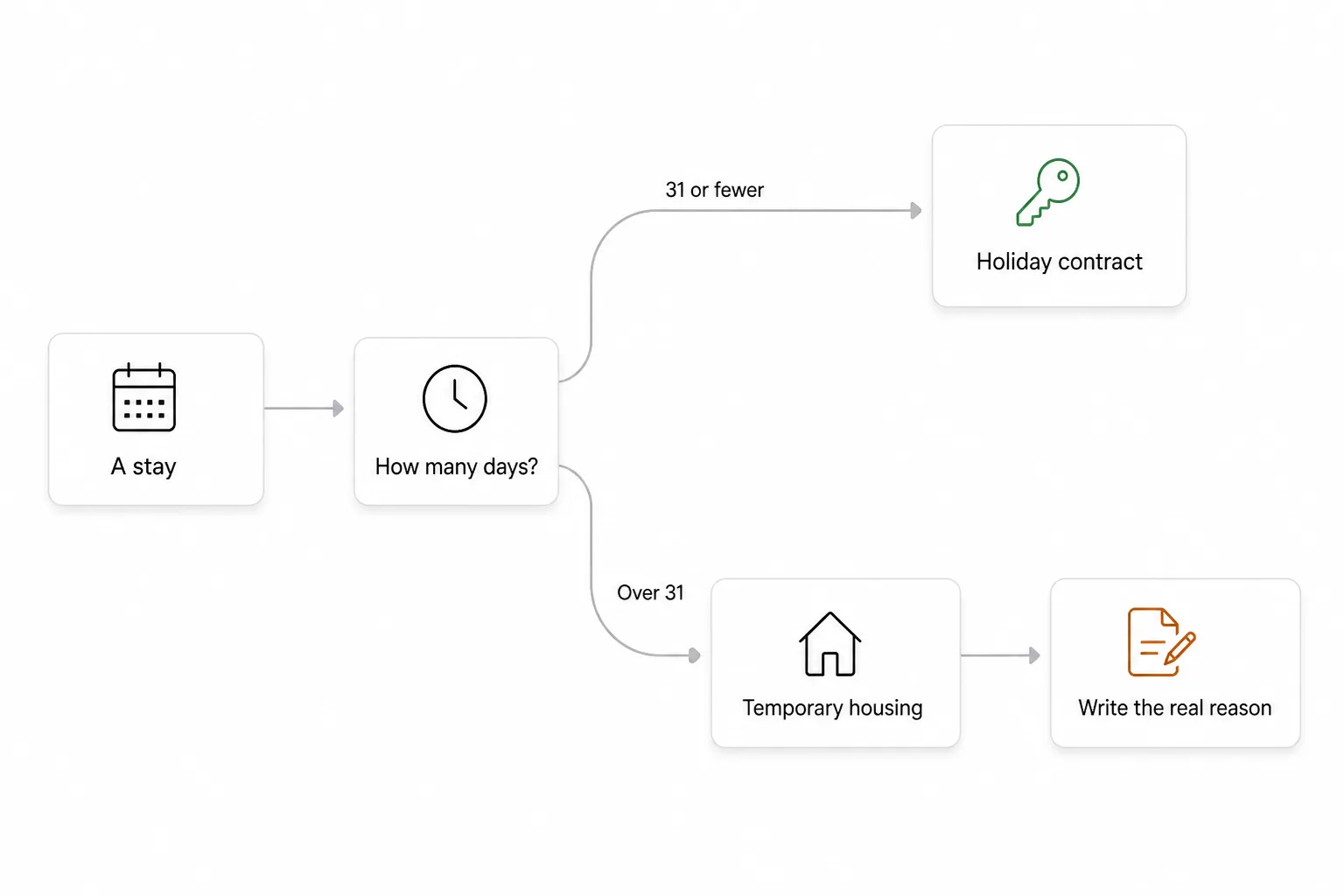
Since 8 October 2026, a tourist let in Spain lasts 31 days at most. An emergency decree, Real Decreto-ley 29/2026, sets this limit nationwide. An earlier decree with the same rule, 26/2026, applied on 1 and 2 October until Congress repealed it. Decree 29/2026 also needs a vote in Congress within 30 days to stay in force. Your region can set a shorter maximum, never a longer one.
A stay longer than 31 days is no longer a tourist let. It becomes a temporary housing rental under Spain’s residential tenancy law. That contract must state why the tenant is living there for a while: a job, a course of study, medical treatment. The reason must be real, and you must be able to prove it.
If the contract does not state a reason, the law treats it as a standard long-term tenancy. That means years, not weeks.
The decree still has to go through Spain’s parliament. If the Congress does not approve it within 30 days, it lapses. We will report back after the vote.
Holiday rental contract template
Copy the text and replace everything in [brackets]. Each detail appears only once: after that, the contract refers to it by its defined term, such as the “Deposit” or the “Arrival Date”. If your region asks for more details, add them. If your guests do not read Spanish, give them this English version alongside the Spanish one.
If you would rather not copy anything, ask for the contract just below. You enter your fixed details once (yours, the home, the deposit, cancellation and the house rules) and download it as a Word file with them already written in. For each booking you only fill in the guest, the dates and the price.
HOLIDAY RENTAL AGREEMENT FOR A TOURIST HOME
Booking reference: [booking reference]
Date: [date of signature]
PARTIES
On the one part, [name or company name], with tax ID [tax ID (NIF)] and address at [host’s address], who runs the tourist home described below (the “Host”).
On the other part, [guest’s full name], holder of identity document [document type and number], phone [guest’s phone] and email [guest’s email] (the “Guest”).
The Host and the Guest (together, the “Parties”) each acknowledge that they have the legal capacity to enter into this agreement and, to that end,
RECITALS
I. The Host runs the home at [full address of the home], listed in the tourist register of [region] (the “Region”) under number [tourist registration number], with a maximum capacity of [maximum guests] people (the “Home”).
II. The Guest wishes to stay in the Home for tourist purposes, and the Parties therefore agree to the following
CLAUSES
1. Purpose and term. The Host grants the Guest temporary use of the Home, furnished and equipped, for tourist purposes. Check-in will take place on [arrival date] from [check-in time] (the “Arrival Date”), and check-out on [departure date] by [check-out time] (the “Departure Date”).
The stay will not exceed thirty-one (31) days. A total of [number of people] people will stay in the Home, the Guest included (the “Travellers”), never exceeding the maximum capacity of the Home.
2. Price and payment. The total price of the stay is [total price] euros (the “Price”), which includes [what the price includes].
The Guest will pay [percentage on booking]% of the Price on confirming the booking and the balance at least [days before to pay the balance] days before the Arrival Date, by [payment method].
3. Deposit. On signing this agreement, the Guest will provide a deposit of [deposit amount] euros (the “Deposit”) by [deposit method]. The Host will return the Deposit within [days to return it] days of the Departure Date, unless there is damage or a breach of this agreement. In that case, the Host may only keep the amount needed for repairs, supported by photographs and an invoice.
4. Cancellation. If the Guest cancels the booking at least [days before arrival] days before the Arrival Date, the Host will refund [percentage refunded before]% of the amounts paid. If the Guest cancels later, the Host will refund [percentage refunded after]%. If the Home cannot be occupied for reasons attributable to the Host, the Host will refund all amounts paid in full.
5. House rules. The Travellers undertake to follow these rules (the “House Rules”): no parties or events; quiet hours between [quiet hours start] and [quiet hours end]; smoking inside the Home is [allowed / not allowed]; pets are [allowed / not allowed]; and no one other than the Travellers may stay in the Home.
The following are also House Rules: [other rules, if any].
The Travellers will also follow the rules of the building’s owners’ association, which the Host provides with this agreement.
6. Guest registration and data protection. All Travellers will provide their identity details before the Arrival Date or on arrival, and those aged fourteen (14) or over will sign the corresponding registration form. The Host will send these details to Spain’s Ministry of the Interior under Real Decreto 933/2021 of 26 October.
Personal data will be processed solely to meet that legal obligation and to manage the stay, and will be kept for the period required by law. The Guest may exercise their data protection rights by writing to [email for personal data].
7. Condition of the Home and liability. The Guest receives the Home clean, in good condition and with the inventory provided. The Travellers will take due care of it, and the Guest will be liable for any damage they cause, except wear and tear from normal use.
8. Host access. During the stay, the Host may only enter the Home with prior notice and the Guest’s consent, except in an emergency such as a water leak.
9. Assistance during the stay. The Host will handle any incident during the stay on [contact phone] and at [contact email].
10. Governing law. This agreement is governed by the tourism rules of the Region and, where they are silent, by the Spanish Civil Code. It falls outside Spain’s Urban Tenancy Act (Ley 29/1994, de Arrendamientos Urbanos) under its article 5(e).
In witness whereof, the Parties sign this agreement in duplicate on the date stated above.
The Host: [signature]
The Guest: [signature]
For a more detailed deposit clause, see how to set a holiday rental deposit. For the house rules, the welcome letter repeats them in a friendlier tone.
Clauses to avoid
Your guest is a consumer. Spanish law protects consumers from unfair clauses, and a court can strike them out. These ones tend to cause trouble:
- Keeping the whole deposit no matter what. You can only keep what it costs to fix real damage.
- Very high penalties. A €500 fine for a late arrival will not hold up.
- Entering the home without notice. During the stay, the home is the guest’s to use. Agree how and when you may come in.
- Charges that were not in the price. Everything you charge must appear in the contract and before booking.
- Making the guest give up their rights. A clause like that is void.
Some good news for you: for a stay with fixed dates, the guest does not get the 14-day cooling-off period that applies to other online purchases. That makes your cancellation policy the rule that counts. Write it clearly.
How to send and sign it
- Show the terms before the booking. Say in the listing that there is a contract and copy its key points: price, deposit, cancellation and house rules. On Airbnb this is required. If the guest first sees them after booking, they can refuse to sign.
- Send the full contract with the confirmation. It should repeat what the listing already said, with nothing new. The booking confirmation email is a good moment.
- Get it signed before arrival. An electronic signature or a signature on the phone works.
- Keep a copy. In Andalucía, for at least a year. Elsewhere, until nothing is left to settle with that guest.
The contract and the guest register share data
Spain’s guest registration form asks for booking details: the contract date, check-in, check-out, the number of travellers and the payment method. They are the same details you put in the contract. Put the booking reference in the contract too, whether it comes from Airbnb, Booking or your own system. That way you can match each stay’s contract and form without doubt.
With Regi, each traveller enters their details and signs on their phone before arrival. Regi sends the form to SES.Hospedajes, the Ministry of the Interior’s system, and keeps it for the 3 years the rules require. You only check that the dates and travellers match your contract.
Frequently asked questions
Do I need a contract for a holiday rental in Spain? In Andalucía, yes: you must give each guest a document with the stay’s details that counts as the contract. In other regions it is not always required, but it is strongly advised. Check your region’s rules.
What if the guest stays more than 31 days? Since 8 October 2026 it is no longer a tourist let. You need a temporary housing contract that states the real reason for the stay. Without that reason, the law treats it as a long-term tenancy.
Can I ask an Airbnb guest to sign a contract? Yes, if you mention it in the listing before they book. If you did not, the guest can refuse and ask you to cancel with a full refund.
Does the contract replace guest registration? No. They are two separate things. The contract is between you and the guest. Guest registration is a duty towards the Ministry of the Interior that always applies. We explain it in guest registration in Spain.
How long do I keep the signed contract? In Andalucía, at least one year. Elsewhere, keep it for as long as a claim about that stay is possible.
Just starting out? Read how to start managing a holiday rental from scratch, with every step in order.
Details and sources
Tourist lets and tenancy law. Article 5(e) of Spain’s Urban Tenancy Act (Ley 29/1994 de Arrendamientos Urbanos) excludes from that act the letting of a furnished home, marketed through tourist channels for profit, when it falls under tourism rules. Real Decreto-ley 29/2026 of 6 October (published in the BOE on 7 October) rewrote that letter: it now covers letting “all or part” of the home and adds that the maximum length, “set by the competent authorities, may in no case exceed thirty-one days”. The new wording has applied since 8 October 2026. Real Decreto-ley 26/2026 of 29 September carried the same wording and applied on 1 and 2 October. Congress repealed it on 2 October 2026 (resolution published in the BOE the same day).
Temporary housing. The same decree defines a temporary housing let (article 2.3 of the act), requires a “real and provable” reason written into the contract, with the burden of proof on the landlord (article 7.2), and sets its length at more than 31 days and, as a general rule, no more than twelve months (article 9 bis). Without the reason, the contract falls under the long-term tenancy rules from the day it was signed. Seasonal contracts signed before 8 October 2026, the day Real Decreto-ley 29/2026 came into force, keep their previous rules (eighth transitional provision). The decree’s preamble leaves regional rules on seasonal lets untouched.
Parliamentary approval. Article 86 of the Spanish Constitution gives the Congress 30 days to approve or repeal a decree-law. This is not a formality: in January 2019 the Congress repealed Real Decreto-ley 21/2018, which also amended this act.
Andalucía. Article 7 of Decreto 28/2016 requires each guest to be given, on arrival, a document stating who runs the home, its code in the Andalusian Tourism Register, the number of people, the check-in and check-out dates, the total price and the contact phone required by article 6. The signed copy is kept for one year and counts as the contract.
Consumer law. Real Decreto Legislativo 1/2007 (Spain’s general consumer protection act) treats non-negotiated clauses that create a significant imbalance against the consumer as unfair (article 82). Its article 103(l) excludes accommodation services with a specific date or period from the right of withdrawal.
Guest registration. Annex I of Real Decreto 933/2021 asks for the contract details (reference, date, check-in, check-out, travellers) and the transaction details (payment method and date).
- BOE, Ley 29/1994 de Arrendamientos Urbanos, consolidated text
- BOE, Real Decreto-ley 29/2026 of 6 October
- BOE, repeal of Real Decreto-ley 26/2026
- BOE, general consumer protection act
- BOE, Real Decreto 933/2021
- BOJA, Decreto 28/2016 on tourist homes in Andalucía
- Airbnb, if a host asks you to sign a contract