


August in the Balearics looked full. The islands closed the month with the highest accommodation occupancy in Spain. Even so, a full calendar did not mean more money.
The reason fits in one line. More guests arrived, but each one stayed fewer nights. This article explains what that changes in your accounts, and what you can check before autumn arrives.
What August looked like in the Balearics
On 22 September 2026, Spain’s statistics office (INE) published August hotel data. For the Balearics, the picture was this:
| August in the Balearics | Figure |
|---|---|
| Guests | +3.8 % against 2025 |
| Nights sold | -0.2 % against 2025 |
| Average stay | 5.32 days (was 5.53) |
| Bed occupancy | Just over 90 % |
| Foreign guests | 89.5 % of the total |
The Balearics had the highest occupancy in Spain. And still sold fewer nights than the year before. More people came, and they left sooner.
One caveat matters. These are hotel figures, not holiday rental ones. INE measures registered rentals in a separate survey of tourist apartments, and the August edition lands at the end of September. The latest official number is July’s: the Balearics led the country in tourist apartment occupancy, at 83.3 % of the beds on offer.
The signal still applies to you. Stays are not getting shorter in hotels alone.
Across Spain, the average stay in tourist apartments fell 7.3 % in July. And in the Balearics, what was a one or two week house rental a decade ago is now around five days. Those are different sources, and they do not replace the Balearic rental figure for August, which does not exist yet.
More guests and fewer nights empties the till
Your income does not depend only on how many days the place is booked. It depends on how many bookings it takes to fill those days.
Picture two months with the same 30 nights sold:
- Month A: 3 stays of 10 nights.
- Month B: 6 stays of 5 nights.
Occupancy is identical. The work is not. Month B has twice the cleans, twice the arrivals and twice the departures. Say each guest changeover costs you 60 € in cleaning, laundry and coordination. Month A spends 180 € and month B spends 360 €. Same income, 180 € less in your pocket.
There is a second effect that is easier to miss. Short stays leave odd gaps in the calendar. A two night hole between two bookings almost never sells. Those gaps do not show up in last month’s occupancy, but they do show up in next month’s.
To put numbers on your own case, the full income and cost formula is in our guide to working out the profitability of your holiday rental. Here only one conclusion matters: occupancy measures full days, not money earned.
The booking window has got shorter
There is a second change under way, and it is the one that makes planning hardest.
Guests book much closer to the travel date. Habtur, the Balearic holiday rental association, said it again in September: the season ended well, but the bookings arrived in the last few weeks. That makes it almost impossible to tell in June how August will go.
The other change is length. A decade ago, renting a Balearic house for one or two weeks was normal. Today the average is around five days, and often less.
When you see an empty June calendar, the temptation is to cut prices across the whole season. That is usually the expensive mistake: the late demand would have come anyway, and you have already given away your best dates.
Three rules for cutting prices with a purpose
1. Discount by date, not by season. If Tuesdays in October are empty, touch Tuesdays in October. Leave alone the weekends that sell themselves.
2. Adjust the minimum stay gap by gap. A seven night minimum protects your costs in July. In a three night hole between two bookings, that same minimum guarantees you sell nothing. Lower the minimum only inside the gaps.
3. Set a floor per stay, not per night. Work out what each changeover costs you. A two night booking below that floor loses you money even as your occupancy goes up.
A weekly dashboard for autumn
You do not need expensive software. A spreadsheet and fifteen minutes a week will show you trouble coming:
| What you track | What it tells you |
|---|---|
| Nights sold, against 2025 | Whether you are behind, or simply later |
| New bookings at 7, 14 and 30 days | Whether the late demand is actually arriving |
| Average stay of new bookings | Early warning that stays are getting shorter still |
| Average nightly price of new bookings | Whether you are quietly selling cheaper |
| Cost per stay | Your real price floor |
| Cancellations | Whether a full calendar holds |
| Net income after commissions | What you actually keep |
Tell a price problem from a calendar problem
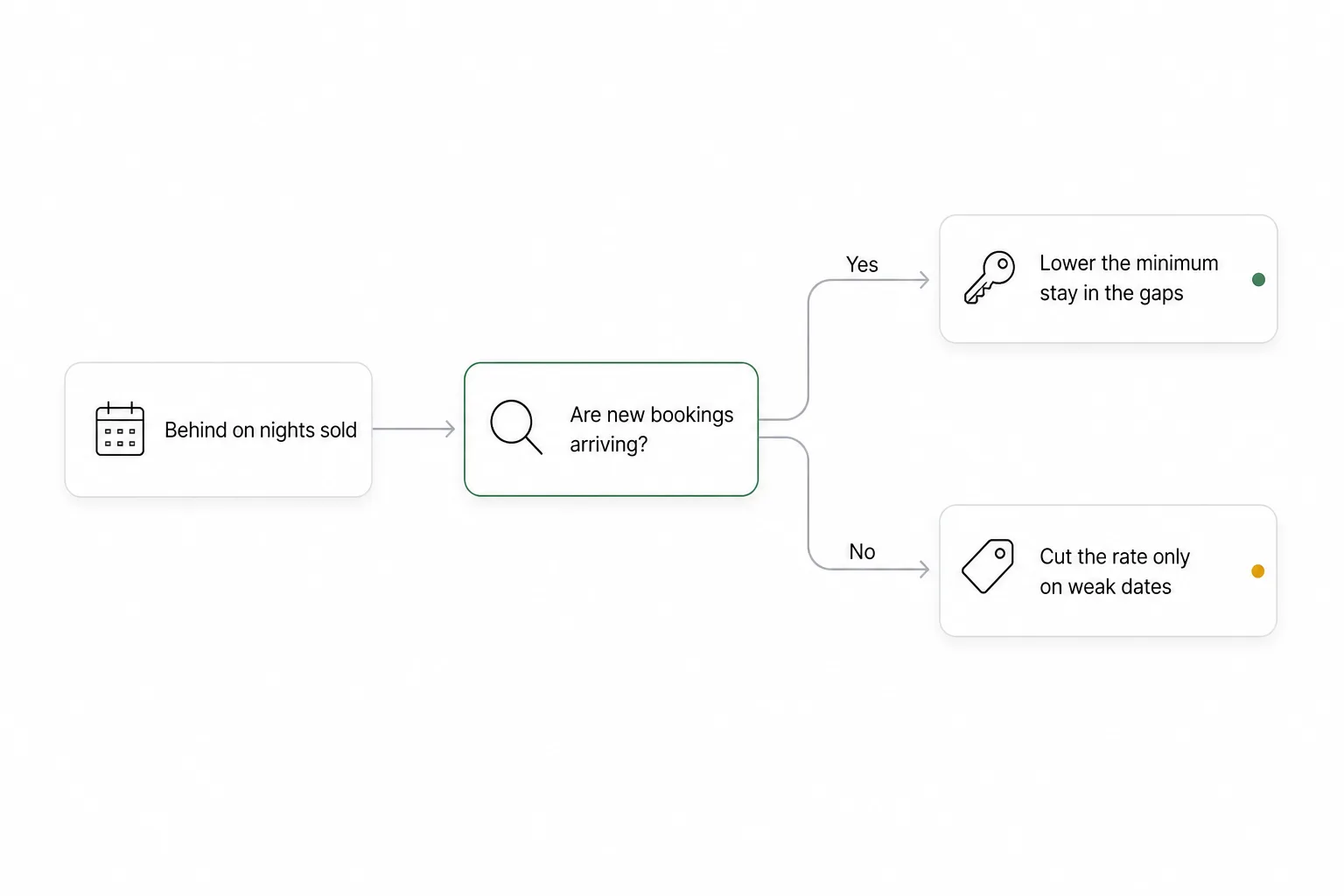
Almost every autumn decision comes out of one question. If you are behind on nights sold, check whether new bookings are still coming in.
If they are, you have a calendar problem. The demand is there, but your gaps cannot be sold as they stand. Adjust the minimum stay inside those gaps.
If they are not, you have a price problem on those dates. Cut the rate there only, not across the season.
When demand piles into the final weeks, the risk moves. It stops being an empty house and starts being the same night sold twice. It is worth checking that your calendars are properly synced between Airbnb and Booking before October.
And if low season is your real hole, the work starts before winter. We cover it separately in our guide to beating tourism seasonality.
What to check when the official August figures land
At the end of September, INE publishes its tourist apartment survey. Look at four things and no more:
- Nights sold in apartments, and the change against August 2025.
- Average stay, which is the figure that explains the rest.
- Bed occupancy in the Balearics, to compare with July’s 83.3 %.
- The price index, which rose 6.2 % across Spain in July.
Two warnings before you draw conclusions. That survey covers registered tourist apartments, not every holiday home in the islands. And Mallorca is not Menorca: check by island and by property type before you change your prices.
Frequently asked questions
Isn’t 90 % occupancy a good season?
It is a good sign, but it is not the answer. Occupancy tells you how many days the place was full. It does not tell you at what price, across how many bookings, or at what cost. Two seasons with the same occupancy can end very differently.
Why do guests go up while nights go down?
Because each guest stays fewer days. In Balearic hotels, the August average stay fell from 5.53 to 5.32 days. With more people and fewer days each, the total number of nights can still drop.
Do hotel figures apply to my holiday rental?
Only as context. Hotels and holiday rentals have different guests, prices and costs. To compare with your own case, wait for the tourist apartment survey, and remember even that does not cover unregistered rentals.
Should I cut prices if autumn looks weak?
First check whether new bookings are arriving. With the booking window this short, an empty calendar thirty days out no longer means what it meant five years ago. If the late demand shows up, cutting early only costs you money.
Where do I find the official data?
On the INE website, in the hotel occupancy survey and the tourist apartment survey. The figures are provisional and get revised, so always check the current publication before making a decision.
Details and sources
- INE, hotel occupancy survey for August 2026 (published 22 September 2026, provisional data). Spain closed August with 48.7 million overnight stays, up 1.4 %; ADR rose 7.3 % to 166.9 € and RevPAR 7.0 % to 133.1 €. The Balearics had the highest bed occupancy of any region, just over 90 %.
- The Balearic reading of those same figures, published by Última Hora on 22 September 2026: guests +3.8 %, overnight stays -0.2 %, average stay of 5.32 days against 5.53 in August 2025, and 89.5 % foreign guests.
- INE, non-hotel accommodation occupancy survey for July 2026 (published 31 August 2026). Overnight stays in tourist apartments were unchanged against July 2025; the average stay fell 7.3 % to 4.8 nights; national bed occupancy was 52.3 % and the Balearics led with 83.3 %. The tourist apartment price index rose 6.2 %.
- Habtur statements on the 2026 season, on real occupancy against registered places, and on bookings landing in the final weeks, in Última Hora, 16 September 2026.
- Context on shortening Balearic stays, from one or two weeks a decade ago to around five days, and on the start of the season as described by Habtur’s president, in Atalayar, 17 August 2026.
- The 60 € changeover cost is an illustrative figure used to show the calculation, not a market price. Use your own real cost.
- For the national picture of the same effect in hotels, including what ADR and RevPAR mean, see Spanish hotel prices in 2026.