

On Monday 14 September 2026 at 09:00, sales open for the 2026-2027 season of Imserso, the Spanish state programme of subsidised off-season holidays for pensioners. There are 879,213 places spread between October and June, two contracted tour operators, and a list of 158 coastal hotels published on 8 September. For a coastal hotel in Spain, the programme is often the difference between opening in January and closing; for many, this is also the first year the numbers do not add up.
August’s dispute sums it up. The Valencian hotel associations say the programme pays hotels between €28 and €30 per person per day on full board, and that looking after that guest costs at least €35 plus VAT. The figure is neither official nor universal, but it has put on the table the question every hotel director should answer with their own spreadsheet before signing the next campaign.
This is not a guide for pensioners or a hotel directory. It is a decision framework for management, revenue, reception and administration: which dates matter, what the programme requires, how to work out the real margin per group and what to do whether you have already signed or are still negotiating.
The sales calendar that matters to a hotel
First, do not confuse two calendars. The one published this week is the sales calendar for users: when each accredited pensioner can book. The contract between your hotel and the operator, the quotas and the group dates run on a separate track, and by now they should be closed.
| Date | Who can book |
|---|---|
| Monday 14 September, 09:00 | Priority applicants from Andalucía, Aragón, Castilla y León, Extremadura, Galicia, Madrid, Melilla, Navarra and La Rioja |
| Tuesday 15 September | Non-priority applicants from that first group |
| Wednesday 16 September | Priority applicants from Asturias, Catalonia, Castilla-La Mancha, the Valencian Community, Ceuta, the Balearics, the Canaries, Cantabria, Murcia and the Basque Country |
| Thursday 17 September | Non-priority applicants from that second group |
| 14 to 18 September | Bookings limited to the applicant’s own provincial quota |
| From Saturday 19 September | Unsold places from any province open to any accredited applicant |
“Priority” does not reserve a place: it only gives one day’s head start within the regional group. The score depends on age, income, disability, large-family status and, with the most weight, not having travelled in the previous season.
Demand is large. According to Hosteltur, Imserso has sent 2,938,156 accreditation letters covering 4,602,255 people, with 13 September as the deadline for receiving them. Even so, the share that reaches your hotel depends on how many places you contracted, in which groups, and on how strongly users choose your destination.
How many places there are and who sells them
The 2026-2027 contract is an extension of the previous one, split into three lots:
| Lot | Places | Value before VAT | Contractor |
|---|---|---|---|
| 1. Mainland coast | 440,284 | €26,054,497 | UTE Turismo Social (BTravel Turismo Accesible and Viajes Halcón, Ávoris group) |
| 2. Island coast (Balearics and Canaries) | 228,142 | €19,888,095 | UTE Mundicolor (IAG7 Viajes, World 2Meet and Next Continental Holdings) |
| 3. Short breaks, circuits and city stays | 210,787 | €12,714,361 | UTE Turismo Social |
| Total | 879,213 | €58,656,953 |
These places are trips, not hotels or rooms. A single property can host several groups over the campaign, and short-break places are spread across circuit hotels that change with each route.
The list published by Preferente on 8 September gives a snapshot of the known coastal inventory: 158 hotels, 111 with Turismo Social (Catalonia 48, Valencian Community 30, Andalucía 28, Murcia 5) and 47 with Mundicolor (Canaries 26, Balearics 21). It is a trade-press list, not a document signed by Imserso: the live catalogues at turismosocial.com and mundicolor.es change by destination, departure and availability, and a hotel missing from the list has not necessarily turned the programme down.
Two contract rules affect your planning directly:
- Mandatory deseasonalisation: 36 % of each lot’s places are distributed proportionally across the months of the campaign. There is guaranteed demand in December, January and February, at the contract price.
- High season with a supplement: October, May and June on the mainland coast and the Balearics; December, January and February in the Canaries. The user pays the supplement to the operator; what reaches the hotel is set by your contract, not by the public price.
What the programme requires of a hotel
The tender and its extension set the minimum; the contract with the operator is what actually binds you. Before assuming any condition, find it in your contract:
- Three-star minimum and accessible common areas.
- Full board on the coast (half board in provincial capitals), with a shared double room as the base.
- Mandatory social and cultural activities and general medical services at the hotel.
- Single rooms with a supplement paid by the user: €22 on the mainland coast and the Balearics, €24 in the Canaries and €26 on short breaks, subject to availability.
- Pets up to 10 kg including the carrier on mainland and island coast trips, with a percentage of places set aside.
- Gala meals on public holidays, with a €20 supplement per person and meal charged to the user.
- Information material on active ageing and the prevention of elder abuse, and tougher penalties for quality failures.
What is not in the tender but is in your contract: the net rate per person per night, the group dates and quotas, the release (when the operator can hand unsold places back to you), the terms for name changes, cancellations and no-shows, the payment period and what happens to supplements. Those clauses, not the public price, decide whether a group is profitable.
What the hotel is paid and what it costs
The price a pensioner pays ranges from €132.91 (four days in a provincial capital, low season) to €564.72 (ten days in the Canaries with transport, high season). A ten-day stay on the mainland coast with transport costs the user between €309.22 and €409.22. That amount covers return transport, group insurance, activities, the operator’s services and margin, and comes on top of the public funding in the contract. Dividing the public price by the number of nights does not give you the hotel’s rate.
What does circulate is an industry estimate. Hosbec, the Valencian Community’s hotel association, has said since August that the programme pays hotels between €28 and €30 per person per day on full board, that the real minimum cost is around €35 plus VAT, and that staff, energy, food and supply costs have risen more than 30 % while rates stayed frozen. One trade source mentions €26 a day. None of these figures is an official tariff: they are what the associations bring to their negotiation with Turismo Social.
To compare properly, split the cost per guest per night into two blocks:
| Avoidable cost (only exists if the guest comes) | Cost of staying open (exists whether you take Imserso or not) |
|---|---|
| Food and drink for full board | Minimum core staff and maintenance |
| Room cleaning and laundry | Base energy for the building, heating of common areas |
| Energy per occupied room | Insurance, licences, local taxes |
| Incremental staff (extra shifts in dining, housekeeping, front desk) | Depreciation and financing |
| Activities and entertainment | Opportunity cost: rooms you cannot sell to another segment |
| Waste, breakages, pet-related incidents | Reopening cost if you close (refit, rehiring) |
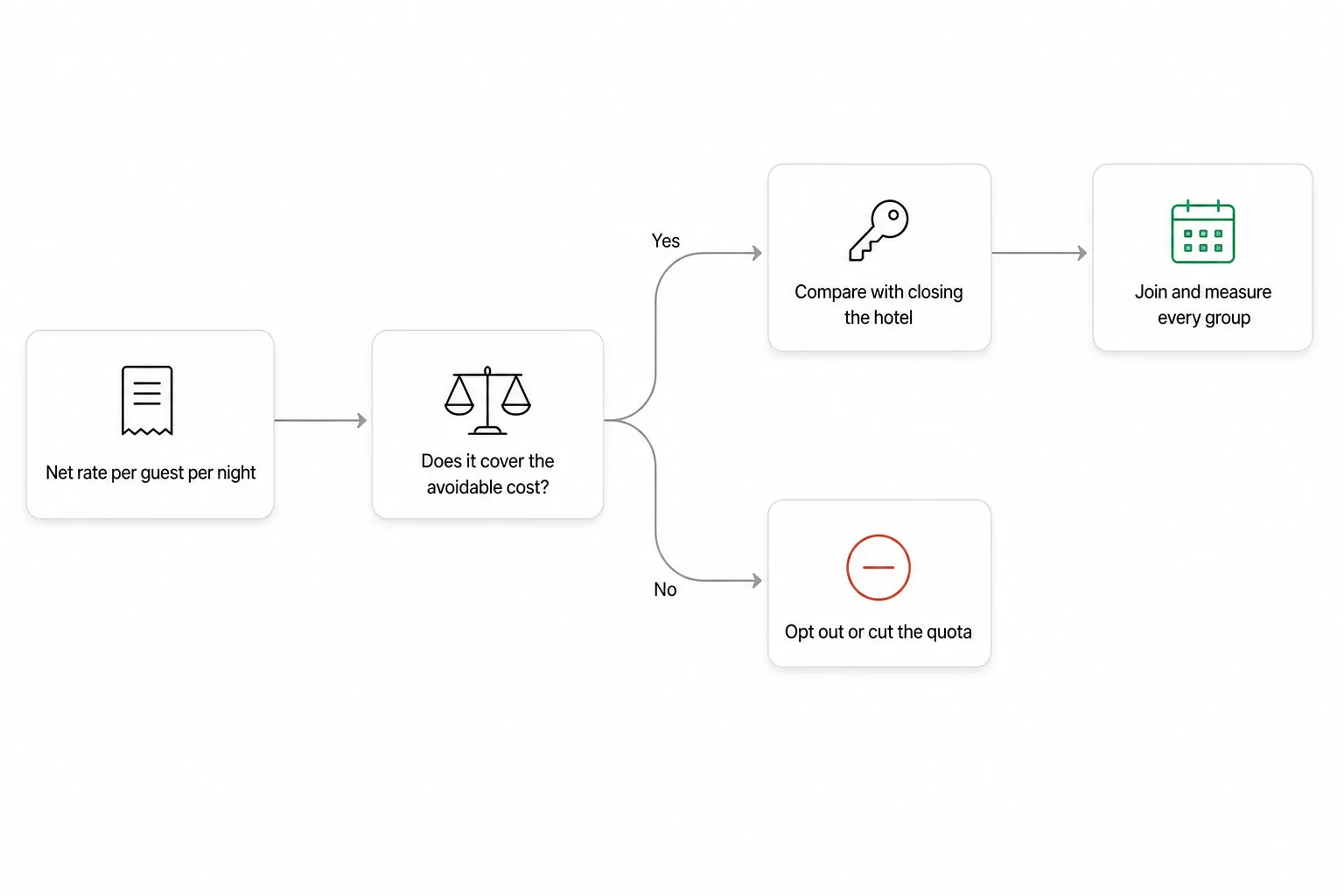
The useful question is not “does the rate cover total cost?” but two questions in order. First: does the net rate cover the avoidable cost of each guest? If not, every place sold loses money and joining only makes sense for reasons that are not financial. If it does, then second: does the contribution margin the groups leave, plus extras, beat the cost of staying open compared with closing?
A profit-and-loss template per group
Fill this template in per group, not per season. The figures in the example are illustrative: replace them with those in your contract and your accounts.
| Item | How it is calculated | Example (10-night group) |
|---|---|---|
| Places contracted | Per contract | 120 |
| Places sold after release | Actual occupancy of the group | 108 (90 %) |
| Guest-nights | Places sold × nights | 1,080 |
| Net rate per guest-night | From your contract | €29.00 |
| Group revenue | Guest-nights × net rate | €31,320 |
| Food and drink | Real cost per guest-night | €12.00 |
| Cleaning and laundry | Real cost per guest-night | €3.00 |
| Energy per occupied room | Real cost per guest-night | €2.50 |
| Incremental staff | Extra shifts, prorated | €8.00 |
| Activities and incidents | Real cost per guest-night | €1.50 |
| Avoidable cost per guest-night | Sum | €27.00 |
| Contribution margin of the group | (Net rate − avoidable cost) × guest-nights | €2,160 |
| Extras sold (bar, excursions, upgrades) | Net revenue per guest-night × guest-nights | €2,700 |
| Total contribution of the group | Margin + extras | €4,860 |
| Cost of staying open during the group | Proportional share of fixed costs | To fill in |
| Payment period | Days between the group’s departure and the operator’s payment | To fill in |
With those assumptions, each guest leaves €2 of margin per night before extras. The break-even in the example sits at an avoidable cost of €29: food only has to rise 17 %, or incremental staff cost €10 instead of €8, for the group to turn negative. Always run three scenarios:
| Scenario | Occupancy | Food cost | Group margin (before extras) |
|---|---|---|---|
| Base | 90 % | €12.00 | €2,160 |
| Food +10 % | 90 % | €13.20 | €864 |
| Occupancy 75 % and food +10 % | 75 % | €13.20 | €720 |
If in the pessimistic scenario the margin does not even cover the share of fixed costs you could save by closing, the group is only held up by indirect benefits, and those have to be measured, not assumed.
For the rest of your inventory, the framework in Spanish hotel prices and RevPAR in 2026 helps you compare the Imserso margin with what other segments leave on the same dates.
If you have already signed: preparation before the first group
An Imserso group arrives as a block: a coach, a rooming list of forty or a hundred people, full board from dinner on the first day and activities from day one. Whatever is not ready in September gets improvised in October.
- Inventory and release in the PMS and channel manager. Block the contracted places per group, note each release date and decide in advance what you will do with the places handed back.
- Rate and board codes. Create a specific rate with full board included and the breakdown you need to reconcile: accommodation, meals, single supplement, pets.
- Rooming lists, name changes and no-shows. Rehearse with a test group’s list: who loads it, how last-minute changes are recorded and how a no-show is documented for settlement.
- Accessible rooms and the pet quota. Set aside the adapted units and those that accept animals, and make sure reception knows which they are without asking.
- Reception, dining room and activities aligned. One shared timetable per group: arrival, first meal, the operator’s briefings, excursions and departure.
- Included services in writing. A sheet stating what is in the package and what is charged separately, so the guest does not find out on the bill and the waiter does not have to decide.
- Reconciliation per operator. Actual stay, invoice to the operator and payment received, group by group. Small differences from changes and no-shows add up fast over a nine-month campaign.
If the hotel needs to renew equipment for this guest profile, the 2026 grants for renewing hotel equipment remain open until 30 September unless closed early.
The traveller registry is not included in the package
The fact that Turismo Social or Mundicolor channels the booking changes nothing in your obligations under Royal Decree 933/2021 (Spain’s traveller-registration rule): every person staying is reported to SES.Hospedajes, the Interior Ministry’s platform, with a signed registration form and complete data. The operator sends you a rooming list; it does not send you registration forms.
With a group of a hundred, manual check-in is the bottleneck on arrival day. Three decisions ease it:
- Import the operator’s list to pre-load the booking, but collect each guest’s document and signature, which is what the form requires.
- Open check-in before arrival. An online check-in link sent with the trip documents lets much of the group arrive with the form already done.
- Prepare a manual queue for those who have not completed it, with someone who reviews incomplete data and knows what to do with companions.
This guest profile also benefits most from a clear, unhurried check-in: there are applicable ideas in cognitive accessibility at check-in. And one limit: any health or disability data the operator may have collected for the trip is not traveller-registry data. Do not copy it into your system unless you need it to provide a specific service.
Indirect benefits: measure them, do not assume them
The arguments in favour of the programme are real, but they only count if you quantify them:
- Keeping staff and suppliers through the winter avoids the cost of reopening and rehiring in spring. Put a number on it: what closing and reopening costs you.
- Opening services (restaurant, spa, bar) that would otherwise be shut and that also sell to guests from other segments.
- Direct repeat business, within what the contract allows: a guest who comes back on their own in June with their family is revenue at market rate.
- Extras not included: your own excursions, room upgrades, bar, laundry.
To make this more than a hunch, tag the source and group of every booking in the PMS and measure total revenue per available room, not just accommodation. And do not credit the programme with all of the destination’s winter demand: part of it would come anyway.
Two decision trees
If you are still negotiating the 2026-2027 campaign, or already thinking about the next one:
- The net rate covers the avoidable cost with margin and the destination has no winter alternative: join, contracting by group and measuring each one.
- The rate covers the avoidable cost but the margin is minimal: cut the quota, keeping the months in which you have no other demand and freeing rooms for other segments in October, May and June.
- The rate does not cover the avoidable cost: stay out, unless the cost of closing is greater than the loss per group, and in that case with a cap on places and a review date.
If you have already signed and the numbers do not convince you:
- Keep the contract this campaign and document the real margin of every group: it is the argument you will otherwise lack in the next negotiation.
- Renegotiate the next campaign with that data, not with the association’s figure. Hosbec is asking for a minimum of €35 plus VAT, a periodic review mechanism and marketing guarantees from December to February; your hotel can ask for something different and more specific.
- Replace part of the volume in the months where an alternative exists: direct sales to senior travellers outside the programme, private groups from associations and clubs, themed breaks, sports stays, health tourism and agreements with local companies. None of them replaces Imserso volume at a stroke; combined and measured, they can replace the groups with the worst margin. The underlying tactics are in how to fill the low season.
Frequently asked questions
When do Imserso 2026-2027 trips go on sale?
Monday 14 September 2026 at 09:00 for priority applicants in the first group of regions, then staggered until the 17th. From 14 to 18 September bookings are limited to the provincial quota; from 19 September leftover places from any province open up.
How much is a hotel paid per Imserso pensioner?
There is no public tariff: it is set in the contract between each hotel and the operator. The Valencian hotel associations speak of €28 to €30 per person per day on full board and are demanding at least €35 plus VAT. These are negotiating figures, not official data.
Does the hotel have to be three stars?
Yes, three stars is the contract’s minimum category, with accessible common areas, full board, activities and general medical services. Check the detail in your contract with Turismo Social or Mundicolor.
Does the hotel have to register Imserso travellers with SES.Hospedajes?
Yes. The booking comes through the operator, but the obligation under Royal Decree 933/2021 belongs to the establishment: a signed registration form reported for every person staying, with the same deadlines as any other booking.
Can I leave the programme mid-season?
It depends on the clauses of your contract, which provides for tougher penalties for non-compliance. Before considering it, calculate the margin per group with the template above and compare the real loss with the cost of the penalty and of closing.
Sources consulted
- BOE, resolution calling 879,213 places for the 2026-2027 season, primary source for places, modalities, durations, public prices, supplements and the reduced fare.
- Imserso, sales open on 14 September 2026, primary source for the sales calendar by regional group and the opening of leftover places.
- Imserso, contract extension for the 2026-2027 season, lots, values, contractors, hotel requirements, the 36 % monthly spread and pets.
- Ministry of Social Rights, note on the start of bookings, split of places by modality and the season’s novelties.
- Hosteltur, how booking priority works and accreditation letters, priority criteria and number of accredited people.
- Preferente, hotels that have signed with Ávoris and Mundiplan (8 September 2026), trade list of 158 coastal hotels.
- Preferente, hoteliers demand that Ávoris raise the rate (29 August 2026) and Infobae, Valencian hotels threaten to leave Imserso (25 August 2026), rate and cost figures attributed to Hosbec.