



If you employ people in a hotel, a campsite or an apartment business in Spain, one piece of paper changes on 5 October. From that day, everyone who starts work gets far more information about the job in writing.
You do not have to redo the contracts of your current team. What you do have to do is open your contract template and its annexes, find the gaps and fill them before that date.
The four dates that matter
| When | What happens |
|---|---|
| 15 September 2026 | The official gazette publishes Real Decreto 723/2026, of 9 September. |
| 5 October 2026 | It takes effect. It applies to anyone who starts work from that day. |
| 20 days from publication | The ministry must post a template on the SEPE website. It was not there on 17 September. |
| 30 working days | Your deadline to answer someone already on the payroll who asks for the information. |
The SEPE template is not a condition for the duty to exist. The decree says its absence does not release you from informing. You can use the contract, one or more annexes, or any other written document, as long as they cover everything the rule asks for.
When the template does appear, compare it with what you already hand over. If it has a field or a format you are missing, switch to it.
Who is covered and who is not
The general rule covers employers and workers under article 1 of the Estatuto de los Trabajadores, Spain’s core employment law, when the relationship lasts more than four weeks.
- A guesthouse with six people on the payroll is covered.
- An owner who runs their own holiday flat alone, with nobody employed, is not. There is no employment relationship here.
- The cleaning or front-desk company that invoices you is not your problem either. It is a separate business, and it informs its own staff.
Special employment relationships follow their own rules, plus this decree in the cases listed in its article 2.
Three situations, three deadlines
| Situation | What you hand over | When |
|---|---|---|
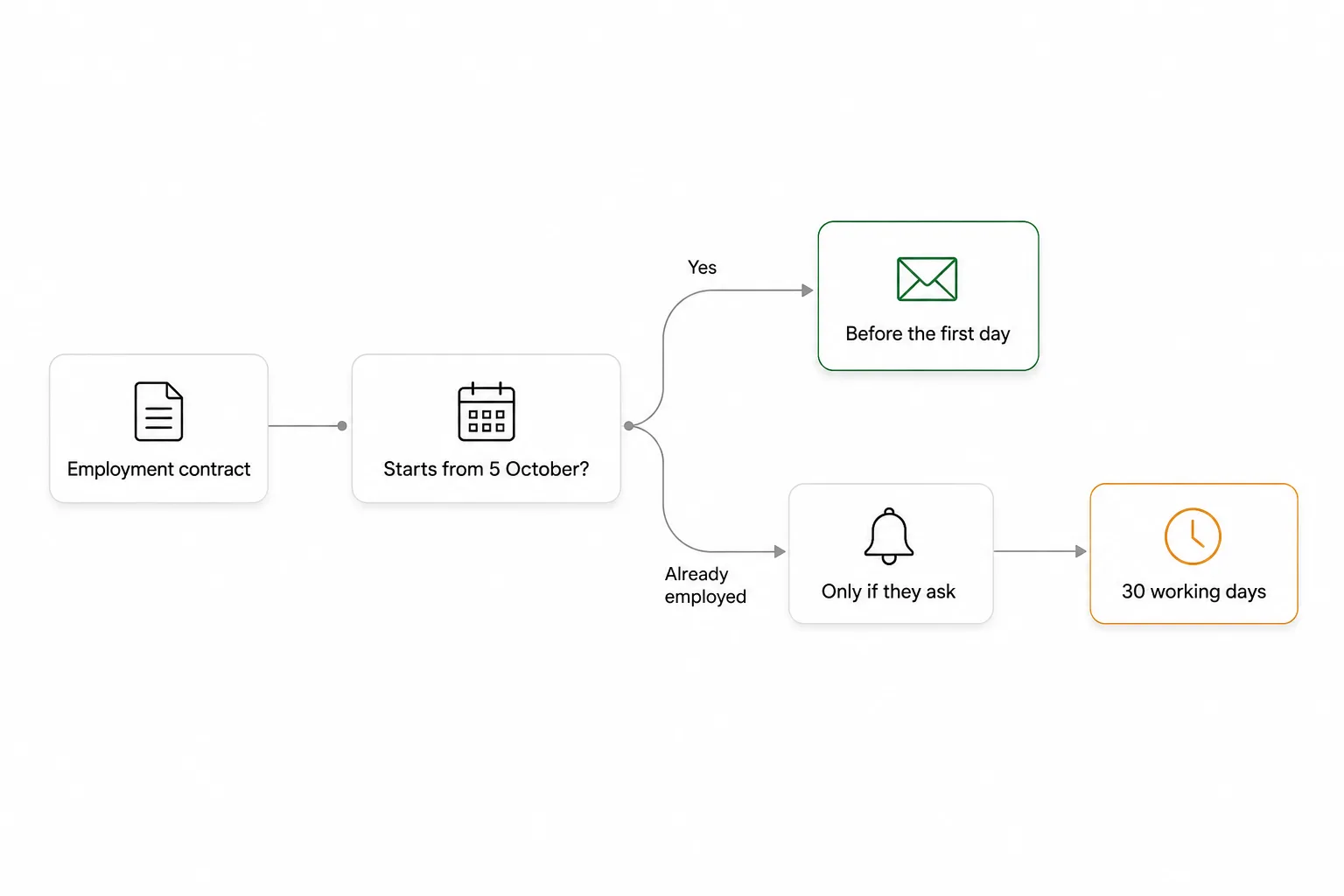
| New hire from 5 October | All the information in article 3 | Before they start work |
| Someone already under contract | Only what they lack, and only if they ask | 30 working days from the request |
| A change to a condition already reported | The change, in writing | As soon as possible, and at the latest the day it takes effect |
You do not have to re-sign every current contract on 5 October. That is the most repeated misunderstanding of the past few weeks.
It is worth preparing an answer before the first request arrives. Decide who receives it, where it is filed and which document answers it.
The review matrix, role by role
Take one sample contract per role and check these blocks. If one is blank or says something vague, that is your work.
| Block | What it has to say |
|---|---|
| Parties and dates | Who employs whom, the start date and, if temporary, the expected end date |
| Place of work | The usual site, the several sites, or that the person chooses where to work |
| Role | Professional group or grade, plus a short description of the tasks |
| Reason for the contract | If it is temporary, the specific reason and how it relates to the length |
| Pay | Base salary, each supplement separately, how often it is paid and how variable pay is worked out |
| Working time | Hours per day, week and year, shifts, night work, overtime and holidays |
| Probation period | Length and conditions |
| Training | Any training the employer provides |
| Collective agreement | Which one applies, with its code, publication date and validity |
| Social security | The bodies that receive contributions and the cover attached |
| Termination | The procedure and the notice period on each side |
Shifts and irregular hours need real numbers
This is where an accommodation business really feels the rule. “As the hotel needs” no longer fills the gap.
When hours are not fixed, the information has to say how they are set, the reference days and hours when work can be asked for, and the minimum notice both to start a task and to cancel it. It also has to say how a shift swap works.
Here is a front-desk example in a coastal hotel. Instead of “rotating shifts”, the document would say something like this:
- Morning, afternoon and night rotation in six-day cycles.
- The monthly rota is published on the 25th of the previous month.
- A shift change is given 48 hours’ notice and recorded on the rota.
- Overtime is paid back as time off within the following four months.
Those numbers are an example, not a rule. Yours come from the provincial collective agreement, from the national hospitality agreement (ALEH VI), from the Estatuto and from your own working calendar. If your province sets a different notice period, the agreement wins. Our summary of the ALEH VI covers the sector side.
Seasonal staff need an honest estimate
Spain has a permanent seasonal contract, the fijo discontinuo. For those workers, on top of the call-up rules and the collective agreement, you have to report the periods of work and non-work, or an estimate of them. The rule adds that this does not stop you from pinning the dates down at the moment of the call-up.
That comma matters. An estimate is not a promised date.
If your opening depends on the season, on occupancy or on winning a contract, write the estimate and say what it depends on. For example: work expected from April to October, adjusted to the opening calendar communicated in February.
What you should avoid is an exact date you cannot hold to. A forecast that is missed every year becomes a problem, not a formality.
Pointing to the collective agreement has limits
Article 3.3 lets you point to the law or the collective agreement instead of repeating the content, but only for some items: part of the pay, four of the working-time points, the probation period, training, termination and social protection.
And the reference has to be precise. It must identify the text and the article that governs each point. A loose clause saying “as per the agreement” does not do it.
Some items admit no reference at all and must be written out one by one. Among them, the specific reason for a temporary contract and the automated systems we turn to next.
Rota and bonus algorithms have to be reported too
This is the part that will surprise most hotels. If an automated system takes part in decisions about hours, tasks, pay, career, place of work or dismissal, the worker has to be told.
The information must explain that the system exists and set out its guidelines, its criteria and how it works.
The supplier does not have to sell it as artificial intelligence. Ordinary automatic rules count as well:
- The rota tool that spreads shifts according to forecast occupancy.
- The housekeeping software that assigns rooms to each cleaner by formula.
- The automatic calculation of a bonus from review scores or front-desk upsells.
This individual right is new and sits alongside one that already existed: the works council’s right to information about algorithms, under article 64.4.d of the Estatuto. They are two separate things and both still apply.
If you are already reviewing automated tools, reuse the inventory the EU AI Act asks for. It is explained in the AI Act for hotels and accommodation.
Equality, harassment and LGBTI measures, at the exact scope
The employer reports that the applicable equality plan and the protocol against sexual and sex-based harassment exist, and how to identify them. It also reports the work-life balance policy when it goes beyond what the law already requires.
Measures for the equality of LGBTI people are reported when the employer has them.
This decree does not create any of those plans, and it does not change the headcount at which they become compulsory. It only requires you to say they are there. The sector content stays in the ALEH VI.
How to deliver it and how to prove it
You can hand the information over on paper or electronically. If it is electronic, it has to be accessible, storable and printable. And the employer keeps proof that it was sent or received.
The information also has to be accessible and understandable for people with a disability or with borderline intellectual functioning.
A simple log is enough as proof. Record the document version, the date, who received it and the acknowledgement. Keep it somewhere you will still find it in two years, not in a chat thread.
Do not send employment data through loose channels. A payslip or a contract reason does not travel well over WhatsApp.
What failing to inform costs
Not informing in writing within the terms and deadlines set by regulation is classed as a minor offence under article 6.4 of the LISOS, Spain’s law on social-order offences and penalties.
On the scale in article 40 of that law, a minor offence runs from 70 to 750 euros depending on the grade. Check the amounts in force on the day, because they are updated by decree.
That is the price of the paperwork failure. It is separate from the serious offences that can arise another way: a temporary contract with no real reason, a missing written form where one is required, or conditions below the law or the agreement. Writing something down fixes none of that.
A twenty-day plan
- Gather every contract template and annex you use, by site and by collective agreement.
- Take a sample: one permanent, one temporary and one seasonal contract per site.
- Run each one through the matrix above and mark the gaps.
- List the tools that decide shifts, tasks or bonuses automatically.
- Draft the fields that admit no reference to the agreement, starting with the reason for temporary contracts.
- Write the expected work and non-work periods for each seasonal worker, and what they depend on.
- Pick the channel: who receives requests from current staff and which inbox they land in.
- Test delivery and record-keeping end to end with one person.
- Diary a review for when the SEPE publishes its template.
If you have an employment adviser, this is the moment to hand them the matrix and the list of automated tools. That is where they will save you most.
Frequently asked questions
Do I have to re-sign my team’s contracts on 5 October?
No. People already working for you only get the information they are missing, and only if they ask. From that request you have 30 working days.
Can I wait for the SEPE template?
No. The decree says the absence of the template does not condition compliance. Use the contract, an annex or another written document that covers everything required.
Does this apply to a two-week contract for a busy weekend?
The general chapter applies to relationships lasting more than four weeks. Even so, the usual rules on the form and content of the contract still apply.
Does a rota program count as an algorithmic system?
It can. If it allocates shifts, tasks, pay or location by automatic rules, it falls under article 3.2.k, whether or not the vendor calls it artificial intelligence.
Is this the same as EU pay transparency?
No. Real Decreto 723/2026 transposes Directive 2019/1152, on transparent and predictable working conditions. Pay transparency is a different directive, 2023/970, and Spain has not transposed it yet.
Details and sources
- The decree is Real Decreto 723/2026, of 9 September, published in gazette number 228 on 15 September 2026. It takes effect twenty days later, on 5 October 2026. It fully repeals Real Decreto 1659/1998 and develops article 8.5 of the Estatuto de los Trabajadores.
- The content to be reported is in article 3.2, from letter a) to letter q). Letter k) is the one on algorithmic or automated systems; letters l) and m) cover the equality plan, the harassment protocol and LGBTI measures.
- The reference allowed by article 3.3 covers only letters f) 1.º, g) 1.º to 4.º, h), i), n) and p), and it must clearly identify the rule or agreement that applies.
- The delivery deadline for a new hire is in article 7; notice of changes is in article 5; the medium and the proof are in article 6.
- The single transitional provision governs existing staff and the 30 working days from the request. The first additional provision orders the template to be published on the SEPE site within twenty days of publication. On 17 September 2026 it was not there.
- The European framework is Directive (EU) 2019/1152, on transparent and predictable working conditions.
- The penalty regime is in the Ley sobre Infracciones y Sanciones en el Orden Social: article 6.4 classes the missing written information as a minor offence and article 40 sets the amounts.
- For the works council’s right to information about algorithms, see article 64.4.d of the Estatuto de los Trabajadores, added by Ley 12/2021.
- The sector agreement that crosses with all of this is the amendment to the ALEH VI, summarised in our article on the ALEH VI.
This article informs and orients. It does not replace your employment adviser. Check the requirements and the amounts in force through official channels before making a decision.