

The phone rings at eleven at night. On the other end, the duty officer at the town hall asks how many rooms you can free up before dawn for people who have just left their homes with nothing. That is not the moment to start reading Spain’s civil protection law, decide on a rate, or work out who will sign the invoice.
Which is precisely the problem. According to the Barómetro del Alojamiento en España 2026, the Booking.com and Statista accommodation survey, only 14% of the establishments polled have a formal written agreement with local authorities for emergencies. Another 20% rely on an informal understanding, and 49% would help if asked but have nothing in writing. Almost the whole sector is willing. Almost none of it is prepared.
This article is not about the evacuation plan for your own building. It is about the opposite case: when the emergency belongs to someone else and your property becomes part of the response. What you can be asked for, what you are actually obliged to do, who pays, how the first two hours run, and what happens to the guests you already had.
Three scenarios people merge, and shouldn’t
Most of the confusion in this conversation comes from treating three operations with different owners, durations and money as if they were one.
| Scenario | Who activates it | What you give up | Who pays |
|---|---|---|---|
| Self-protection plan | You, for an emergency inside your building | Nothing, you protect your own people | You |
| Housing evacuees | A public authority or its contracting entity | Rooms, meals and sometimes function rooms | The administration, by contract |
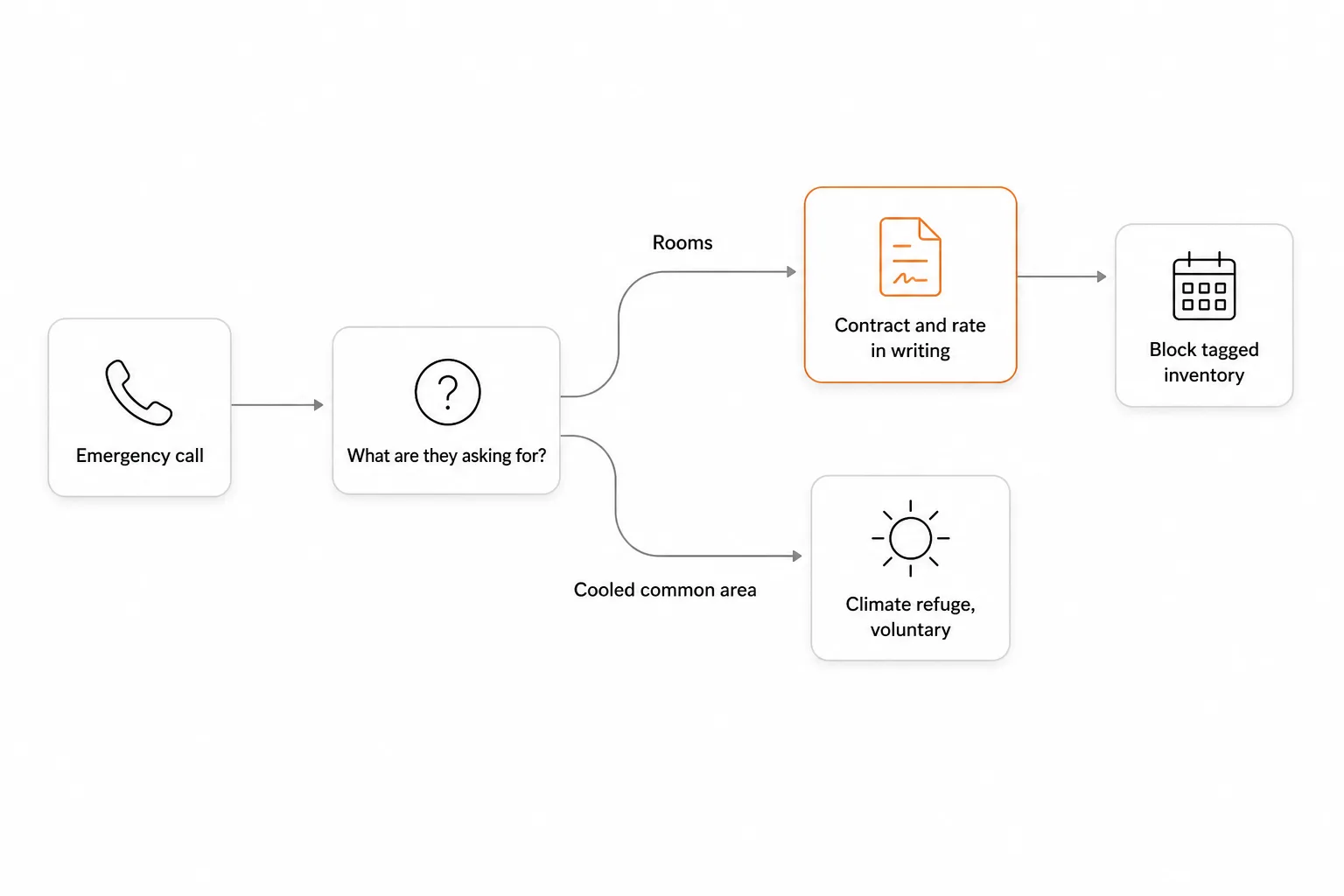
| Climate refuge | The municipality or region, during an alert | A cooled common area for a few hours | Nobody, access is free for the public |
The first you must have. The second you negotiate. The third you apply for. Mixing them up leads to blocking inventory nobody will pay for, or promising beds when all anyone wanted was your lobby open with air conditioning and drinking water.
What the law can require, and what it cannot
Ley 17/2015, Spain’s National Civil Protection System Act, devotes article 7 bis to the duties of citizens and legal entities. It is worth reading closely, because it contains two things that look alike and are paid very differently:
- Personal and material services ordered by the competent authority in an emergency, which the text frames as carrying no right to compensation for that obligation itself.
- Temporary requisition of any kind of goods, along with their transitional intervention or occupation where necessary. Here the law does recognise that those who suffer losses are entitled to compensation as provided by law.
The same article limits these measures to the time strictly necessary and requires them to be proportionate to the severity of the situation. It also adds a duty that is easy to forget: operators of facilities must inform those who may be affected about the risks and the prevention measures in place.
Alongside it, Real Decreto 524/2023, which approves the Norma Básica de Protección Civil (the basic civil protection standard), organises the system of plans (state, territorial, special and self-protection) and requires operators of certain activities to keep a self-protection plan integrated with the public ones. What neither that decree nor Ley 17/2015 does is turn every hotel into a shelter for third parties simply by existing.
Why the hotel is the manual’s second option, and why that matters
The guide to albergues provisionales (provisional shelters) published by Spain’s Dirección General de Protección Civil y Emergencias with Cruz Roja ranks accommodation alternatives in a very specific order. First, self-sheltering with family and friends. Second, establishments intended for that purpose, such as residences and hotels. Only then adapting a sports hall or an exhibition centre, and last of all an outdoor shelter, which the guide advises against on cost and on the impact it has on people.
That hierarchy matters more than it looks. The official manual places your property ahead of the hall full of camp beds. You have rooms, bathrooms, a kitchen, trained staff and access control, which is exactly what the guide describes as hard to improvise: family privacy, an administration area keeping the register, a health point, an orderly store room.
In negotiating terms: you are not asking for a favour, you are offering the option the system itself prefers. Use that to ask for clear terms, not to overcharge.
The one page you agree in advance, not at eleven at night
Prepare a single sheet and get it signed, or at least discussed, with your town hall, your regional government or Protección Civil. These are the fields that need to be closed:
- Who calls and through which channel, with a 24/7 contact in both directions.
- Capacity you can genuinely mobilise at 2, 12 and 48 hours, not your theoretical capacity.
- Accessible rooms available, and how many you can guarantee.
- Families, minors and pets: what you accept and on what terms.
- Meals: whether you provide them, on what board basis, and how medical diets are handled.
- Transport to the property and who arranges it.
- Initial duration and extensions, with a fixed review point.
- Rate or compensation, and exactly what it includes.
- Invoicing: who is billed, with what document, and on what payment terms.
- Damage, deep cleaning and insurance, including notifying your insurer.
- Security, and who provides it if reinforcement is needed.
- Public communication: who speaks to the press and what can be said.
- Data protection: what information the authority hands you and on what basis.
- Stand-down: how the operation ends and how the account is reconciled.
One warning that is worth money: do not block inventory without a guarantee of activation and payment. Holding twenty rooms “just in case” through a three-day alert that is never activated is a loss nobody will make good.
On who actually contracts, there is a useful precedent. In July 2026, during the Sierra Oeste wildfire, the Comunidad de Madrid offered hotel accommodation with meals and transport to evacuated people through an emergency contract with Cruz Roja, aimed at those with no alternative of their own or unable to return to an uninhabitable home. The hotel does not contract with the affected family: it contracts with the administration or with the entity it designates. Knowing that in advance changes the whole conversation about rates and invoicing.
The first two hours
When the call comes in, the order matters more than the speed:
- Name one owner of the operation, plus a stand-in for the next shift. Everything goes through them.
- Confirm the request in writing: who is asking, how many people, from when, with what services and who pays. An email will do.
- Block and tag the inventory in the PMS and channel manager with its own code, separate from ordinary bookings. Without a tag there is no reconciliation afterwards.
- Set up a separate reception point, away from the main desk if you can, so evacuee arrivals do not collide with your guests checking in.
- Record what you need and nothing more. The civil protection guide talks about registers and family files because an improvised shelter has nothing else. Your hotel already has a system.
- Assign within capacity limits and fire regulations. An emergency does not raise the legal occupancy of a room or a floor.
- Coordinate the delicate parts: medication, reduced mobility, minors with no identified adult, animals.
- Reconcile per shift: people and rooms, with a time and a signature. If this runs for three days, that list is your invoice.
Traveller registration does not vanish because there is an emergency
This is where improvisation is most common, so precision pays. An emergency does not automatically suspend your registration duties. Nor is the opposite true: not every institutional or free placement is treated like an ordinary tourist stay.
What you can do from minute one:
- Clarify with the authority who the contracting and paying party is. A booking in the administration’s name is not the same as a stay contracted by the person being housed.
- Ask what information the authority hands you and on what legal basis. If you receive a list, do not expand it on your own initiative.
- Document arrivals, departures and companions with your usual traceability. That is what protects you if an inspection or a claim follows.
- Minimise. Do not copy health, disability or social data you do not need to provide the service. If someone volunteers it, do not store it by default.
- If you are unsure which regime applies to a specific case, ask in writing whoever is requesting the accommodation, and check with your advisers.
For the substance of it, how the parte de viajeros (traveller report) works, what fields it carries and what deadlines apply, we already have the full explanation in the traveller register and the parte de entrada and in our guide to traveller registration. What an emergency changes is not the content of the report: it is who gives you the data and on what terms.
One operational note: if your check-in depends on someone typing at the front desk, thirty arrivals at once at three in the morning will break it. A flow that works from the guest’s phone, like online check-in, copes far better with that kind of peak, and it keeps reception free for what genuinely needs a person.
Your existing guests are still there
The least planned part, and the one that causes the most damage. Before you accept, answer this:
- Which confirmed bookings are affected, and how much notice can you give?
- Do you relocate, and to which properties? With what compensation?
- Do you close channels, or block specific room types only?
- Do you have messages ready in your source markets’ languages?
- Who reinforces reception, housekeeping and food service, and at what cost?
- Is there petty cash for urgent purchases outside your normal supplier route?
And one rule that prevents most disputes: do not move a guest who has already paid without agreeing it first with whoever is requesting the emergency accommodation. If the administration needs your rooms, the administration needs to know that this means shifting bookings, and that has a cost that belongs in the negotiation.
A climate refuge is a different thing, and a much easier one
If what you are being offered is a climate refuge, relax: nobody is asking for beds. It means opening a cooled, accessible indoor space for a few hours so people can shelter from a heatwave.
In the Canary Islands, Ashotel has coordinated a network of climate refuge hotels across the western islands. The criteria it has published for joining are sensible and concrete: a cooled and accessible indoor space, free drinking water, official programme signage, a designated responsible person and trained staff working to a specific protocol, plus an accredited carbon footprint calculation or one in progress. In return the property receives the training, the programme badge and the action protocol.
On 6 August 2026 the Canary Islands regional ministry for ecological transition and energy met Ashotel to coordinate folding that network into the future Red de Refugios Climáticos de Canarias, which has already identified more than 750 potential refuges across more than 70 municipalities. Nationally, the MITECO (Spain’s environment ministry) runs a Red de Refugios Climáticos open to both public and private spaces, with a minimum-requirements guide and a contact address for joining.
For a coastal hotel with a sharp season it is also one of the few initiatives that builds local standing in quiet months without cannibalising rate. If you are working on that, read it alongside our strategies against seasonality.
When it ends: the log, the cost and the review
The operation does not finish when the last person leaves. Close these three things in the following week:
- A consolidated daily log: people housed per night, services provided, incidents, arrivals and departures.
- Real cost: extra staff, utilities, laundry, deep cleaning, damage, lost commission and displaced bookings. Separate what was an avoidable cost from what you would have spent anyway just by keeping the hotel open.
- A protocol review: what failed, which field on your one-pager was blank, which phone number nobody answered. That document is what turns an experience into a capability.
Then do the important part: sign the formal agreement. The 14% who have one are not more generous than the 49% who would help. They simply had the conversation on a Tuesday morning rather than at eleven on a Wednesday night.
Frequently asked questions
Am I obliged to house evacuated people if the town hall asks?
Ley 17/2015 provides for a duty to collaborate when the competent authority requires it, and even for temporary requisition of goods, but these are exceptional powers bounded by proportionality and time. The normal case is a request for collaboration or a contract, not an order. Always ask for the request in writing and check with your advisers before refusing or before accepting terms you cannot meet.
If my rooms are requisitioned, do I get paid?
The law recognises a right to compensation for losses caused by temporary requisition of goods, as provided by law. That is distinct from the personal and material services the same article frames as carrying no right to compensation. Exactly where a given case falls depends on the facts, so document everything from minute one and do not sign away anything without advice.
Do I still have to file a parte de viajeros for an evacuated person?
An emergency does not by itself suspend your registration duties, and it does not automatically turn every placement into an ordinary stay either. The prudent course is to clarify with the authority who the contracting party is, document arrivals and departures as usual, and get any instruction that departs from your normal process in writing.
Can I cancel confirmed bookings to make room?
It depends on your terms, the channel and what you agree with whoever is requesting the accommodation. Moving a guest who has already paid carries cost and reputational risk, so it belongs in the negotiation rather than in the improvisation. Put in writing who absorbs the relocation and any price difference.
Is a climate refuge the same as housing evacuees?
No. A climate refuge means opening a cooled, accessible common area for a few hours during a heat alert, with free public access and an activation protocol. It does not involve giving up rooms or providing meals, and membership is voluntary.