


Search for how to keep a guest register in Spain and you will find two answers that contradict each other. One describes a numbered paper ledger you have to buy, stamp and keep under lock. The other says paper is gone and everything happens online. Both are partly right, and that is exactly why hosts get stuck.
The 2026 reality is simpler than it looks: the guest register is still mandatory, but it is no longer a book. It is an electronic record. And the parte de entrada, the traveller entry form, is still very much alive, with one specific job that most people assume disappeared: it is the document the guest signs.
This guide covers what each document is, which format the law accepts today, what data it must hold, who signs, how long you keep it and how it all connects to the submission to SES.Hospedajes (Spain’s Interior Ministry reporting platform). If what you need is the general obligation and how data reaches the authorities, that is covered in depth in the traveller registration guide; here we focus on the two documents and how you actually produce them.
Two different documents, not one
The terms get used interchangeably and they should not be. Each one has its own job and its own rule:
| Document | What it is | Where it ends up |
|---|---|---|
| Parte de entrada (entry form) | The form holding one traveller’s data, signed by that traveller | Stays with you as the record of the signature |
| Libro de registro (register) | The ordered set of all that data, now in electronic format | Kept 3 years and produced on request |
| Reporting | Sending the data to the authorities | SES.Hospedajes or the regional police platform |
The historical confusion is understandable: these used to be one single gesture. You filled the form by hand, bound it into the ledger and walked a copy to the police station. Today they are three steps on three different supports.
The paper register book is no longer required
Not as an obligation. This is the part that outdated content keeps repeating.
The rule behind the classic ledger is Orden INT/1922/2003, and that is where the details still circulating online come from: printed registers ordered consecutively, forming books of at least 100 and at most 500 sheets. That order was amended in 2021 to allow digital format explicitly, and then came Real Decreto 933/2021, whose repeal clause leaves the old order in force only “insofar as it does not contradict” the new text.
And the new text is unambiguous. Its article 5 states that the obliged parties must keep an electronic record (registro informático) containing the data listed in the annexes. Not a book, not sheets, not binding: an electronic record.
Real Decreto 933/2021 has been mandatory for tourist accommodation since 2 December 2024, so there is no transitional regime left to lean on.
The entry form: what it is and who signs it
Here the mistake runs the other way. Many hosts assume the entry form was abolished, and it was not.
Article 4 of Real Decreto 933/2021 keeps the parte de entrada as the instrument used to collect traveller data, and sets two rules worth reading twice:
- Everyone aged fourteen or over signs. Not just the booking holder: each traveller above that age signs their own form. For minors, the accompanying adult provides the data.
- The establishment provides the forms. They are not purchased or collected from any office. The accommodation generates them itself, on paper or electronically.
The signature can be captured on paper or on a digital support. A finger-drawn signature on a phone during online check-in is as valid as one in ink, with the advantage that it stays attached to the record without anyone filing anything.
What data it must contain
The exact fields live in the annexes to Real Decreto 933/2021 and fall into three blocks. Broadly:
The operator: name or company name, NIF or CIF (Spanish tax identification number), municipality and province, phone, email and, where it exists, the website or listing URL.
The property: accommodation type, name, full address, postcode, town and province.
Each traveller: first name and surnames, sex, identity document type and number along with the document support number, nationality, date of birth, address, town and country, phone, email, number of travellers and, for minors, the family relationship.
On top of that sit the transaction details: check-in and check-out dates, booking data and payment data.
The field-by-field list, split into what you ask the guest and what you fill in yourself, is in what guest data to collect for the parte de entrada, with a template to print.
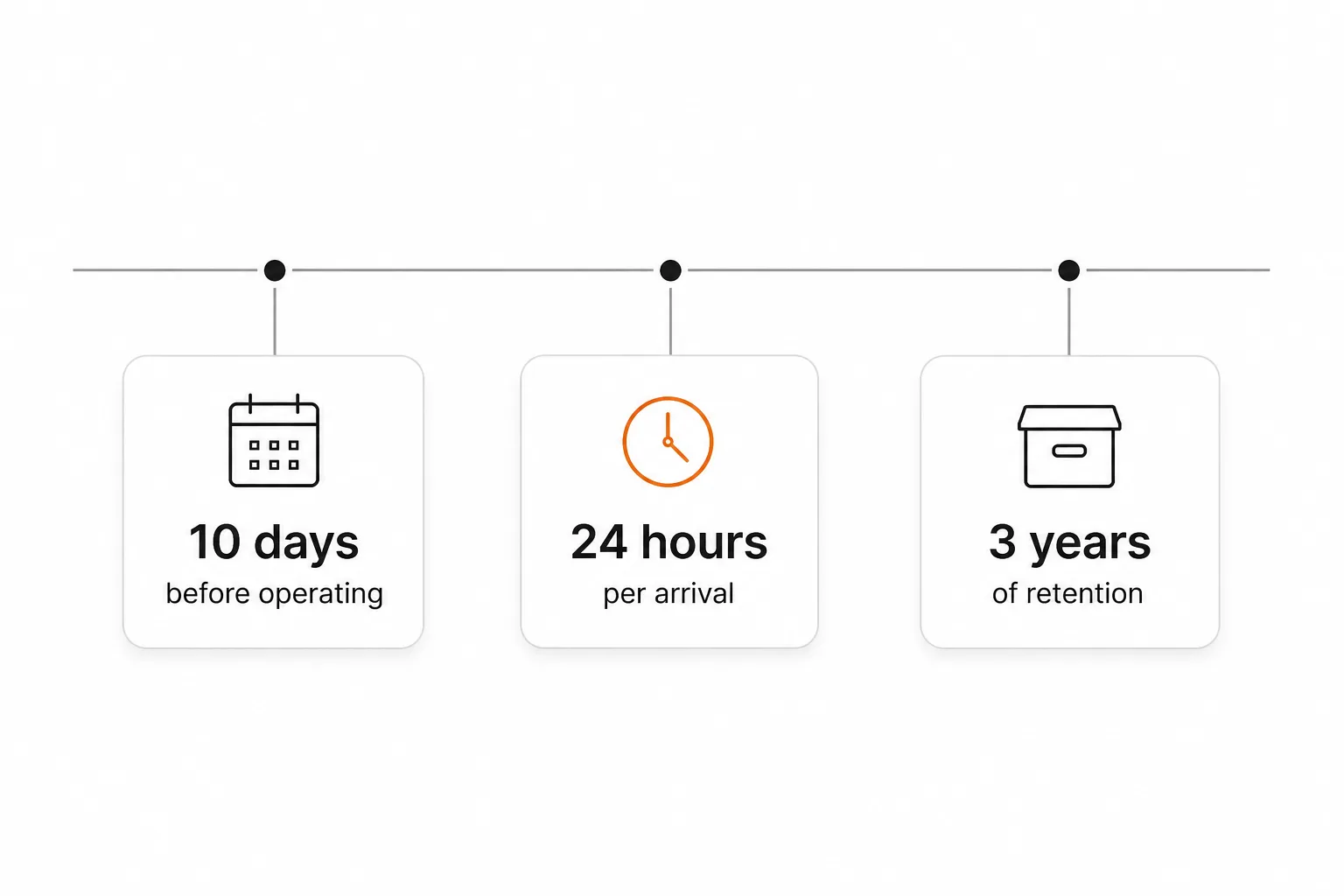
Deadlines: 10 days, 24 hours and 3 years
Three numbers for three different moments. They are the ones most often mixed up:
- Before you start operating. Operator and property data must be reported beforehand, and in any case within ten days of completing the administrative formalities required to run the activity. Any later change triggers a new report (article 6.1 and 6.2).
- With every booking and every arrival. Booking, contract or cancellation data, and the start of services, must be transmitted immediately and within no more than 24 hours (article 6.3).
- Afterwards. Electronic record data is retained for three years from the end of the stay (article 5.3).
Reporting is done electronically. Only non-professional hosting may use other means.
The non-professional exemption
Article 5.4 exempts anyone hosting on a non-professional basis from the record-keeping and retention duties. The exemption is real, but far narrower than most people hope:
- It removes the register, not the report. The data still has to be sent.
- It is not a label you assign yourself. If you rent a vivienda de uso turístico (tourist-use dwelling) regularly, listed on platforms and for profit, that is not non-professional hosting, whether you own one property or fifteen.
What does not go in the register is a copy of the guest’s document. Why you shouldn’t scan a guest’s passport, and what to do with copies you already keep, is in copying a guest’s passport or ID: what the law says.
Cataluña and País Vasco: the report goes elsewhere
The register and the form work the same across Spain, but the recipient of the report changes in the regions with their own integral police force. In Cataluña data goes to the Mossos d’Esquadra and in País Vasco to the Ertzaintza, through their own platforms, which already operated before Real Decreto 933/2021.
The point that matters if you manage properties in several regions: sending a Catalan property to SES.Hospedajes does not count. Each property reports to the system that matches its location. Confirm the exact channel on the regional police portal before registering your establishments.
How to set it up, step by step
- Register your property on the platform that applies to you and report operator and property data before you start operating.
- Build your entry form with the fields from the annexes. You can assemble it yourself or let your check-in tool do it.
- Collect data and signature from every traveller aged 14 or over, on paper or on screen. The earlier the better: online check-in lets you do it days before arrival.
- Feed the data into your electronic record, which is today’s guest register.
- Report within 24 hours and keep the receipt.
- Retain the record and the signed forms for three years. If you host on a non-professional basis you are exempt from steps 4 and 6 (article 5.4), but not from step 5: reporting still applies.
If something went wrong along the way, do not leave it: reports can be amended or cancelled, and correcting in time always beats a register carrying false data.
Frequently asked questions
Do I need to buy a stamped register book? No. Real Decreto 933/2021 requires an electronic record. The printed ledger with numbered sheets belongs to the 2003 order, which now survives only where it does not contradict the newer rule.
Does a spreadsheet count as a guest register? It meets the format requirement if it holds every field from the annexes and you keep it for three years. What it does not do is report for you or store signatures, so you are still running two manual processes.
Who signs the entry form? Every guest aged fourteen or over. Data for minors is provided by the accompanying adult. The signature is valid on paper or on a digital support.
Do I have to give the traveller a copy of the form? Handing over a copy comes from the 2003 model. Under the current system what matters is that the signed form stays in your record. If a guest asks for a copy, giving it costs nothing and is good practice.
Does reporting to SES.Hospedajes replace the guest register? No. Reporting is one obligation and record-keeping is another. The platform receives the data, but the electronic record and the signed forms stay with you for three years.
What if my property is in Cataluña or País Vasco? The register and the form are identical. What changes is the recipient of the report: Mossos d’Esquadra and Ertzaintza respectively, each on its own platform.