


Ask each guest for their name, surnames, ID document, date of birth, home address and a phone number or email. Everyone aged 14 or over signs their own form. You fill in the booking and payment details yourself.
This guide gives you the full list, field by field, and a template to print. In Spain this form is called the parte de entrada. If you want to know what it is and when it is sent, read our guide to the guest register and the parte de entrada.
The details you ask each guest for
Every person staying gets their own record, children included. These are the details:
| Detail | Who gives it | Watch out for |
|---|---|---|
| First name and surname | Everyone | Exactly as on the document |
| Second surname | Those who have one | Required with a Spanish DNI |
| Sex | Everyone | Male, female or other |
| Date of birth | Everyone | Day, month and year |
| Nationality | Everyone | As shown on their document |
| ID document type | Adults | Spanish DNI, NIE or passport |
| ID document number | Adults | No extra spaces or dashes |
| Support number | Adults with a DNI or NIE | A second code on Spanish cards. Passports have none |
| Home address, town and country | Everyone | Where they live, not where they are staying |
| Postcode | Everyone | Helps pick the right Spanish town |
| Phone or email | Everyone | One is enough, both is better |
| Relationship to the adult | Under-18s | Son or daughter, grandchild, guardian… |
Ask for everyone’s details, not only the person who booked. A group of four means four records.
The DNI is the Spanish national ID card and the NIE is the number Spain gives to foreign residents. Most of your foreign guests will simply use their passport or, if they come from the EU, their national ID card.
The details you fill in yourself
Some details come from the booking, not from the guest. You write them once:
| Detail | Where it comes from |
|---|---|
| Booking reference | Your system or the platform |
| Contract date | The day the booking was made |
| Check-in date and time | The arrival |
| Check-out date and time | The departure |
| Number of guests | How many people are staying |
| Number of rooms | If it applies to your property |
| Internet access | Yes or no |
| Payment method | Card, bank transfer, platform… |
| Payment instrument and holder | The card or account that paid |
| Payment date | When you were paid |
| Card expiry | Only for card payments |
If the booking came through Airbnb or Booking.com, the payment method is usually “platform”. The platform holds the card details, not you.
Who fills in and who signs
Age changes what each guest does. Follow the same path for every person in the group:
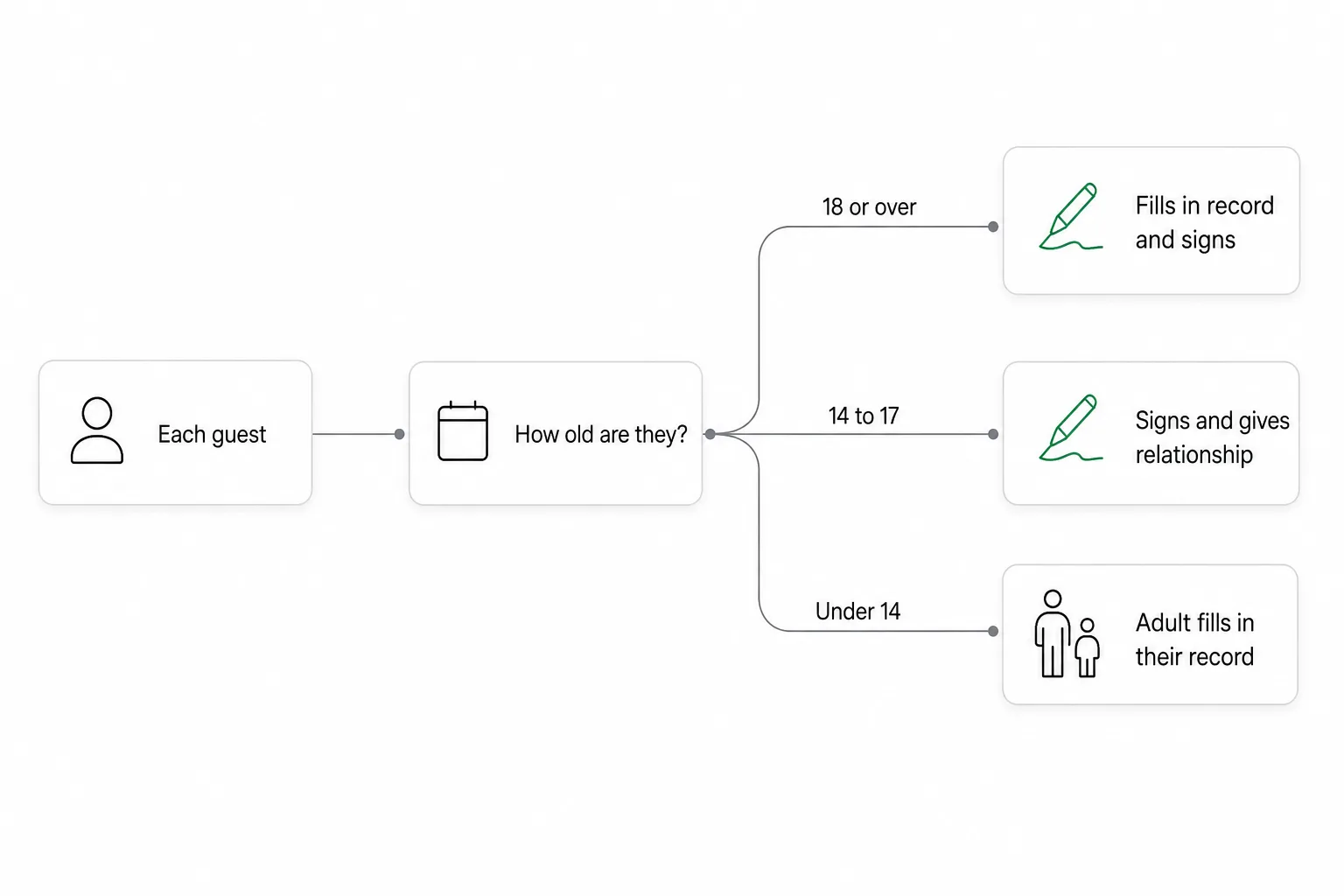
- 18 or over. Fills in their full record, with their ID document, and signs.
- 14 to 17. Fills in their record and signs. They also give their relationship to the adult they travel with.
- Under 14. The adult gives the child’s details, with the relationship. The child does not sign.
The signature can be on paper or on a phone screen. Both count.
The template, ready to use
We have put all these fields into a template. It has two PDF sheets: one for the booking and one to copy for each guest. It also comes as a spreadsheet, one row per guest.
It is our own template, not an official government form. There is no official printed form you have to buy or download. The law says which details to collect, and each property prepares its own parte.
What not to ask for
Do not ask for a photo or copy of the passport or ID card. Spain’s data protection authority, the AEPD, said so in June 2025. A copy shows more than the law asks for, such as the photo. And it still misses details the form needs, such as the home address or phone.
You can still check the document. If the guest arrives in person, looking at it is enough. For online check-in, the AEPD suggests other ways, such as a code sent to the guest’s phone or email. In how Regi handles guest data we explain why we do not keep copies either. The steps to check it without copying it, and what to do with copies you already keep, are in copying a guest’s passport or ID: what the law says.
Do not ask for details outside the list, such as job or reason for travel. The less you store, the less you risk.
Where to keep what you collect
The details go into a computer record, not a paper book. A spreadsheet works if it has every field. Keep the signed forms too.
Keep everything for three years after the stay ends, then delete it. Keeping is not the same as sending. The details also go to SES.Hospedajes, the Interior Ministry’s system, within 24 hours. How to send them is in our guest registration guide.
The most common mistakes
Most rejected forms go wrong when the details are collected, not when they are sent:
- Mixing up the support number and the ID number. They are two different codes on a Spanish card.
- Writing the property’s address. It is the address where the guest lives.
- Forgetting the children. Each child has a record and a relationship.
- Dates the wrong way round. Check-out comes after check-in, with a time on both.
If SES.Hospedajes sends a form back, SES.Hospedajes errors and how to fix them lists each message and what to do.
Frequently asked questions
Do I need details for babies? Yes. Every guest goes on the form, whatever their age. The adult travelling with the baby gives the details and the relationship.
Can a guest send a photo of their passport instead? No. The AEPD says asking for a copy is excessive. The guest should type or write their details in a form, on paper or online.
Is there an official parte de entrada PDF? There is no mandatory official form. The law sets the details and the property prepares the parte. Our template covers those details, but it is not an official document.
What if a guest refuses to give a detail? Explain that every property in Spain must collect it by law. Without it you cannot send their form, and sending it incomplete is also an offence.
How long do I keep the signed records? Three years after the stay ends. Then delete them.
Details and sources
Where the list comes from. Annex I of Real Decreto 933/2021 lists the data for accommodation. For guests it asks for first name, first and second surname, sex, ID number and type, support number, nationality, date of birth, usual residence (address, town and country), landline, mobile, email, number of guests and relationship if any guest is a minor. For the transaction it asks for the contract reference, date and signatures, check-in and check-out with times, the property’s address, rooms and internet, and the payment details (type, instrument, holder, card expiry and date).
What is required in practice. The annex does not say which fields are required for each person. The conditions in the table (a document for adults, a second surname with a Spanish DNI, at least one contact, a support number only for a DNI or NIE) are the ones SES.Hospedajes applies when it checks a form. Regi sends exactly those fields, and the template follows the same list.
Who signs. Article 4.2 says everyone over fourteen signs, and the details of under-14s are given by the adult with them. Article 4.3 makes the property responsible for the details matching the document, which the guest must show.
Register and retention. Article 5 requires a computer register with the annex data, kept for three years after the service ends. Non-professional hosts are exempt from the register, but must still send the data.
Copies of documents. The AEPD’s note of 17 June 2025 says the decree does not allow asking for a copy of the document, because it breaks the data minimisation principle.
- Real Decreto 933/2021, consolidated text (BOE, in Spanish)
- AEPD: asking for a copy of the ID card or passport in accommodation is not allowed (in Spanish)
More on the blog:
- Guest register and parte de entrada in Spain
- Guest registration in Spain: the complete guide
- SES.Hospedajes errors and how to fix them
- Guest registration app: what it should do
This guide is for information only and is not legal advice. Always check the current requirements through the official channels of Spain’s Interior Ministry and SES.Hospedajes.