

If you have been running an accommodation in a Spanish village or a rural area for years, your guest report has probably always lived in the same browser tab: hospederias.guardiacivil.es. A username, a password and a form you knew by heart.
That application is no longer where reports are sent. The Guardia Civil (Spain’s national gendarmerie) is still the competent authority across much of the country, but the channel your data travels through has changed: everything now enters through SES.Hospedajes, the Ministry of the Interior’s platform. That distinction, who receives the data versus where it comes in, is exactly what trips people up.
This guide covers what Hospederías was, what replaced it and when, how traveller registration works today if your property sits in Guardia Civil territory, and what to check if you are coming from the old system.
What the Guardia Civil Hospederías application was
Hospederías was the web application used by accommodations located in Guardia Civil territory (essentially, municipalities where the Policía Nacional has no jurisdiction: villages, rural areas and much of the coast outside the larger cities) to submit the traveller entry report. You logged in with your own credentials, filled in each guest’s details and sent them to the relevant post.
It ran alongside the equivalent Policía Nacional systems, Webpol and E-Hotel, and that was precisely the friction of the old model: two forces, two applications, and a manager expected to know which jurisdiction their property fell into. Anyone with apartments in several municipalities could end up operating two separate accounts at once.
What replaced it, and when
Real Decreto 933/2021, published in the BOE on 27 October 2021, reorganised documentary registration for the accommodation sector and created a single point of entry: SES.Hospedajes.
The transition took a while. The decree came into force in April 2022, the reporting obligation was first set for January 2023 and was postponed several times. The adaptation period ended on 2 December 2024: since that date the decree’s obligations apply in full and SES.Hospedajes is the route for guest reports across most of Spain.
Competent authority and reporting channel are not the same thing
This is the most common confusion. Hospederías falling out of use does not mean the Guardia Civil stopped receiving guest reports. It means you no longer choose the recipient: you submit once to SES.Hospedajes and the platform routes the information to the force with jurisdiction over your property.
| Where the property is | Old channel | Channel in 2026 |
|---|---|---|
| Guardia Civil territory | Hospederías | SES.Hospedajes |
| Policía Nacional territory | Webpol / E-Hotel | SES.Hospedajes |
| Cataluña | Mossos d’Esquadra | Mossos d’Esquadra |
| País Vasco | Ertzaintza | Ertzaintza |
The last two rows are not a new exception: Cataluña and País Vasco have regional police forces with their own powers in this area, and their channels were already running before the decree. Nothing changed there because SES.Hospedajes exists.
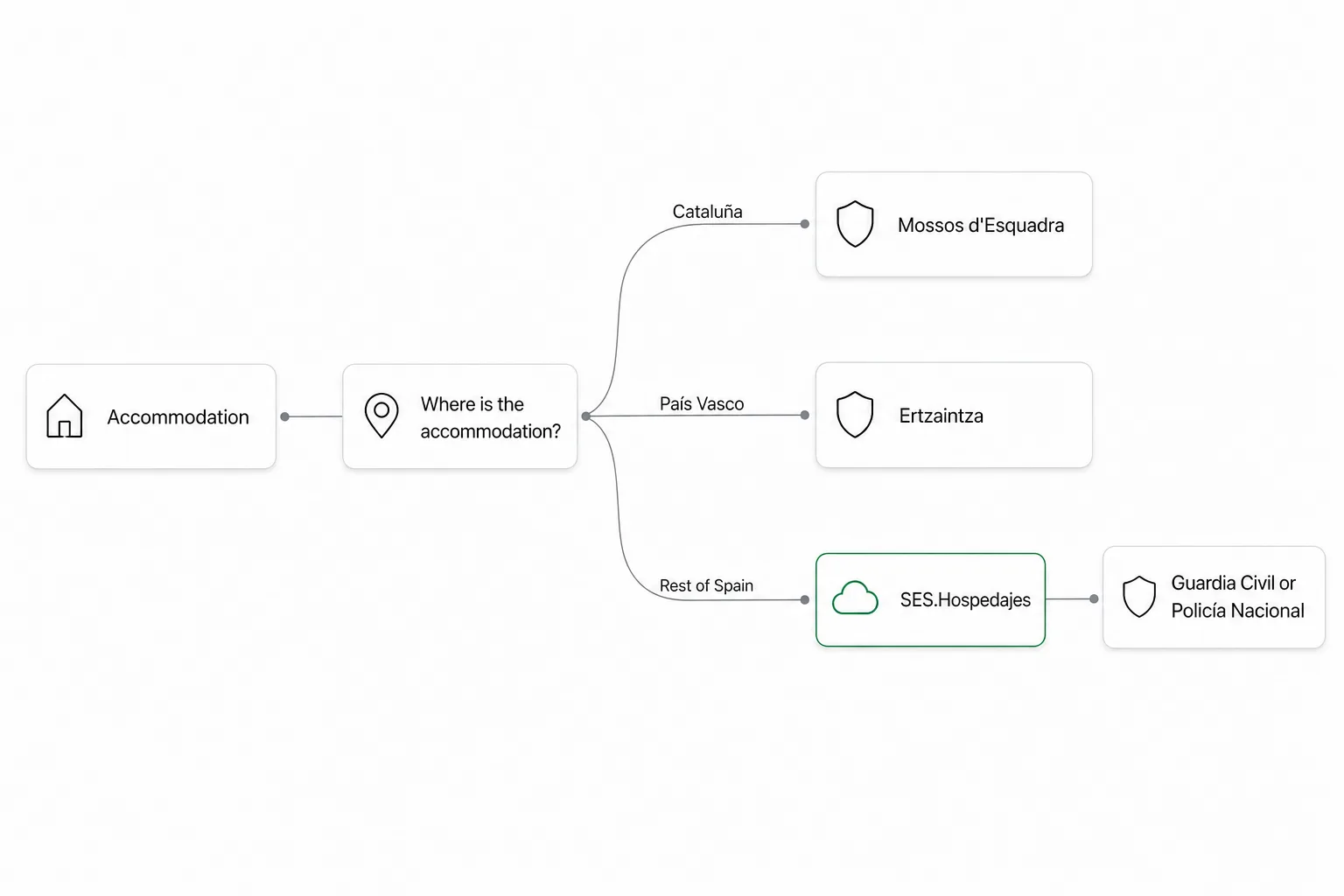
How to tell which channel applies to you
Three questions and you have your answer:
- Is the property in Cataluña or País Vasco? Then you report to the regional police through their own channel, not to SES.Hospedajes.
- Is it in any other region? SES.Hospedajes, full stop. It makes no difference whether your town is Guardia Civil or Policía Nacional territory: that routing is no longer your job.
- Did you have a Hospederías account? It does not transfer. You need your own SES.Hospedajes registration, with the electronic identification it requires, and it is worth doing before your next arrival rather than on the day.
How registration works today, step by step
- Register the establishment with SES.Hospedajes, using the electronic identification the platform requires at the time.
- Collect the guest’s data, at check-in or before arrival if you use online check-in.
- Report the data immediately and, in any case, within a maximum of 24 hours. The clock has three triggers (article 6.3 of RD 933/2021): booking data counts from the moment the booking or contract is formalised, traveller data from the start of the service, and a cancellation of the booking or contract must be reported within the same window. If you take bookings in advance, the first report is due before anyone walks through the door.
- Keep the electronic record for 3 years from the end of the service (article 5).
The field-by-field detail (what is required about the traveller, the transaction and the establishment) is set out in our guide to traveller registration and SES.Hospedajes. Two points here, because they carry over as mistakes from the old system: every guest is reported, not just the booking holder, and the data of children under fourteen is provided by the accompanying adult, stating the family relationship.
Common mistakes when coming from Hospederías
- Insisting on the old URL. If the page does not respond or redirects you, it is not a temporary outage: the procedure no longer lives there.
- Assuming your account migrated by itself. Hospederías credentials do not open SES.Hospedajes.
- Confusing the register book with the report. They are two separate obligations: the electronic record you keep for 3 years, and the report you submit within 24 hours.
- Stockpiling reports and sending them on Sunday. The clock runs per booking and per stay, not per week: every booking formalised and every arrival starts its own 24-hour clock.
- Reporting only one guest per booking. The whole party goes into the report.
- Keeping the data in a loose spreadsheet. This is a record of sensitive personal data: it needs access control and a deletion date.
What happens if you do not comply
Breaches are penalised through Ley Orgánica 4/2015 on public safety, which provides for fines of 100 to 600 € for minor infringements and 601 to 30,000 € for serious ones. Lacking the documentary record and omitting mandatory reports are the two cases that most directly affect a tourist accommodation.
Beyond the amount, sustained non-compliance is a convenient way in for an inspection, and inspections tend to pull the thread towards your tourist licence and your tax position.
How Regi handles it
With Regi, the guest fills in their details and signs from their phone before arriving, and the report goes to SES.Hospedajes on its own. There is no form to fill in by hand and no tab to remember, and the 24-hour window stops depending on whether check-in fell on a Friday night: the report goes out as soon as the guest finishes, temporary SES.Hospedajes errors are retried automatically, and a submission the platform will not accept is marked as failed with a button to retry it. What Regi does not do is guarantee the deadline: a submission to an external system can fail, so every report shows its state (sent, accepted, rejected) and it is worth checking any that never reach accepted. Reports are kept for the 3 years the regulation requires and deleted automatically.
If you want to compare options first, traveller registration apps covers what to look for, and check-in app covers the arrival experience side.
Frequently asked questions
Can I keep using my Hospederías credentials?
No. Your account in the Guardia Civil application does not transfer to SES.Hospedajes. You have to register again on the Ministry of the Interior platform with the electronic identification it requires.
Has the Guardia Civil stopped receiving guest reports?
No. It remains the competent authority wherever jurisdiction says so. What changed is the route: the data reaches them through SES.Hospedajes instead of a dedicated application.
Do I have to send the report twice, to SES.Hospedajes and to the Guardia Civil?
No. A single submission to SES.Hospedajes covers the obligation. Duplicating it adds nothing and multiplies the risk of inconsistent records.
What if my property is in Cataluña or País Vasco?
You report to the Mossos d’Esquadra or the Ertzaintza through their own channels, which existed before RD 933/2021. If you manage properties in several regions, you will be living with more than one channel.
What about the reports I submitted through Hospederías before the change?
Submissions made through what was then the valid channel do not need redoing. What you do need to keep is your own electronic record of those stays for the 3 years set out in article 5 of the decree.
Stop wrestling with the guest report
Related reading
- Traveller registration in Spain: the Interior Ministry report
- Traveller registration app: automate the guest report
- Check-in app: automatic registration and more revenue
- How to cancel a guest report you already submitted
This guide is for information only and does not constitute legal advice. Always verify the traveller registration requirements currently in force through the official channels of the Ministry of the Interior and SES.Hospedajes.