


On 4 September 2026 Spain’s official gazette (BOE) published the amendment to the VI Acuerdo Laboral Estatal de Hostelería (ALEH VI), the state-level labour agreement for the hospitality sector, signed on 11 June by the employer confederations CEHE and CEHAT and the unions FeSMC-UGT and CC. OO.-Servicios. The text runs until 31 December 2030 and touches four things a hotel, hostel, campsite or holiday-apartment company with staff will notice soon: how you dismiss, how misuse of the time clock and phones is sanctioned, which LGTBI measures are mandatory and what the company does when AEMET (the state weather agency) or civil protection issue a warning.
It is not a pay agreement. The ALEH sets common rules for the whole sector and coexists with the regional, provincial or company collective agreement that fixes your pay scale and working hours. Nor is it an emergency manual for guests: it governs the relationship with the people who work for you.
This article turns the 16 pages of the BOE into owners, deadlines and evidence. It informs and orients; it does not replace your employment adviser or your prevention service, and at several points we say what to ask them.
What changes on 4 September 2026 and what does not
The resolution of the Directorate-General for Labour of 25 August 2026 registers and publishes an amendment to the ALEH VI (agreement code 99010365011900). It changes the preamble and articles 6, 9, 10, 15, 16, 17, 38, 39, 40 and 41, updates the tables in annex I and adds two new chapters: XIII (articles 67 to 74, LGTBI measures) and XIV (articles 75 to 80, protocol for catastrophes and adverse weather events).
| What changes | What does not change |
|---|---|
| Term extended to 31 December 2030 | The nature of the ALEH: a state framework agreement, not a pay agreement |
| Two-day prior hearing before a disciplinary dismissal | Pay scales and working hours, which stay in your lower-level agreement |
| New faults for time records, phones, social media and uniforms | The maximum sanctions per type of fault (article 41.1) |
| Mandatory LGTBI chapter above 50 employees | Guest obligations and traveller registration |
| Sector protocol for weather warnings, with implementation milestones | The statutory right in article 37.3.g, which already existed |
The dates, precisely: signature on 11 June 2026, resolution on 25 August, publication on 4 September. The preamble sets the new term “from the moment of publication of this text in the BOE”. Some earlier news reports gave other signature dates; the BOE is the one that counts.
A three-step scope check
Before changing a single procedure, answer three questions.
- Do you employ anyone? Article 3 of the ALEH VI applies it to employment relationships under a contract of employment (article 1.1 of the Workers’ Statute). A self-employed host who runs their own rental with no staff is not covered by listing it; if they hire someone for cleaning or reception on an employment contract, they are.
- Is your activity in article 4? The functional scope expressly lists hotels, hostels, residences, “dwellings marketed for tourist purposes”, apartments providing any hospitality service, spas, hostels, guesthouses, motels, rural accommodation, campsites and, in general, any establishment providing lodging services.
- Which collective agreement applies alongside it? The ALEH is a framework agreement (article 10). The new paragraph 8 adds the LGTBI protocol and the catastrophe protocol as matters of the agreement “although not exclusively reserved”, which “shall be complemented and developed at lower bargaining levels”. Reading the state framework is not enough: your regional, provincial or company agreement may specify deadlines, kits, training or protocols, and if you run properties in two regions you may end up with two different developments of the same chapter.
A two-day hearing before a disciplinary dismissal
This part was not invented by the ALEH. Supreme Court ruling 1250/2024 of 18 November (full chamber, unanimous) held that an employer cannot dismiss on disciplinary grounds without first giving the worker the chance to defend themselves, applying article 7 of ILO Convention 158 directly, with effect for dismissals after the ruling was published. The ruling itself allows an exception: where the employer “cannot reasonably be expected” to grant that hearing.
What is new is that article 41.3 of the ALEH turns that principle into a concrete procedure:
- The company must inform the worker of the facts alleged and their possible legal classification before handing over the dismissal letter.
- It does so through the channel it usually uses to communicate with staff (email, internal app, a letter in hand).
- The worker has two days to reply by whatever means they choose, including through union or works council representatives.
- During those two days they keep working as normal, unless the company informs them that the days count as paid leave; only then can it apply temporary measures such as suspending access to the site or to the corporate email, or asking for work tools back for the time being.
- Once the deadline passes, the company may go ahead with the dismissal “or any other decision it considers”.
All of this adds to, and does not replace, the requirements of article 55.1 of the Workers’ Statute: written dismissal stating facts and effective date, a contradictory file if the person is a staff representative, and a hearing of union delegates if membership is known.
Time clock, phones and social media: the new grading of faults
Articles 38, 39 and 40 add conduct that did not exist in the 2023 text and that responds to mandatory working time records and the use of devices. Maximum sanctions do not change: they remain those of article 41.1.
| Conduct | Grade | Article | Maximum sanction (article 41.1) |
|---|---|---|---|
| Two breaches or bad practice in the working time control and record system | Minor | 38.10 | Warning or suspension of up to two days |
| Using a phone, social media or devices during the shift without authorisation, except in an emergency | Minor | 38.12 | Warning or suspension of up to two days |
| Three to four breaches or bad practice in the time record system | Serious | 39.21 | Suspension of three to fifteen days |
| Appearing on social media in the company uniform on one’s own initiative without consent | Serious | 39.22 | Suspension of three to fifteen days |
| Five or more breaches or bad practice in the time record system | Very serious | 40.14 | Suspension of sixteen to sixty days or dismissal |
| Defaming the company name or brand on social media | Very serious | 40.15 | Suspension of sixteen to sixty days or dismissal |
The text also adds minor damage to equipment through misuse (38.11), using goods or premises for private purposes (39.6) and breaching the smoking ban (39.20). Two cautious examples: a housekeeper who twice in a month clocks out late because she forgot fits 38.10, and a written warning is the ceiling; a receptionist answering personal messages on a phone with no authorisation fits 38.12, but if the phone is the work tool or a general authorisation exists there is no fault. Defaming the company online is a different matter, and 40.15 itself is “without prejudice to the exercise of fundamental rights”.
What the table does not do: it does not authorise blanket monitoring of phones or email, does not remove proportionality, does not replace a written internal policy on clocking and devices, does not waive the burden of proof, does not touch privacy and does not skip the prior hearing if the sanction is dismissal. If your lower-level agreement has its own disciplinary rules, your adviser will need to cross-check both.
Protocol for adverse weather events (chapter XIV)
Chapter XIV grew out of the October 2024 DANA floods and Royal Decree-law 8/2024, which added the article 37.3.g leave to the Workers’ Statute. It applies in every establishment under the ALEH (article 76), always “for the protection of workers”, and may be developed at each lower bargaining level.
Warning, alert and assessment: three different things
The protocol adopts AEMET’s warnings (article 77) and reproduces its table of levels (article 78). Keep three pieces apart:
| Piece | Who issues it | What it means for the shift |
|---|---|---|
| Weather warning (yellow, orange, red) | AEMET, by zone and threshold | Information about forecast hazard. Under a red warning: “do not travel unless strictly necessary” |
| Alert, restriction or official notice | Competent authority (civil protection, government, town hall) | Triggers the duty to report and not travel, and the paid leave |
| Preventive assessment | Site management and the prevention service | Decides concrete measures (close outdoor work, shelter, reassign tasks) based on the above |
A colour on its own is not an automatic closure. Article 78 says so indirectly: the company takes into account “the last alert issued by the competent authority before the start of the shift”, and whoever receives “an official notice from a competent authority” that travel is impossible must inform the company and not travel. AEMET’s red warning demands extreme caution; the order not to travel comes from the authority.
The shift flow: before, during and at the end
With that vocabulary, chapter XIV can be read as a flow per shift.
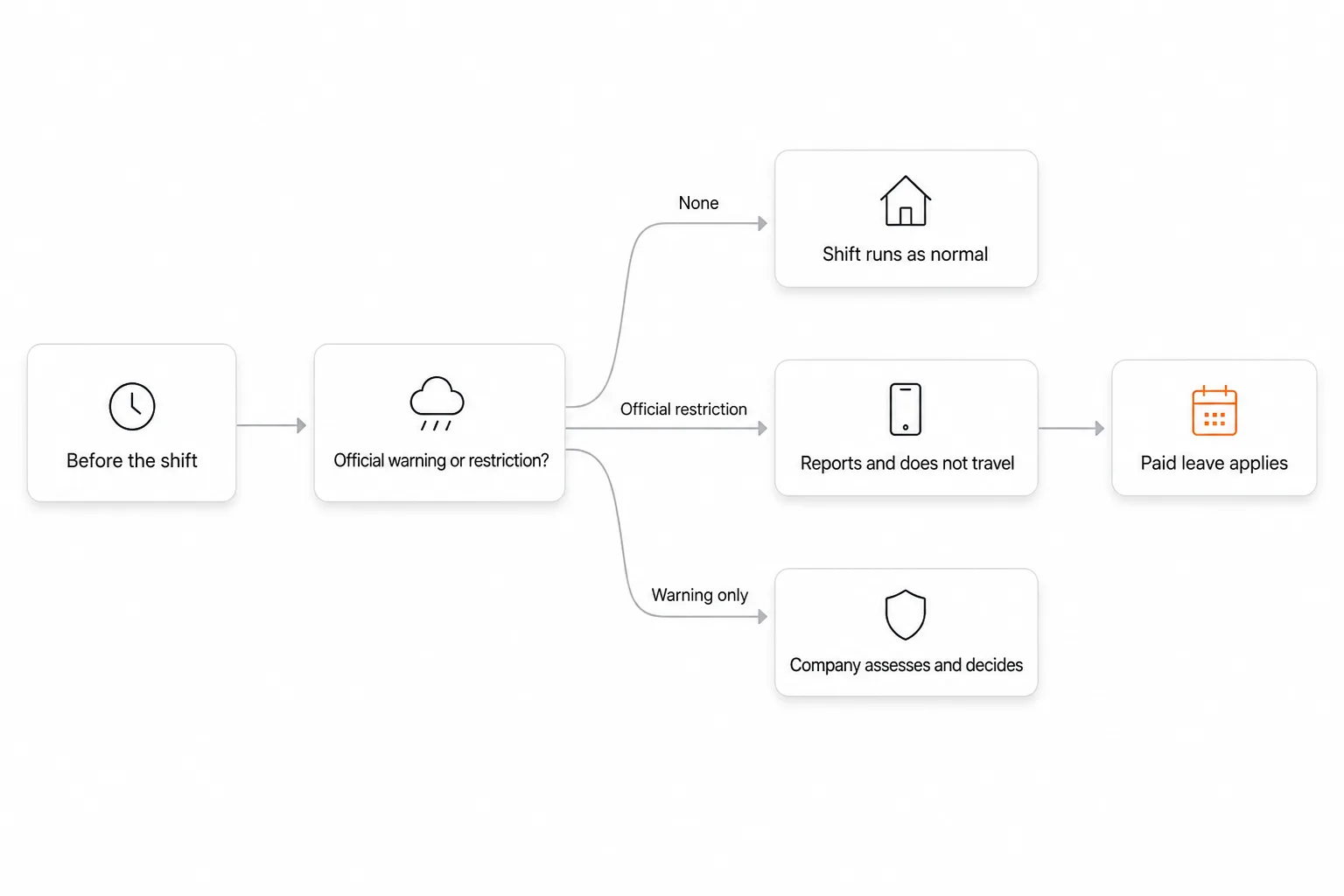
Before the shift
- Whoever runs the site (or, if absent, regional management) and the prevention service must have constant information on road closures, flooded or floodable areas and landslides (article 79). Assign one person to check AEMET and your region’s civil protection channels before each shift during an alert.
- If the worker receives an official notice that travel is impossible, they must inform their managers and avoid travelling to the workplace (article 78).
- If there is no restriction but there is a warning, the company assesses and decides which measures to adopt, “following the indications of the competent authorities”.
During the shift
- If the alert arrives while at work, the worker is offered the option of staying on site until it ends, and the company provides shelter and protection in its facilities “within its means”.
- Time spent on site beyond the working day is not counted as working time, except in cases of force majeure.
- Anyone who chooses to leave while a government order bans travel does so at their own risk and must leave that decision recorded in writing.
- If a new alert allows travel, the worker returns “as soon as possible”.
At the end
- Anyone unable to travel to their post must report it as soon as possible, giving detailed reasons. Keep that message: it is the evidence for the leave.
- Before reopening, affected facilities must be checked (water near electrical equipment, false ceilings, landslides) “in the shortest possible time”.
The paid leave in article 37.3.g
Read it in the Statute, not in a summary. Article 37.3.g grants paid leave of up to four days “for inability to reach the workplace or to travel along the roads needed to get there, as a result of recommendations, limitations or prohibitions on travel established by the competent authorities, and also where there is a situation of serious and imminent risk, including those arising from a catastrophe or adverse weather event”. After the four days, the leave “shall be extended until the circumstances that justified it disappear”, without prejudice to the company applying a suspension or reduction of hours for force majeure under article 47.6. If the job can be done remotely and the networks work, the company may set that up.
The ALEH lands it for hospitality (article 79): where there are “restrictions, limitations or prohibitions on travel or situations of serious (RED WARNING) and imminent risk officially established by a public authority”, workers may take the leave “for the time set by the red warning and for a maximum of four days”.
Two reading cautions:
- Do not shrink the right to “red warning only”. The law speaks of official recommendations, limitations or prohibitions and of serious and imminent risk. The ALEH’s parenthesis illustrates the typical case; the higher rule is the Statute.
- Do not promise four days for any rain. The leave requires an inability to reach or travel that originates in an official measure or a serious and imminent risk, and it lasts as long as that circumstance lasts, with a four-day cap before the article 47.6 regime.
Implementation milestones
Article 79 sets three time references. Watch the anchor of each one, because they differ:
| Measure | Wording of the text | Indicative date | Verb in the BOE |
|---|---|---|---|
| Detailed evacuation plans per location (routes and safe assembly points) | Six months “from the entry into force of this plan” | 4 March 2027, if the plan enters into force on publication | Stated with a deadline |
| Emergency kit per site (torches, batteries, first-aid kit, thermal blankets) | Twelve months “from the entry into force of this plan” | 4 September 2027, under the same assumption | ”Shall be provided” |
| Training module on evacuation routes, not compulsory | Twelve months “counting from the signature of this agreement” | 11 June 2027 | ”Must be available” |
The dates in the third column are a reasonable reading, not a certainty: the text says “entry into force of this plan”, and the agreement enters into force on publication. Before turning them into internal deadlines, ask your adviser which date governs each sentence and whether your lower-level agreement develops them. The training module is “not compulsory” for the person receiving it, but the duty to have it available does carry a deadline.
Obligation, illustrative measure and recommendation
Article 79 presents its list of preventive measures “by way of example and not exhaustively” as measures that “may be adopted”, and inside that list mixes verbs. Article 80 is titled, plainly, “Recommendations”. This reading by verb helps you prioritise; the final interpretation belongs to your adviser and your prevention service.
| Content | Wording in the BOE | How to treat it |
|---|---|---|
| Constant information for management and prevention under a red alert | ”Must have” | Organisational obligation |
| Report and do not travel after an official notice; report inability to travel | ”Must inform”, “must report” | Worker’s obligation |
| Check facilities after the event; reassess by the prevention service; monitor health | ”Must be checked”, “must be reassessed” | Preventive obligation |
| Evacuation plan, kit, training module | Express deadline | Dated commitment |
| Assess sites in floodable areas; protect outdoor work | ”Shall assess”, “measures shall be adopted” | Obligation tied to the risk assessment |
| Internal communication channels during the emergency | ”Efforts shall be made” | Expected measure, no deadline |
| Shelter on the premises when leaving is unsafe | ”Shall be offered”, “within its means” | Illustrative measure |
| Mark wet areas, ventilate, keep wet equipment off, disinfect, PPE | Tasks “after the catastrophe” | Joint work of management, prevention and staff |
| Stay informed, avoid outdoor work, take extra care in vehicles | Article 80 | Recommendation |
One operational detail: company decisions are communicated “as soon as possible” by site management or the prevention service to staff representatives, prevention delegates and every affected worker. That channel must work without corporate email and without electricity: a messaging group with consented personal numbers and a printed list of alternative contacts.
LGTBI measures (chapter XIII): by company size, not by establishment
Chapter XIII applies Law 4/2023 and Royal Decree 1026/2024. Its article 67.2 makes it mandatory for companies with more than fifty employees under the ALEH, and voluntary for the rest. The threshold is “more than 50”, not 50, and it is measured per company, not per hotel or building.
How to count, under article 3 of RD 1026/2024:
- The company’s total headcount, whatever the number of sites and the type of contract, including permanent-seasonal (fijos discontinuos), fixed-term and agency (ETT) workers.
- Each part-time worker counts as one person, regardless of hours.
- Fixed-term contracts that ended in the previous six months are added: every hundred days worked, or fraction, counts as one more person.
- The count is taken on the last day of June and December, and once the negotiating committee is set up it stays fixed for the life of the measures, even if headcount falls below 51.
With seasonal staff and a high season, a group of three mid-sized hotels can cross the threshold without any single establishment doing so on its own. Whether you cross it requires a formal calculation, not a front-desk estimate.
What the chapter requires of companies that are covered:
- Recruitment (article 70): no invasive questions about personal or family life; questions on sexual orientation, gender identity or expression, sex characteristics or family group are prohibited; objective and neutral criteria; social media checks only for professional purposes and with the candidate informed about the data processing.
- Career and performance (article 71): objective criteria in promotion and appraisal, respectful language in documentation, training for anyone who manages staff, and a ban on taking LGTBI status into account in any termination.
- Training (article 72): specific modules in training plans, aimed at the whole workforce, including people with responsibility for staff.
- Anti-harassment protocol (article 74): covered companies must include one; if they do not draw up their own, the protocol in annex II of RD 1026/2024 applies, and it reaches everyone working within the company’s organisation as well as applicants, agency staff, suppliers, customers and visitors.
If you are below the threshold, nothing stops you adopting the chapter; and if your regional agreement already includes planned measures, article 67.2 respects the units that “already have one”.
A 30-day checklist
For a small company, what matters is named owners and simple templates that work outside corporate email during an emergency.
- Confirm which lower-level agreement applies and whether it develops chapters XIII and XIV.
- Calculate headcount under RD 1026/2024 with data as of 30 June and 31 December.
- Appoint, per site, a deputy manager and a prevention lead with a consented personal phone number.
- Inventory locations, access routes, floodable areas and outdoor work.
- Draft the evacuation plan per location, budget the kit per site and set the target dates.
- Set up the internal communication channel and the printed list of alternative contacts.
- Update the disciplinary procedure with the two-day hearing and publish the clocking and devices policy.
- Review recruitment, appraisal, training and the LGTBI protocol if you cross the threshold, or decide whether to adopt it voluntarily.
- Brief managers and staff representatives, and keep a record of the session.
- Keep versioned evidence: communications, drills, facility checks, dates.
Reception when part of the team cannot get in
A property does not close because half the team is on paid leave: guests are already inside and keep arriving. The plan needs a safe minimum staffing level per shift, a lawful redistribution of tasks within what the collective agreement and the risk assessment allow, and a delay or schedule change message that goes out on its own. What it cannot include is asking anyone to travel against an official restriction.
Digital tools help here, with two clear limits: they communicate and keep evidence, but they do not decide for the company or replace preventive judgement. An online check-in lets a guest arriving in the middle of an alert complete their registration from their phone without anyone crossing a closed road, and the check-in link with a QR code fits in a three-line message. The duty to register travellers and report to SES.Hospedajes (the Spanish police registration platform) is not suspended by bad weather; how to meet it without a staffed desk is covered in the guide to traveller registration and RD 933/2021. For out-of-hours arrivals and bookings that look like no-shows, the same protocol we prepared for EES-related delays applies.
How to host evacuated people or coordinate with civil protection is a different subject with different rules; this article stays with the workforce.
Frequently asked questions
Does the ALEH VI raise hospitality wages?
No. The ALEH is a state framework agreement that organises common matters (job classification, disciplinary rules, equality, protocols). Wages, hours and most concrete conditions are negotiated in the regional, provincial or company agreement that applies to you.
I run my holiday rental with no employees. Am I affected?
No, as long as you employ nobody under a contract of employment (article 3). If you hire someone for cleaning or reception on an employment contract and your activity falls within article 4, then yes.
Does an orange AEMET warning entitle staff to the paid leave?
Not on its own. Article 37.3.g requires that the workplace or the roads needed to reach it cannot be accessed because of official recommendations, limitations or prohibitions, or that a serious and imminent risk exists. The warning colour is information; what triggers the leave is the official restriction or that risk. Document the authority’s communication.
Do I have to give the two hearing days as paid leave?
Not necessarily. Article 41.3 says the worker keeps working as normal during the two days, unless the company tells them the days count as paid leave. Only in that case can it apply temporary measures such as suspending access to the site or to corporate email.
I have 48 permanent staff and 12 seasonal workers in high season. Is the LGTBI chapter mandatory for me?
Probably yes, but it has to be calculated. RD 1026/2024 counts total headcount including permanent-seasonal, fixed-term and agency workers, part-timers as one person each, and adds fixed-term contracts that ended in the previous six months. Run the formal count as of 30 June and 31 December before deciding.