


From 7 September 2026 the external border crossings of the Schengen area lose the safety valve that let them stop taking fingerprints and facial images for up to six hours when queues got out of hand. The Entry/Exit System (EES) itself does not change: what lapses is a temporary exception that several European airports have leaned on this summer.
Your hotel, hostel or holiday rental does not run the EES and cannot shorten the queue. But it inherits the consequence: the guest who used to land at 20:10 and ring the bell at 21:00 may now turn up at 23:30, transfer gone, phone dead, reception closed. That is no longer a border problem. It is an operations problem.
This article separates what changes from what does not, clarifies who is affected, draws the line between the EES and the traveller registration that is actually yours, and leaves you with an international arrival protocol that keeps working long after the date.
What changes on 7 September 2026 and what does not
The Entry/Exit System began its progressive rollout on 12 October 2025 and, according to the European Commission, has been running at every external border crossing point since 10 April 2026. It replaces the passport stamp with an electronic record holding travel document data, a facial image, fingerprints and the date and place of each entry and exit.
To soften the launch, Regulation (EU) 2025/1534 allowed member states to partially suspend the system at a given crossing point when traffic became so intense that waiting times were excessive: for up to six consecutive hours biometrics were not captured, while the entry was still recorded. That option opened for 90 days from full operation, with a 60-day extension to cover the summer. The clock runs out in the first week of September: industry sources cite 6 September as the last day it can be used and 7 September as the first day without it.
| What changes on 7 September | What does not change |
|---|---|
| The queue-driven partial suspension is no longer available | The EES works exactly as it has since April |
| Border posts must capture biometrics from every liable traveller | Who is liable and who is exempt |
| Waiting-time risk at traffic peaks may rise | Contingency rules for a technical failure of the system |
| Nothing at the accommodation | Your traveller registration duty and reporting to SES.Hospedajes |
Two caveats to avoid overstating things. First, the end of the exception does not cause queues on its own; waits depend on the airport, the volume, staffing and the kiosks available. Second, September and October remain heavy-traffic months at Spanish airports, so the change lands while the load is still high.
Who the EES applies to and who it does not
The EES applies to non-EU nationals entering the Schengen area for a short stay (up to 90 days in any 180-day period). In practice: the British, American, Canadian, Brazilian or Moroccan guest landing in Málaga from outside Schengen.
According to the Commission’s official information, the following are outside its scope:
- Citizens of the EU, plus Iceland, Liechtenstein, Norway and Switzerland.
- Nationals of Andorra, Monaco, San Marino and the Vatican.
- Non-EU nationals holding a long-stay visa or residence permit issued by a Schengen state.
- Family members of EU citizens holding a valid residence card, among other categories.
Three distinctions that prevent mistakes when you scan your bookings:
- Nationality and flight origin are not the same thing. A Canadian arriving in Palma from Frankfurt already went through the EES in Germany; there is no border control in Palma.
- The EES is passed once per entry into Schengen, not on every leg. Internal flights and trains do not trigger it.
- The date of entry into the Schengen area is what the record cares about, not the date of your booking.
EES and SES.Hospedajes: two registers that never touch
This is the confusion that can do the most damage. The EES and Spain’s traveller registration share one thing: both take data from a passport. In everything else they are independent systems with different rules, authorities and purposes.
| Aspect | EES | Traveller registration (SES.Hospedajes) |
|---|---|---|
| Who does it | Border authority of the state of entry | The accommodation |
| When | On crossing an external Schengen border | On checking in, within the legal deadline |
| Data | Document, facial image, fingerprints, entry and exit | Identity, document, dates and stay details |
| Legal basis | EU regulations | Royal Decree 933/2021 plus regional rules |
| What you must do | Nothing | Identify the guest, sign the report and file it |
What an accommodation must not do because of the EES: ask the guest for fingerprints, biometric photos or “the EES receipt”; promise a fast border crossing; or try to verify the guest’s border record. None of that exists as a lodging obligation, and asking for data you do not need is a data protection problem, not diligence.
What stays exactly the same: identifying the traveller, the entry report and its submission. How that works, with which fields and deadlines, is covered in the guide to traveller registration and Royal Decree 933/2021; the format of the report and the register, in the post on the traveller register and entry report. This article does not repeat it.
Why the accommodation inherits the problem
This summer produced enough evidence to take the issue seriously. The airports association ACI Europe documented waits of up to five hours at peak times, and the British press, citing airline data, named Tenerife Sur, Palma, Alicante and Málaga among the airports with prolonged queues. In Spain, according to trade press, an internal threshold of around 25 minutes of waiting has been used to trigger contingency measures (priority lanes for families and passengers with reduced mobility, adjustments with slot coordinators). It is not a published rule, and it should be read as what it is: an operational reference.
For you, every hour of queue turns into a chain of small failures:
- Out-of-hours arrivals. The guest expected at 21:00 shows up at 23:30 or 01:00.
- Bunched reception. Several affected flights unload at once and a desk that handled two arrivals an hour now faces eight.
- Failed transfers. The driver waited, left, and the guest has no idea how to get there.
- Apparent no-shows. A booking that looks like a no-show and is actually standing in the terminal queue.
- Guests without instructions. Phone at 3 % and no idea whether the door opens with a code or a key.
None of those failures needs new technology. They need decisions made in advance.
Before arrival: a flow for international bookings
The goal is simple: a guest who will cross an external border should have every piece of information before boarding, and you should know how to reach them if they are delayed. Six steps.
- Spot arrivals from outside Schengen without over-profiling. The useful data point is the arrival flight or port, not nationality. If your system allows an optional “flight or transport number” field, ask for it in the confirmation; otherwise ask in the pre-arrival message. Do not ask for nationality or sensitive data the operation does not need.
- Send a factual notice with the official link. Three sentences: a new entry control exists, there may be waits, and here is where to check whether it applies. No alarmism, no interpreting their case.
- Bring the online check-in forward. If the guest fills in their details and signs before flying, a late arrival is just a key handover. The ideal moment to slip it in is the booking confirmation email, and the mechanism, a mobile-friendly check-in link with a QR code.
- Confirm a contact channel that works while roaming. WhatsApp or email, plus an emergency phone for the property. Make sure the guest can receive messages abroad.
- Explain what happens if reception closes. Desk cut-off time, alternative access and how to let you know.
- Set a cut-off time for reporting delays. “If you have not arrived or messaged us by 22:00, we switch to the late-arrival procedure.” That one sentence removes most of the 2 a.m. calls.
Pre-flight message template, to adapt:
Hi [name]. We look forward to welcoming you on [date] at [property]. Since 2026, entry into the Schengen area for travellers from outside the EU is recorded through the Entry/Exit System (EES), and some airports may have waits on arrival. You can check whether it applies to you on the official portal: travel-europe.europa.eu/ees. To make your arrival quick, please complete your online check-in here: [link]. If your flight is delayed or you think you will arrive after [time], message us at [WhatsApp or phone] and we will hold your booking and send access instructions. Safe travels.
If you also send a welcome letter with house rules and access details, this message shrinks to the three EES sentences and the check-in link.
Reception and access: preparing the critical window
On the property side, five pieces:
- A daily arrivals board. Booking, expected time, flight, flight status, last contact and who is responsible. A shared spreadsheet is enough; the mistake is not having one.
- Scalable cover. In hotels and hostels, reinforce reception between 21:00 and 01:00 on days with several affected flights. In holiday rentals, one reachable person with access to the board.
- Self check-in with a safe fallback. A code lock or key box for late entry, and a plan B for when it fails (a second box, a trusted neighbour, a concierge service). Sending the code only once the guest confirms they are on their way lowers the risk.
- Short multilingual instructions. How to get from the airport at that hour, where the access is, what to do if it does not work. In the guest’s language and in English.
- A protocol for vulnerable groups. Families with small children, unaccompanied minors and guests with reduced mobility should not reach a key box at 01:00 with nobody there. For those bookings, assisted arrival even if it costs.
Reply template for a guest messaging from the border queue:
Thanks for letting us know, [name]. Your booking is safe and we are expecting you. When you get through, message us “on my way” and we will send the access code and map. If you arrive after [time], access is [short instruction]. Any problem, call [phone]. No need to rush.
And one detail that gets forgotten: if you contract transfers, tell the driver how border waits are handled and who pays for the extra time. Better to decide today than argue at 23:00.
Delay or no-show: when the booking changes status
The most expensive question this season will be this one: at what point does a “delayed” booking become a “no-show”, with everything that implies for charging and for releasing the room? The answer is not in the EES. It lives in your policy, in the booking contract and in the trace of what you did.
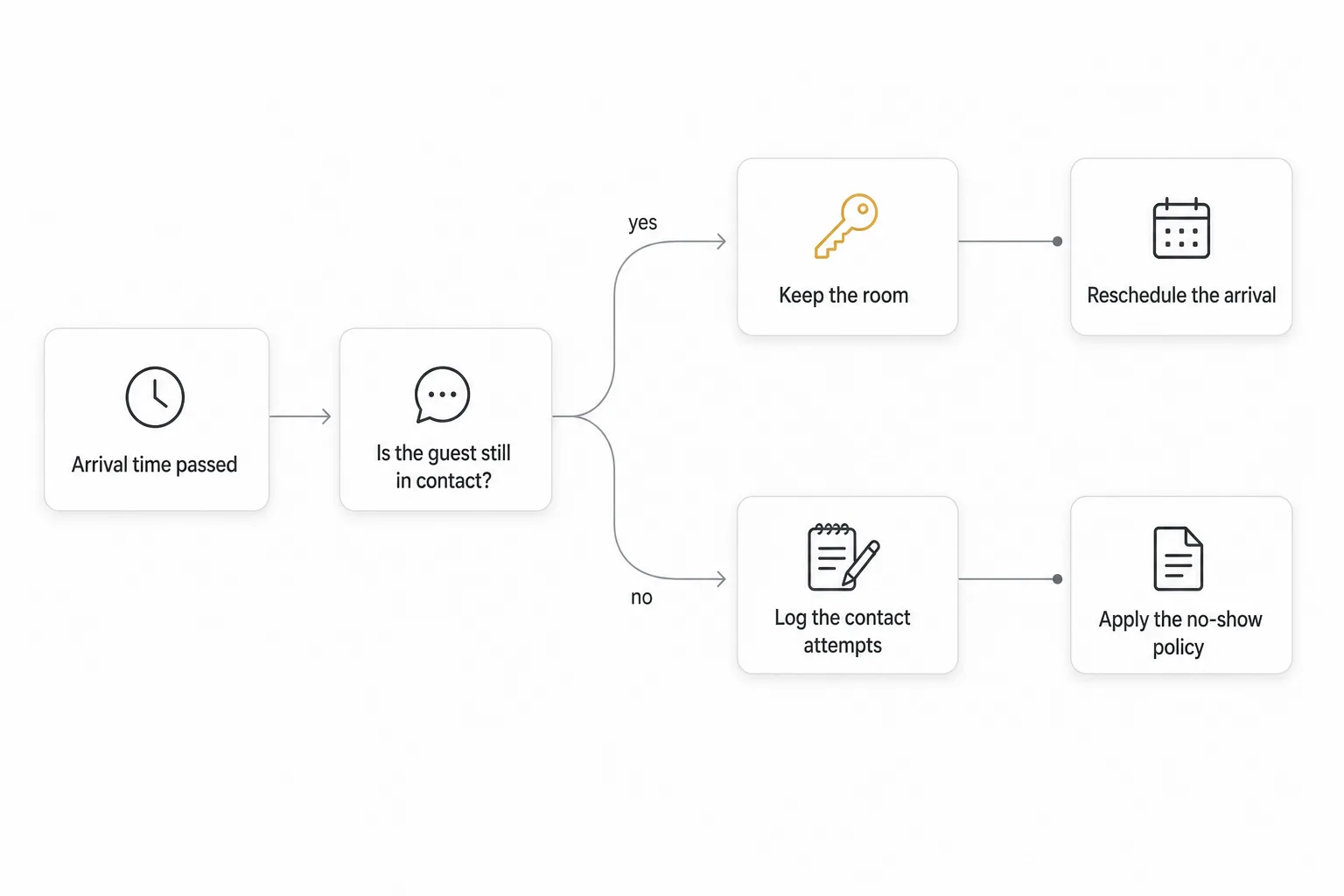
Four practical rules:
- Write the rule down. For example: a booking is a no-show when X hours have passed since the arrival cut-off, at least three contact attempts have been made through two channels, and there is no reply and no delayed flight that explains it.
- Log every attempt. Time, channel, content. If there is a dispute later with the guest, the OTA or the bank, that list is your evidence.
- Check rate, intermediary and insurance before charging or releasing. A non-refundable OTA rate, a flexible direct booking and an agency booking are not handled the same way, and the traveller’s insurance may cover a night lost to delay.
- Keep the room while the flight shows as delayed and the guest stays in touch. It is the cheapest decision of all: a night sold twice costs reputation, refunds and time.
A seven-day plan to get it done
It does not need a project. It needs one week and one owner.
| Day | Task |
|---|---|
| 1 | Audit bookings for the next six weeks arriving via an airport or port with an external border |
| 2 | Update two automations: the pre-flight message and the “running late” reply |
| 3 | Test out-of-hours access end to end, with someone who does not know the property |
| 4 | Agree with reception or your on-call person who decides what, and until what time |
| 5 | Write the no-show rule and the checklist to run before charging |
| 6 | Bring forward the online check-in of every international booking arriving within two weeks |
| 7 | Set up the arrivals board and decide what you will measure |
What to measure through the autumn, to know whether the protocol works or is overkill:
- Expected versus actual arrival time, by flight origin.
- Avoidable contacts: calls and messages a prior instruction would have resolved.
- Assisted out-of-hours arrivals and their staffing cost.
- Access incidents (codes that fail, empty boxes, guests at the door).
- Real no-shows versus delays that eventually checked in.
If late arrivals do not rise within four weeks, you can ease off the cover. If they do, you have the data to adjust hours instead of improvising. Either way, the protocol keeps its value as an international arrival procedure after 7 September: the date is the trigger, not the reason.
Frequently asked questions
Do I have to ask my guests for any EES document?
No. The EES is run by the border authority and produces no receipt the accommodation must request, keep or report. Your obligation remains traveller registration: identify the guest, complete the report and file it with SES.Hospedajes.
Does a British guest arriving from Paris go through the EES in Spain?
Usually not. The EES check happens on crossing the external Schengen border, in that case in France. An internal Schengen flight does not trigger it again. That is why the useful field for your arrivals board is the flight origin, not nationality.
Can I charge the night if the guest does not arrive because of a border queue?
It depends on the rate conditions, the booking channel and what can be documented. A border wait neither turns the booking into a no-show automatically nor forces a refund. Write your rule down, log your contacts and read the contract before deciding.
Is the EES the same as ETIAS?
No. The EES is the electronic entry and exit record that replaces the passport stamp and is already running. ETIAS is a pre-travel authorisation for visa-exempt travellers, on its own timeline and not yet required. Link the official portal and keep the two apart in your messages.
What if the Commission extends the flexibility after all?
The protocol stays useful. The partial suspension only kicked in at specific peaks and for six hours at most, so waits have existed all summer regardless. A well-built international arrival flow serves you with or without an extension.