


On 14 August 2026 the Canary Islands official gazette (BOC) published Ley 7/2026, de 31 de julio, and it took effect the next day. Its title is about planning permits and housing construction, so a lot of owners never opened it. That was a mistake: its eleventh final provision rewrites more than twenty points of Ley 6/2025, the law that governs holiday lets across the archipelago.
Three changes hit anyone renting in the Canaries. A new occasional tourist use of up to 15 days a year appears, a presumption of tourist use now applies to any letting of 31 days or less and forces you to redraft seasonal rental contracts, and a deadline of 31 July 2027 opens for owners who never filed the classified-activity notification with their town hall. This article covers all three, with the text of the law in hand, and what to do about each.
What Ley 7/2026 is and when it applies
Its full title is Ley 7/2026, de 31 de julio, on speeding up planning permits and boosting housing construction, and its thirteenth final provision is blunt: the law enters into force the day after publication. That means 15 August 2026.
What matters for holiday lets is its eleventh final provision, which amends Ley 6/2025 in twenty-eight sections: preamble, articles 4, 7 and 9, two brand new articles (11 and 12), several transitional provisions and the penalty regime. The preamble states the goal openly: to «delimit the object and purpose of the so-called vivienda vacacional, allowing a clearer separation from non-tourist housing».
Translated: the Canary Islands want it to be much harder to dress up a tourist rental as a seasonal one.
Occasional tourist use: 15 days a year
This is the change that made the headlines and also the most misread one. Section thirteen of the eleventh final provision adds a fourth paragraph to article 4.2 of Ley 6/2025 allowing complementary planning instruments to enable «tourist use of dwellings for a maximum period of 15 days per year», and to do so without applying the reserve percentages of article 4.1. The purpose is absorbing peaks in demand from festivals of declared tourist interest or from «activities of general interest, events, occasions or competitions of special cultural, social or sporting relevance».
Which events actually count
Not any village fiesta. The law closes the list with four criteria, and the event has to fit one of them:
- Those covered by article 146.3 of Ley 13/2022, the Spanish General Audiovisual Communication Act.
- Those expressly declared by the competent authorities to be an event of general, tourist, social, cultural or sporting interest.
- Those whose cultural or sporting relevance is evidenced by public subsidies, prizes or official recognition.
- Official national or international competitions organised by federations registered in the relevant sports-entity registers.
A packed but undeclared local celebration enables nothing.
What you have to file
The new article 7.8 requires a declaración responsable before starting the activity, with the same content as the ordinary one except for two points the law carves out (the second paragraph of point a) of section 4, and section 7). It must also state two things the ordinary regime never asks for:
- The distribution of the marketing periods across the year, which cannot exceed 15 days.
- The specific festival, activity, event or competition the marketing is based on.
In return, the new article 9.3 confirms the best part: these homes keep their residential use, because the change-of-use rules in article 9.1 and 9.2 do not apply. Article 4.2 adds that this occasional provision of accommodation is not a classified activity and the rules on hospedaje (lodging) use do not apply either: residential land classification is enough.
The practical limit almost nobody mentions
Here is the small print. The law says complementary planning instruments may enable that use. It does not say the use is enabled. It is a door the Canarian legislator built, but each town hall opens it, by first approving the planning instrument that provides for it.
As of publication of this article, we are not aware of any Canarian municipality that has done so. If someone tells you that you can already let your home for 15 days over carnival, ask which municipal instrument enables it. Without one, the figure exists in the gazette and not on your street.
The 31-day rule: when your rental is presumed to be tourist
This is the change with the biggest day-to-day consequences, and the one that forces you to update contract templates right now. The reform adds two new articles to Ley 6/2025.
Article 11: when tourist activity is presumed
Article 11 presumes, unless proven otherwise, habitual tourist accommodation activity, treated for all purposes as a tourist rental, when short stays in residential dwellings are marketed and one of these conditions applies:
- a) Advertising or marketing takes place through a tourism offer channel.
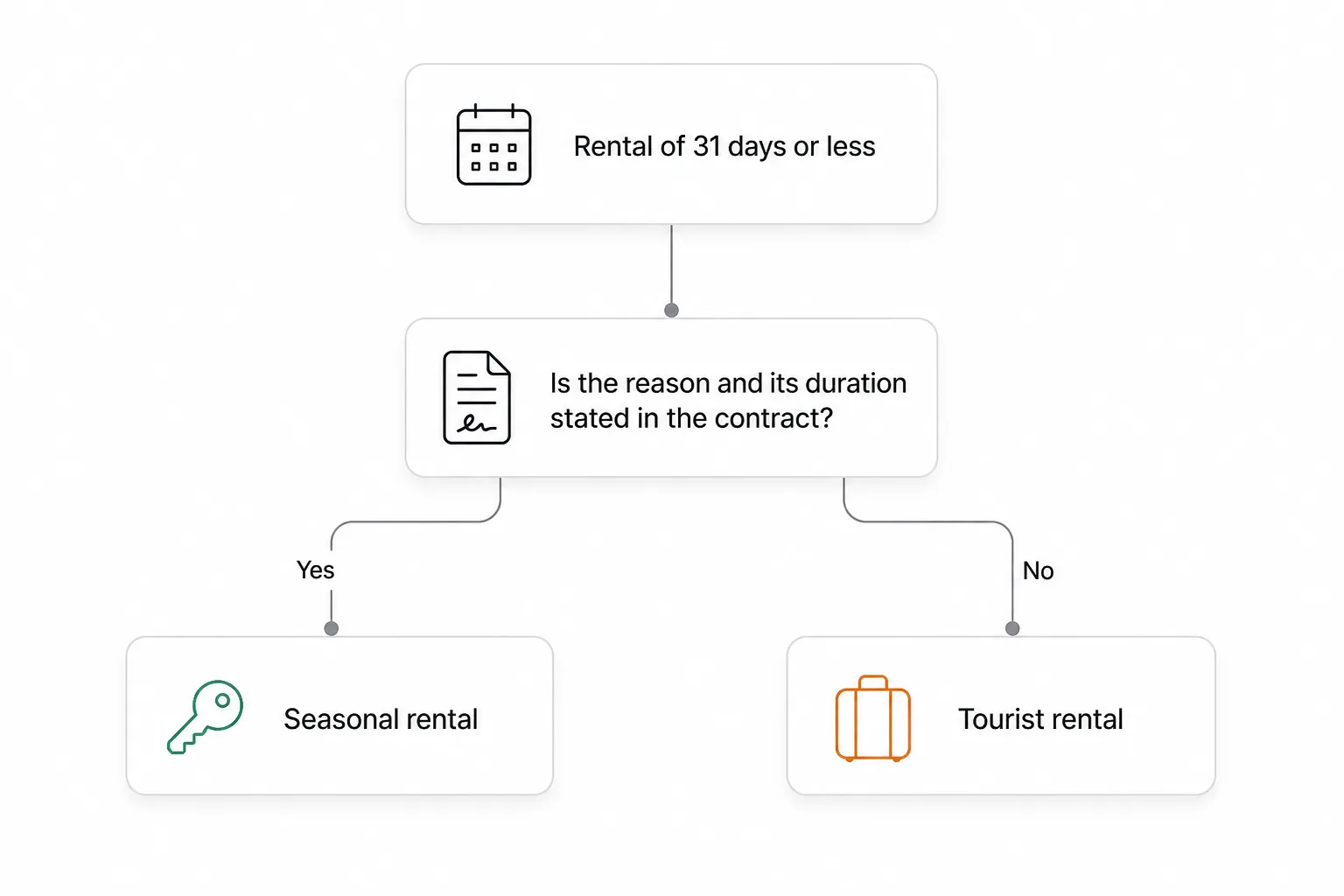
- b) Accommodation is provided for a continuous period equal to or shorter than 31 days, once or more within the same year.
They are alternatives, not cumulative. One is enough. And the law defines “tourism offer channel” very broadly: travel agencies, booking centres, mediation businesses «including intermediation channels through the internet», and firms that place advertising for tourist-use dwellings in social media, «whatever their type or format». A listing on a portal, a social media group or a marketplace falls comfortably inside that.
Article 12: what a seasonal landlord now has to do
Article 12 is the one that changes your paperwork, because it puts the burden of proof where it was not before. Under its section 2, the duty to show the contract is not a tourist one falls on the landlord, who must:
- Ask the tenant beforehand for information on «the reason justifying the need for temporary accommodation and its connection with the intended duration».
- State it expressly in the contract.
Section 3 leaves no way out: if the landlord does not ask for the information, the circumstances are deemed not to exist. And if they are not properly specified in the contract, it shall be considered a tourist rental, with none of the “unless proven otherwise” wording that article 11 carries.
What happens if you skip it
Section twenty-five of the reform adds three new infringements to Ley 7/1995, the Canary Islands Tourism Act, which is where penalties are graded:
| Conduct | New article | Category |
|---|---|---|
| Marketing tourist stays in a residential dwelling without meeting the legal requirements | art. 75.21 | Very serious |
| Signing a contract of 31 days or less without stating the reason in the contract | art. 76.24 | Serious |
| Signing a contract of 31 days or less without first requesting the information | art. 77.12 | Minor |
The financial scale sits in article 79.2 of Ley 7/1995: minor infringements up to €1,500, serious ones between €1,501 and €30,000, and very serious ones between €30,001 and €300,000. Confirm the amounts currently in force in the consolidated text before relying on them, since the law lets the Canarian government update them.
Note the jump: forgetting to ask for the information is minor, but failing to reflect it in the contract is serious. Two well-drafted paragraphs separate the two.
Deadline of 31 July 2027: the classified-activity notification
The reform adds a tenth transitional provision to Ley 6/2025 that resolves a very common situation: homes that filed their declaración responsable at the time but never filed the comunicación previa de actividades clasificadas (prior notification of a classified activity) with their town hall.
The law gives them a window: they may file it before 31 July 2027, accompanied by at least two documents:
- A municipal certificate confirming the dwelling was built in accordance with planning rules and holds the required licences. Alternatively, you can show the building is fuera de ordenación (outside current planning but no longer enforceable), because the powers to restore planning legality under articles 361 and 362 of Ley 4/2017 can no longer be exercised, or evidence the consolidated status of the tourist use, by any means of proof admissible in law.
- A technical report signed by a qualified professional, with floor plans, elevations and sections and photographs of the façade and interior, evidencing compliance with classified-activity rules.
Filing it entitles you to the transitional regime under the law. Not filing it carries a consequence worth reading twice: the owner «must cease the tourist activity immediately, with the declaración responsable of consolidated tourist planning use being automatically extinguished». There is no gradation and no administrative discretion.
The provision does not apply to anyone who already filed the prior notification before Ley 6/2025 came into force.
Consolidated use: how you lose it now
The reform rewrites section 11 of the first transitional provision: a declaration of consolidated use lapses when the holder permanently ends the activity for any reason, and the law lists the owner’s legal personality ceasing to exist, transfer of ownership by any title, the operator or the declaring owner ceasing the activity, not operating continuously for more than one year, total demolition, and extinction of the right of enjoyment or management over the dwelling.
There is one narrow exception for inheritance. On transfer on death, where the deceased was both owner and holder of the declaración responsable, the new owner may notify the cabildo of the change of holder and continue the activity up to a maximum expiry period of 10 years from that transfer, with no later transfer on death extending it.
The new section 13 tightens oversight: the cabildo reviews the declaración responsable and, if the outcome is negative, sends the town hall a binding report to set it aside, and removes the dwelling from the Registro General Turístico.
Technical requirements: 35 m², bathrooms, energy and access
Section twenty-two rewrites the seventh transitional provision, which sets the technical requirements until the implementing regulation is approved. They are:
Floor area and bathrooms. As a general rule, a minimum of 35 m² of usable floor area, two full bathrooms where capacity exceeds four guests and three where it exceeds eight.
The exception to the 35 m². The minimum usable area required by the habitability rules in force when the declaración responsable is filed will do, provided the dwelling meets at least one item on a long list: private parking on the same plot, a pool, sports or wellness facilities, exclusive garden areas (9 m² per guest place on urban land, 100 m² on rural land), a charging point for zero-emission vehicles, a quality or EMAS certification, an energy transition plan reaching zero or negative carbon footprint within five years, an A or B energy rating, noise monitoring, cooling equipment rated A, compliance with accessibility rules, or evidence that the operator is self-employed and directly tied to running the property.
Energy. A minimum rating of class F for buildings legally existing at 31 December 2007 and class D for later ones, with exceptions for dwellings excluded from certification or constrained by heritage rules. Each declaración responsable also triggers the requirements of Directive (EU) 2023/1791.
Domestic hot water. Via solar panels where technically and legally possible, or alternative renewable installations where a technical certificate shows CO₂ emissions and non-renewable primary energy consumption equal to or lower than those of a solar thermal system.
Access. There must be vehicle access to the plot or to the nearest reasonable approach point. If the final stretch is on foot, or if the access is not paved, that must be stated in the advertising and marketing of the property. It is a transparency duty plenty of listings breach today without realising: check your Airbnb, Booking and direct-website pages.
Which regime applies to you
| Your situation | What this reform means for you | What to do now |
|---|---|---|
| New registration of a holiday let | The technical requirements and the ordinary regime of Ley 6/2025 | Check area, bathrooms, energy, hot water and access before filing |
| Declaración responsable filed, no classified-activity notification | Tenth transitional provision | File it before 31 July 2027 with municipal certificate and technical report |
| Prior notification already filed before Ley 6/2025 | The tenth transitional provision does not apply | Nothing on this front |
| Consolidated tourist use | New section 11: wider grounds for losing it | Watch for inactivity beyond one year and any transfer of ownership |
| Inherited property with consolidated use | The transfer-on-death exception | Notify the cabildo of the change of holder; 10 years maximum from the transfer |
| Use already enabled by planning or by Ley 14/2019 (green islands) | Section 12 of the first transitional provision | You keep the Decreto 113/2015 declaration, with no new consolidated-use filing |
| Seasonal rental in the Canaries | Articles 11 and 12 | Redraft the contract template with the reason and its link to the duration |
| You want to let for 15 days around an event | Article 4.2 fourth paragraph and article 7.8 | First confirm your town hall has approved the planning instrument |
Document checklist
Before the year is out, have these gathered and filed:
- Your declaración responsable and its filing receipt.
- The classified-activity prior notification, or an appointment booked to file it.
- Municipal certificate of planning legality, or evidence of fuera de ordenación or consolidated use.
- Technical report with plans and photographs, if the tenth transitional provision applies to you.
- A valid energy performance certificate.
- Documentation of the hot water system and, where relevant, the technical certificate for the renewable alternative.
- An updated seasonal rental template with the reason-and-duration clause.
- Supporting evidence of the reason for every seasonal contract signed since 15 August 2026.
- A review of your listings: disclose on-foot or unpaved access where applicable.
What this reform does not change
It is worth separating the obligations, because they overlap and it is easy to assume one replaces another:
- Guest registration is untouched. Real Decreto 933/2021 requires you to collect every guest’s details and report them to SES.Hospedajes, Spain’s national police reporting platform. That is a state public-security obligation, independent of Canarian tourism rules and of any regional reform. The full framework is in our guide to the traveller registration app.
- The NRUA is still annulled. The preamble of Ley 7/2026 reasons at length about Real Decreto 1312/2024 and Regulation (EU) 2024/1028, but that is the Canarian legislator’s background argument, not a revival of the national registry: the Spanish Supreme Court struck it down, as we explain in the Supreme Court annuls the NRUA.
- Your Canarian tourism registration number is still the one that counts. In the Canaries that is the VV (vivienda vacacional), and it is the number your listings must display. See how to check it in how to verify your tourism registration code and how to add it to platforms in how to add your registration number on Airbnb and Booking.
- Regional licences still rule. The region-by-region map is in tourist licence in Spain.
What to watch over the coming months
Two open fronts that are not obligations today and should not be treated as such:
- The implementing regulation. The seventh transitional provision applies «until the rules developing this law come into force» to govern classification, categorisation and building requirements. When that regulation lands, the 35 m², the bathrooms and the rest may change.
- The decree on unidad de explotación. A decree has been announced that would loosen the single-operator rule and allow individual apartments to be let. As of today it is a proposal pending approval, not a rule in force. Do not plan around it.
Frequently asked questions
When did Ley 7/2026 start to apply in the Canary Islands? On 15 August 2026. It was published in BOC nº 163 on 14 August and its thirteenth final provision sets entry into force for the day after publication.
Can I already let my home 15 days a year for an event? Only if your town hall has approved the complementary planning instrument that enables the figure, and only for festivals or events fitting the list in article 4.2. You also need to file a declaración responsable first, stating the days and the specific event. As things stand, we are not aware of any municipality that has approved such an instrument.
Is a rental of 31 days or less always a tourist rental in the Canaries? Not always, but it is presumed to be. To rebut the presumption, the landlord must have asked the tenant for the reason justifying temporary accommodation and stated it expressly in the contract, together with its connection to the agreed duration. If it is not in the contract, the law treats it as a tourist rental.
What happens if I miss the 31 July 2027 classified-activity deadline? The tenth transitional provision requires the tourist activity to cease immediately and automatically extinguishes the declaración responsable of consolidated tourist planning use.
Do I lose consolidated use if I sell the property? Yes. Transfer of ownership by any title is one of the grounds on which a declaration of consolidated use stops having effect. The only exception provided is transfer on death, with a maximum expiry period of 10 years from that transfer.