

Renting your home to tourists in the Comunitat Valenciana takes more than one piece of paper. You need a report from your town hall, an entry in the regional tourism register, and very often the approval of your neighbours’ association.
Several of those rules changed in August 2026. A new law, Ley 5/2026, rewrote how you renew your registration, what happens when the home is sold, what your insurance must cover, and the technical requirements for almost every type of accommodation. Here is what to do, in what order, and which dates matter.
The three permissions a Valencian tourist rental needs
People say “tourist licence” as if it were one thing. In the Valencia region it is three separate pieces, and none of them replaces another.
1. The town hall urban compatibility report (ICU). This is a municipal document. It confirms that a home at that exact address may be used for tourism. Without it, the registration is not valid.
2. Registration with the Generalitat’s tourism register. You do this with a declaración responsable. It is not a permit someone grants you. It is a document where you state that you meet the requirements. The administration checks afterwards.
3. The owners’ association agreement. When Spain’s horizontal property law requires it, you need an express agreement approving the tourist activity. It has to exist before you register.
What to file in each situation
This table sums up what you file, depending on what has happened. It applies to tourist-use homes unless stated otherwise.
| Situation | What you file | Town hall document |
|---|---|---|
| New registration | Start-of-activity self-declaration | Favourable ICU |
| The five years run out | Renewal self-declaration | New, updated ICU |
| The home is sold | A fresh self-declaration | Favourable ICU |
| The home is inherited | Change-of-ownership declaration | Not required by this route |
| Essential change, closure, operator change | Self-declaration of change | Depends on the change |
Closing down and changing the person who runs the activity also have to be reported. It is not optional, and it does not wait for someone to ask.
What changed in August 2026
The new rule is Ley 5/2026, de 31 de julio, the Valencian government’s annual law on tax, administrative and organisational measures. Its article 194 rewrites several articles of Decreto 10/2021, the regulation that governs tourist accommodation in the region.
The dates, in order:
| Date | What happened |
|---|---|
| 10 August 2026 | Published in the regional gazette |
| 11 August 2026 | Entered into force |
| 17 September 2026 | Reproduced in the national BOE |
Your registration expires after five years
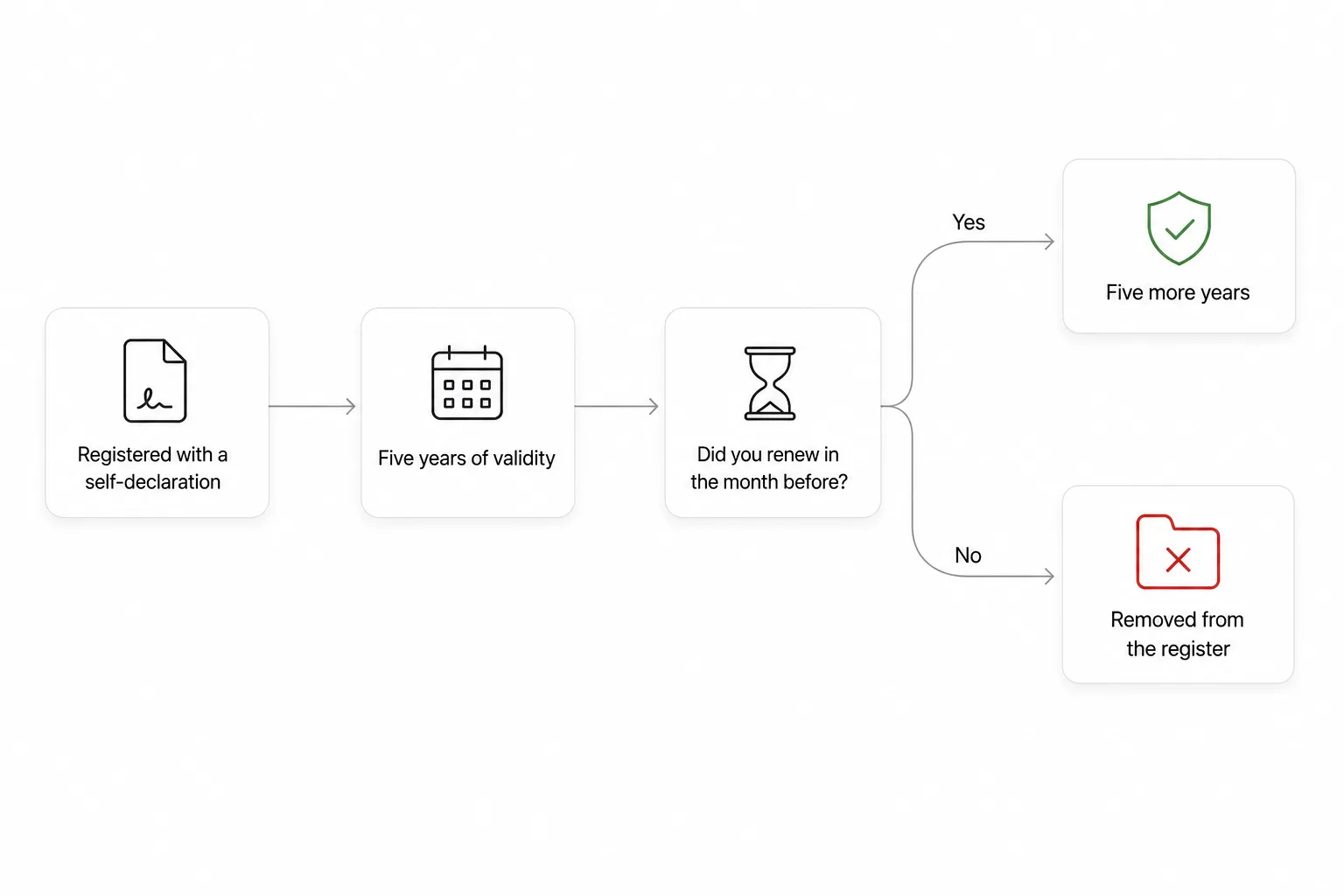
This is the part most owners do not know. The self-declaration is not permanent. It allows the activity for five years from the day you filed it, and the register says so.
To carry on you file a new renewal self-declaration. The conditions are:
- It goes in during the month before each five-year period ends.
- It is signed by the person running the activity, with the owner’s express permission.
- It comes with a new, updated favourable urban compatibility report from the town hall, or the equivalent document the regulation allows.
- It must state that you meet all the requirements in force at the moment of renewal, not the ones that applied when you first registered.
If the deadline passes without that renewal, or without the town hall report where one is required, the home is removed from the register.
There are two different transitional regimes, depending on when your home entered the register. Homes registered from the entry into force of Ley 15/2018 keep their entry for five years counted from Decreto ley 9/2024. Homes registered before that law renew on a different footing, tied to the minimum requirements of annex III. Ask which one is yours before you gather documents.
What happens when the home changes hands
The law splits this into two routes, and the difference is big.
A sale or any other change of owner. If the change happens after 8 August 2024, the rules in force today apply both to the home and to the new owner. You file a fresh self-declaration and provide a favourable urban compatibility report or equivalent document. The date the home was first registered makes no difference.
Inheritance. Transfer on death is left out of that route. The new owner files only a change-of-ownership declaration for transmission on death.
The neighbours’ agreement has to come first
The registration declaration must state that, before registering, the horizontal property law was complied with regarding the express agreement of the owners’ association approving the tourist activity.
Two things to keep in mind:
- Homes registered before Decreto ley 9/2024 do not have to include that statement in their renewal declaration.
- Silence from your neighbours is not permission, and it does not solve a ban already written into the building’s statutes.
Your insurance must cover the tourist activity
Ley 5/2026 made this very clear, and it applies to every type of accommodation, not just tourist-use homes.
The public liability policy has to cover harm to the health or physical safety of guests and third parties arising from the tourist activity, plus risks relating to financial security. And it adds a line worth reading twice. A policy whose cover is limited to residential accommodation is not valid.
Ask your insurer, in writing, for:
- A current certificate of cover.
- The activity declared in the policy, with the exact name of your accommodation type.
- The sum insured and how it relates to your guest capacity.
- Exclusions and excess.
- Validity dates and the last receipt paid.
Do not turn a figure you read in a forum into your minimum cover. The amounts depend on the accommodation type and the table that applies, so confirm them with your insurer and against the current rules.
The changes you have to report
The person running the activity must notify the regional tourism office of any essential change affecting it. That is done with a self-declaration, and it expressly includes closing down and changing who provides the accommodation service.
Hotels have a rule of their own: they may report temporary closures within their declared operating season.
Always keep the receipt, and afterwards download the updated register entry. Filing the form does not by itself change what the register says.
The regional register does not replace your town hall
Being in the tourism register does not mean your town hall will let you operate. These are two separate layers, and both have to come out right.
The urban compatibility report is where they meet. If the municipality has suspended permits or changed its planning rules, the Generalitat requires a report less than six months old. On non-developable land you may also need a declaration of community interest and an environmental instrument.
It is not a theoretical requirement. On 9 January 2026 the Generalitat announced it had started removing from the register homes with problems in their ICU. The notice arrives through the electronic citizen folder and gives ten working days to provide the report. If it does not arrive, the home leaves the register.
Dénia and València show that the town hall decides
Dénia. On 17 August 2026 the council gave final approval to its own tourist-rental bylaw. It allows new registrations up to 1 % in the most protected residential area, widens the compatible zones in the old town and in Baix la Mar, and raises the cap from 15 % to 25 % in the strip between the camí del Llavador and the beach. Before you treat it as binding, check the text published in the Alicante provincial gazette and the date it takes effect. And do not apply those percentages to any other town.
València. Ruling 251/2026 of the regional high court annulled the extension of the Cabanyal-Canyamelar moratorium as far as hotels were concerned. The court held that the evidence the council relied on was mostly about the growth of tourist flats, so the measure was not justified for hotels. The restriction on tourist flats was upheld. The council asked the court to correct the ruling, so it was not final when it became public. It does not grant licences by itself, and it does not remove the neighbourhood’s tourism limits.
The requirements that changed by accommodation type
Ley 5/2026 also reworked the technical annexes. Here is the summary, so you know where to look.
| Type | Main change |
|---|---|
| Hotels | In three-star hotels, internet access can replace the in-room telephone |
| Apartment blocks | The internal line to reception is dropped; the shared laundry is spelled out |
| Tourist-use homes | Key boxes on the public street remain banned |
| Campsites | New occupancy percentages and rules for the bungalow park category |
| Rural houses | The bathroom stool and the quality management section are removed |
| Hostels | The bathroom fittings are set out more precisely |
Two details about tourist-use homes are worth keeping in mind. Cleaning, linen changes and maintenance are the responsibility of the owner or of the person running the activity: pointing the guest at an outside company and walking away is not enough. And extra beds, such as a sofa bed, cannot exceed the fixed capacity by more than 50 %, rounded up, except in two-person homes.
Before you turn any of these lines into building work, open the exact annex for your accommodation type. A rewritten sentence is not always a new task.
A seven-day plan to get your portfolio in order
If you manage several homes, build a sheet with one row per property and these columns: accommodation type, town, registration date, expiry date, owner, person running the activity, ICU, owners’ agreement, insurance policy and pending changes to report.
Then work in this order:
- Transfers after 8 August 2024 with no fresh declaration.
- Files with no ICU you can actually verify.
- Expiry dates in the next twelve months.
- Policies that only cover residential accommodation.
Do not treat a file as fixed until you hold the receipt and see the correct status in the register.
Frequently asked questions
Does Ley 5/2026 mean I have to do something today? It depends on your situation. If your registration expires soon, if you bought or sold after 8 August 2024, or if your policy is residential, you have work to do. Otherwise, review and document.
Does being in the register protect me from the town hall? No. The regional register and municipal control are separate layers. You can be registered and still be unable to operate for planning reasons.
What if I inherit a tourist rental home? You file a change-of-ownership declaration for transmission on death. You do not have to go through the full route that a sale triggers.
Do I need a national registration number? Spain’s Supreme Court annulled the single national register in 2026. It is explained in the Supreme Court annuls the NRUA. What you really need is your regional code, and you can check it with this guide.
Does this cover the guest registration duty too? No. They are different obligations. The licence lets you rent; the traveller report is what you send to the Interior Ministry for each guest. That is covered in the guest registration app.
Details and sources
This article informs and orients. It does not replace planning or legal advice about a specific property. Always verify the requirements in force through official channels before you file anything.
The chain of rules is tangled, and it is worth saying in full. Ley 5/2026 amends article 133 of Ley 3/2026, which in turn amended Decreto 10/2021, the Valencian tourist accommodation regulation. What applies is the current wording, not the three versions added together.
The articles of Decreto 10/2021 touched by article 194 of Ley 5/2026 are 23 (point l), 23 bis, 26 (point 1), 29 (point 2) and 57 (point 3), plus annexes I, II, III, V and VI.
- BOE, Ley 5/2026, de 31 de julio, de la Generalitat: primary text of article 194 and of the entry into force.
- Generalitat Valenciana, tourist-home self-registration: the official procedure for registering, amending and deregistering, with requirements and transitional regimes.
- Generalitat Valenciana, hotel establishments procedure: declarations, changes and closures for hotels.
- Generalitat Valenciana, removal of homes without an ICU: the notice of 9 January 2026 and the ten working day deadline.
- BOE, Ley 15/2018, the Valencian tourism law: the consolidated regional framework.
- BOE, Spain’s horizontal property law: the owners’ agreement and the majorities it needs.
- Dénia town council, final approval of the bylaw: the zones and percentages agreed on 17 August 2026.
If you want the national picture before going into Valencian detail, start with tourist licences in Spain and how to get a tourist licence. And if you are worried about what happens when a home operates without papers, that is covered in illegal holiday rentals.