

Cantabria has started cleaning up its register of holiday homes. On 16 September 2026 the regional tourism minister gave the first clear breakdown: of the 6,145 homes already on the register before the new rule, 2,762 never filed the adaptation form and will be removed.
If you run a tourist-use dwelling (VUT) in Cantabria, your first move is not to read the whole decree. It is to find out where your own file stands, property by property. Everything else follows from that.
What has happened in Cantabria
Decreto 50/2025, of 24 July changed the rules for tourist-use dwellings in Cantabria. It came into force on 26 July 2025.
Homes already on the register were not left out of the change. They had eight months to show they met the new rules. That meant filing one form, the Anexo V, before 25 March 2026.
On 16 September 2026 the regional tourism minister, Luis Martínez Abad, told the press how that review is going. These are his figures, and they cover the 6,145 homes registered before the decree:
| Status of the file | Homes |
|---|---|
| Did not file the Anexo V | 2,762 |
| Checked and correct | 1,021 |
| Still to be checked | 2,362 |
| Already removed | 20 |
The minister added one more figure: the tourism department has opened 63 penalty proceedings and issued 51 fines, worth 210,000 euros in total.
These are dated statements to the press. They are not a decision that affects you personally. The regional tourism directorate said it is working on notifying owners. The individual notice comes later.
How to find out where your home stands
Do not look at your listing. A live listing on a platform says nothing about your file. Look at your paperwork and your notifications inbox.
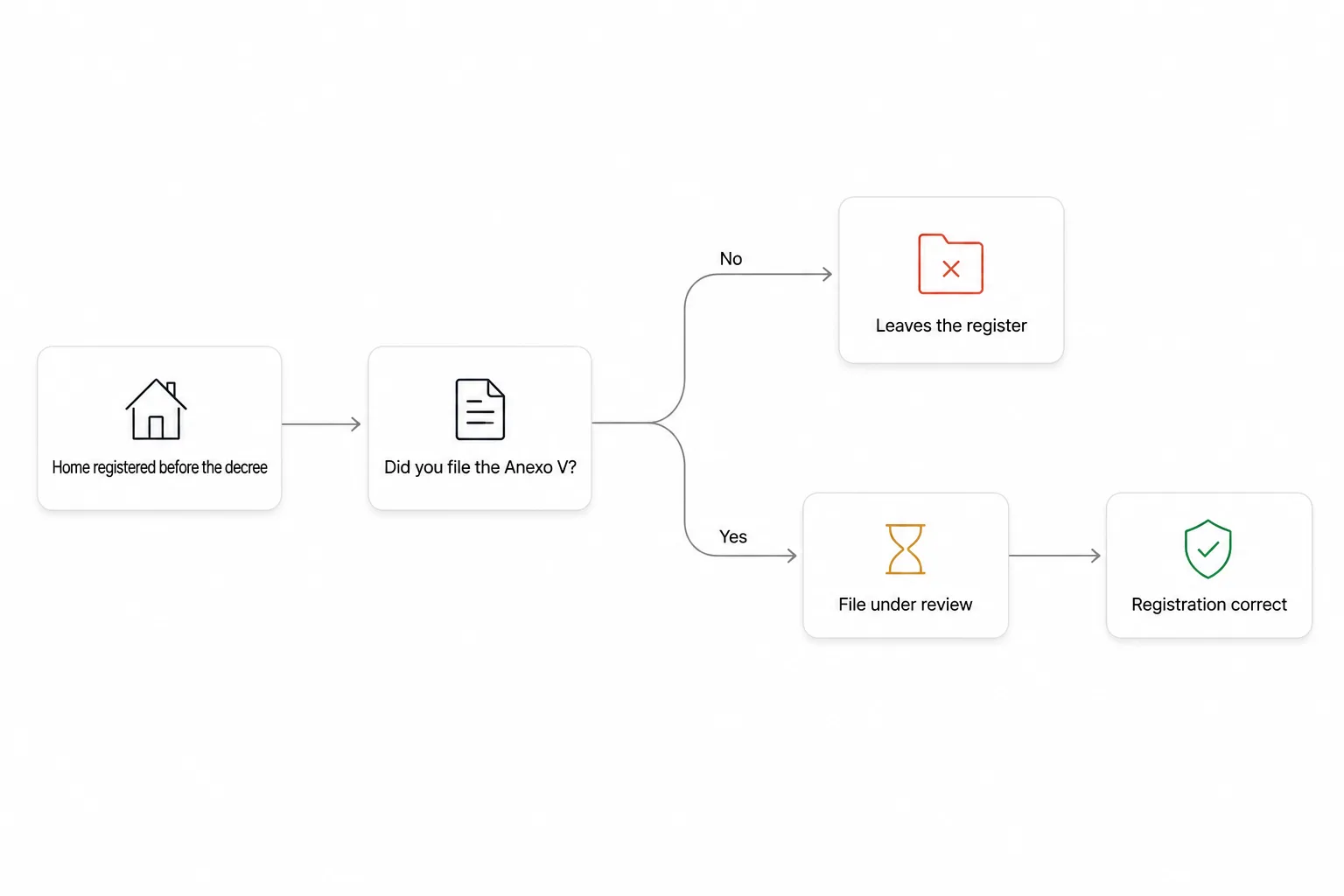
Start with one question: did you file the Anexo V before 25 March 2026?
- You did not file it. Your home is in the group of 2,762. Removal from the register is the expected path, even if nothing has reached you yet.
- You filed it and you already have an answer. Keep that decision. It tells you where you stand better than any news story.
- You filed it and you have no answer. You are in the group of 2,362 files still to be checked. You wait, with your folder ready.
- You registered the home after the decree. The adaptation does not apply to you, but every requirement does, from day one.
What to do if you missed the Anexo V deadline
This is the uncomfortable part. The deadline has passed and no new one has opened.
The decree already says what happens next. The home counts as non-compliant. The tourism department can order the activity to stop and cancel the registration. That runs as a procedure, not overnight, and the decree gives it a maximum of twelve months.
What you can do today:
- Check whether you have already been notified. Look at your post, your electronic mailbox and the address on file.
- Reply within the deadline if you are given a hearing. That is where documents are submitted and your case is explained.
- Gather whatever you do have. A municipal report requested in time, a technical certificate, the owners’ association agreement.
- Get legal advice if you plan to appeal. A cancellation is argued on short deadlines and with the file in hand.
- Stop selling nights you may not be able to honour. If you cannot evidence that the home is authorised, pause that unit before taking more bookings.
Missing the Anexo V is not the same as having a fine. They are two different things, and we separate them below.
What the March instructions protect, and what they do not
In March 2026 the regional department published instructions on how to apply that adaptation regime. They target one situation: the owner did their part, but the document depends on another authority.
According to the preamble of those instructions, the registration should not be cancelled when the delay is not the owner’s fault. It covers two cases:
- The municipal planning compatibility report was requested in time and the council has not issued it yet, or has issued it and it is under appeal.
- The agreement or certificate from the owners’ association was requested and is still pending.
You have to evidence that protection. Keep the dated proof that you applied, and add the document to your file as soon as it arrives.
The folder of documents you need for each home
Article 6 of the decree describes what you declare when you sign the responsible declaration, the self-certified filing that lets the activity start. Signing means you hold those documents and can produce them on request.
Build a folder per home with:
- The title proving ownership or the right to use the property.
- The municipal report on the compatibility of tourist use with local planning.
- The technical certificate covering the minimum housing standard and the capacity.
- The owners’ association approval, where it is required.
- The municipal residence certificate, only for the shared-use option, because there the owner must live in the home.
- A statement that the home is not publicly protected housing.
- Invoices and certificates for the safety equipment.
Date every document and keep the receipt for everything you file. If a request for information arrives one day, that folder is your answer.
The safety equipment, item by item
The decree is specific here, so the check is quick. The home must have:
- One fire extinguisher per floor, visible and reachable.
- A smoke detector in the area near the kitchen.
- A noise monitoring system in the living areas that alerts when levels are exceeded.
- A first aid kit.
A device that nobody checks is not enough. Write down who changes the batteries, who watches the expiry dates and how often the extinguisher is serviced.
What your listing and your plaque must say
This part can be checked from the street, without entering the home. That is why it is worth reviewing today:
- The identification plaque at the entrance, following the model in the decree’s annex.
- The registration number from Cantabria’s tourism business register in all advertising of the activity.
- A phone number for immediate assistance to the guest.
- Official complaint forms available to anyone who asks.
- Prices on display, with the final price itemised.
Check that the number is the same on your site, on every platform, in the booking confirmation and in your automated messages. A number copied from another home in the portfolio is an easy mistake to make and an easy one to spot. We explain how to verify a tourist registration code and how to add the number on Airbnb and Booking.
The hoja de admisión is not the traveller report
These are two separate duties met in two separate ways. They are often mixed up.
The hoja de admisión, the regional admission sheet, is Cantabrian. It records the holder, the registration number, the phone number, the check-in and check-out dates, the total price and the number of guests. The decree says you keep them for at least one year.
The parte de viajeros, the traveller report, is national. It goes to SES.Hospedajes under Real Decreto 933/2021, with its own content and its own deadlines, and it is kept for three years. We cover it in our guides to the guest register and entry report and the traveller registration system.
Meeting one does not release you from the other. And neither of them asks you to keep a copy of the guest’s passport or ID card.
The fines, with the law in front of you
The penalties do not come from the decree. They come from Ley de Cantabria 5/1999, the regional tourism act, which sorts breaches into minor, serious and very serious. These are the amounts in force:
| Breach | Fine | Other measures |
|---|---|---|
| Minor | 250 to 1,500 € | May end in a formal warning |
| Serious | 1,501 to 15,000 € | Suspension or closure for up to 3 months |
| Very serious | 15,001 to 75,000 € | Closure for up to 3 years and up to 3 years barred from public aid |
Do not read that table as a fixed price per mistake. The law requires the deciding body to weigh the case: the harm caused, the risk to people, whether it is repeated and the specific circumstances. An expired extinguisher and running an unregistered activity are not the same thing.
Cancellation, closure and a fine are three different things
When an envelope from the tourism department arrives, the first job is to read what it actually is. Three things get confused:
- Cancellation of the registration. Your home comes off the tourism register.
- Order to stop the activity. You are told to stop marketing it.
- Penalty. A fine inside a sanctioning procedure.
They can arrive together or separately. Before touching calendars or cancelling bookings, note five things from the notice: the date, the body that signed it, the home affected, what it asks of you and within how many days, and when it takes effect. That tells you whether you must stop today or whether you are still at a stage where documents can be added.
The Supreme Court appeal does not pause the decree
On 17 September 2026 the Cantabrian association of tourist-use dwellings announced that it is taking the decree to the Supreme Court, through a cassation appeal against the regional high court ruling that dismissed its challenge. It argues that the decree clashes with EU services rules, that it has procedural defects, and that it applies new rules to businesses that were already operating.
It is real news, but it does not change what you have to do this week. Announcing an appeal does not suspend a rule. Suspending one takes a court order, and there is no public record of that happening.
It is something to watch, not something that buys you time. In the meantime the decree applies and the deadlines run.
A 48-hour audit if you manage several homes
With a portfolio, the dangerous part is not knowing which homes are wrong. This order works:
- Export your inventory with the address, holder and registration number of each home.
- Cross-check those three fields against what you publish on your site, your booking engine and the platforms.
- Sort every file into the four situations listed above.
- Build the document folder for each home and mark the gaps.
- Review safety and listings, which is what can be checked from outside.
- Empty the notifications inbox, the electronic one included.
- Pause only the homes you cannot evidence as authorised, not the whole portfolio.
- Set a review date for when a decision arrives or when there is news on the appeal.
Name one person responsible for answering official requests. If nobody watches the inbox, the deadline passes even when you are right.
Frequently asked questions
Can I file the Anexo V now, after the deadline?
The deadline closed on 25 March 2026 and no new one has opened. You can still add documents to your file, and it is usually a good idea, but that is not the same as having met the deadline. Talk to a lawyer before writing the case off.
If nobody has contacted me, can I assume I am fine?
No. As of 16 September 2026 there were still 2,362 files waiting to be checked. Silence today means yours has not been reviewed yet.
My council has not issued the planning compatibility report. Does that protect me?
Only if you asked for it in time and can prove it. Keep the dated proof of your application and add the report as soon as you have it. If you never applied, the council’s delay does not shield you.
Does the hoja de admisión cover my SES.Hospedajes duty?
No. The admission sheet is a Cantabrian requirement and is kept for a year. The traveller report goes to SES.Hospedajes with its own content and its own deadline, and it is kept for three years.
Do I have to keep a copy of my guests’ ID?
No. Neither duty requires it. Spain’s data protection authority takes the view that asking for a copy of the document to file the traveller report goes against the principle of data minimisation. We explain it in how we handle guest data.
Details and sources
- The rule is Decreto 50/2025, of 24 July, published in Cantabria’s official gazette and in force since 26 July 2025. Its single transitional provision is the one requiring adaptation through the Anexo V within eight months, and the one setting out the presumption of non-compliance, the order to stop and the cancellation of the registration, with a maximum of twelve months to resolve.
- The content of the responsible declaration and the documents you must hold are in article 6; the safety equipment is in article 6.1.g). The duties on the plaque, the registration number in advertising, the phone line, complaint forms, the first aid kit, prices and keeping admission sheets for one year are in article 7. The content of the admission sheet is in article 8.
- The instructions on the single transitional provision were published in gazette number 55 and have applied since 20 March 2026. Their preamble explains why the registration should not be cancelled when the missing documentation is not down to the holder but to pending action by other authorities.
- The fine amounts are in Ley de Cantabria 5/1999, the regional tourism act, consolidated text: article 60 for minor breaches, article 61 for serious ones, article 62 for very serious ones and article 63 for the assessment criteria. The tourism directorate can fine up to 15,000 euros; above that, the regional ministry decides.
- The review figures come from statements by the regional tourism minister, Luis Martínez Abad, on 16 September 2026, reported by elDiario.es Cantabria. They are not a decision, nor an official downloadable dataset.
- The cassation appeal announced by the Cantabrian association of tourist-use dwellings is dated 17 September 2026, according to elDiario.es Cantabria. That report does not state that any suspension of the decree was requested or granted.
- Registration, adaptation, change of holder, amendment, cessation and adding documents are all filed through the responsible declaration and notifications procedure for tourist-use dwellings on Cantabria’s electronic office.
- For the wider picture of licences by region, see our guide to the tourist licence in Spain.
This article informs and orients. It does not replace legal advice. Before making a decision about your file, check the requirements and deadlines in force through the official channels of Cantabria’s culture, tourism and sport department.