

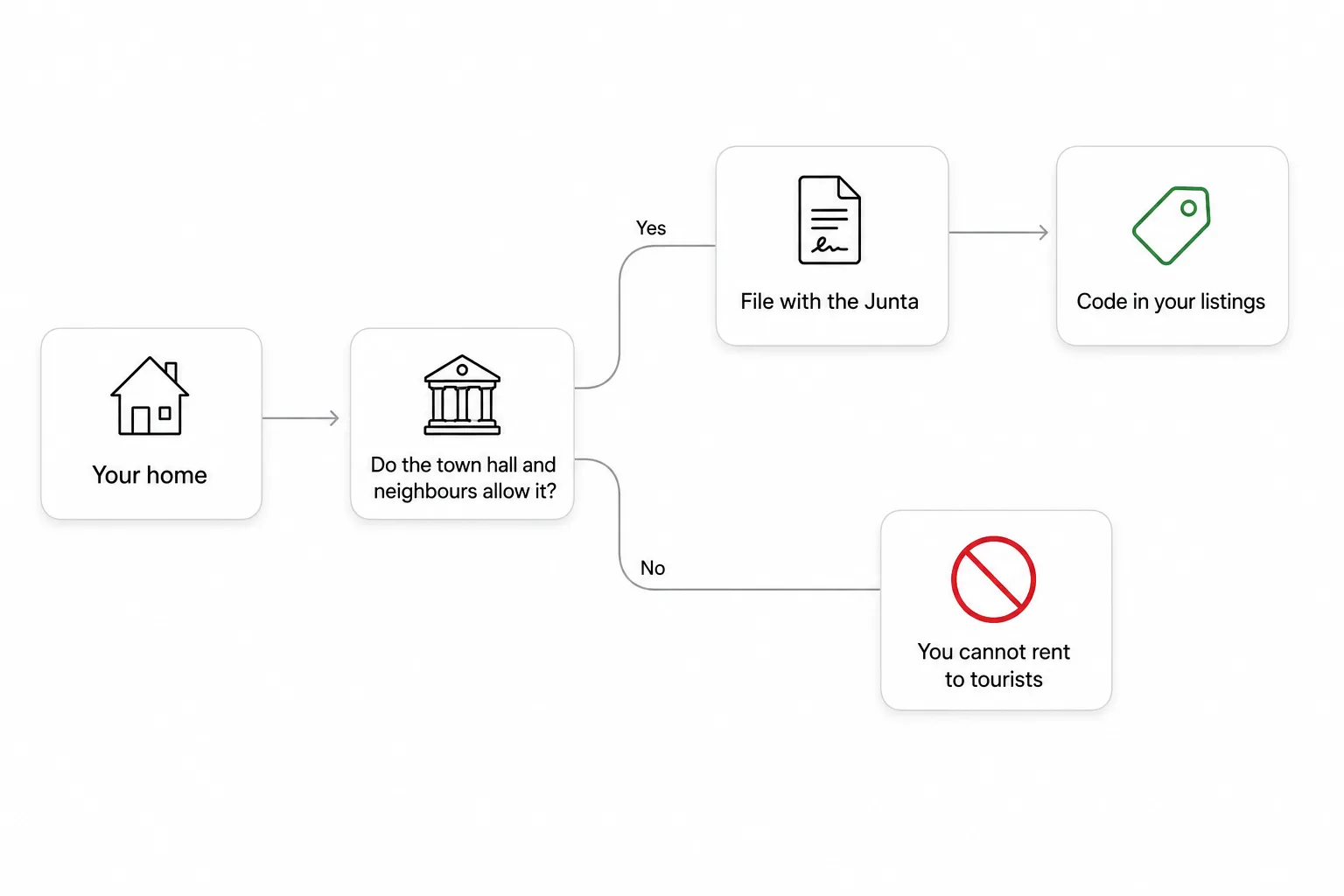
To rent your home to tourists in Andalusia, you register it with the Registro de Turismo de Andalucía, the regional tourism register. It is free and done online. When you finish, the regional government (the Junta) gives you a code, and that code goes in every listing.
Before you fill anything in, ask two questions. Ask your town hall whether your street allows tourist rentals. Ask your owners’ association whether it approves. If either one says no, you cannot register.
Start with the town hall and the neighbours
Many owners start with the regional form. It is better to start with the question that can stop everything: can your home be a tourist rental in that spot?
Your town hall. Each town decides where tourist flats can go. It can cap them per building, per neighbourhood or per zone. The Junta tells the town hall about every new registration, and the town hall can ask for it to be cancelled if it breaks local rules.
Your owners’ association. Since 3 April 2025, renting a flat to tourists in a shared building needs the express approval of the owners’ association (the comunidad de propietarios). The Junta asks for a certificate from the building’s administrator or secretary that says so. If the building’s statutes ban tourist rentals, you cannot register either.
Which homes qualify
The Andalusian rules set minimums for space and equipment. This table sums up the main ones.
| Requirement | What it says |
|---|---|
| Size | 14 m² built per guest, and at least 25 m² in total |
| Guests, whole home | Up to 15 |
| Guests, by rooms | Up to 6, and you live there |
| Guests per bedroom | Up to 4 |
| Bathrooms | 2 above 5 guests; 3 above 8 guests |
| Air conditioning | If you open from May to August |
| Heating | If you open from December to March |
| Equipment | Furniture, kitchenware, first-aid kit, smoke alarm |
| Ventilation | Bedrooms, living room, kitchen and bathrooms |
There are two ways to rent. A whole home is let in full. By rooms means it is your own home: you live there and let rooms. In that case the Junta asks for your padrón certificate, the town hall record that shows you live there.
Some homes cannot register as a VUT. Examples are subsidised housing (VPO), homes on rural land (they have their own category) and homes let to the same person for more than two months in a row.
How to register, step by step
The process is online only. The person who runs the rental files it. That can be the owner, or someone with a contract that lets them rent out the whole home.
- Get a digital certificate. The usual one is issued by the FNMT, Spain’s mint. Foreign owners can get one too, with their NIE. Without it you cannot file.
- Gather your papers. Always, a recent nota simple (a short extract from the Land Registry). If the home is in a building with an owners’ association, the association’s certificate. If you are not the owner, the contract that lets you run the home. If several people own it, they all sign.
- Open the Junta’s online office. Find the procedure for viviendas de uso turístico and choose “inicio de la actividad” (starting the activity).
- Fill in the sworn statement. It is called a declaración responsable: you state that you meet the rules. You add the home’s details, guests, bedrooms and the months you will open.
- Attach the papers, sign and send. When you finish, the office lets you download the decision with your code.
Once your statement is filed and logged, the Junta treats you as able to start renting. It can still check your case later. If a paper is missing, you get 10 days to send it. If you do not, the Junta opens a case to cancel the registration.
Your code and where it goes
The code has three parts: the type of lodging, the province and a number. For example, VUT/MA/12345 is a tourist home in Málaga. Older registrations start with VFT.
Do not confuse the code with your application number. That one starts with letters like CTC and only identifies the paperwork.
The code goes in every listing: Airbnb, Booking, your own website or a sign. It also goes on the receipts you give guests. To check a code, see how to check a tourist registration code. To add it to the platforms, see how to add your registration number on Airbnb and Booking.
Limits set by town halls
Since 2024, Andalusian rules let each town hall limit tourist flats. It can cap them per building, per neighbourhood or for set periods. Every town does it its own way, so never assume one city’s rule applies to another.
Two examples from the cities with the most tourist flats:
- Málaga. It first limited new VUT in saturated areas. Since 25 July 2026 it has also suspended licences for new lodging on residential land. We cover it in Málaga’s lodging moratorium.
- Seville. In October 2024 it capped tourist flats at 10 % of the homes in each neighbourhood. Several neighbourhoods in the old town and Triana were already at that cap.
These limits also end up in court. In April 2026 Andalusia’s High Court (TSJA) struck down a Granada council measure that limited tourist lodging. We cover it, with other cities, in Cuenca’s licence suspension.
What you do every time you rent
Registering is not the end. The Andalusian rules ask for these things on every stay:
- A phone line for guests, open 24 hours.
- Cleaning when each guest arrives and leaves.
- Official complaint forms (hojas de reclamaciones), on display.
- Information for guests: building rules, rubbish, noise, smoking and pets.
- A receipt with your details, the home’s code, the guests, the dates and the price. It counts as the contract, and you keep a signed copy for a year. Our holiday rental contract template already includes those details.
- Guest registration: each guest’s details, sent to the Interior Ministry.
That last one is a national duty that applies across Spain. Each guest gives their details, and you send them to SES.Hospedajes, the Interior Ministry’s system. We explain it step by step in guest registration in Spain.
After you register: platforms, guests and tax
With the code in hand, you have three things left.
Platforms. Put your code in every listing. The national single register number (NRUA) is no longer required: Spain’s Supreme Court struck it down in 2026. See the Supreme Court strikes down the NRUA. Your Andalusian code is the one that counts.
Guest registration. Sign up to SES.Hospedajes before your first booking. You report every arrival there.
Tourist tax. Andalusia has no tourist tax today. Seville and Málaga have asked for one, but the Junta was still saying no in September 2026.
What happens if you rent without a code
Renting to tourists without being on the register is a serious offence under Andalusia’s tourism law. Fines for a serious offence run from €2,001 to €18,000. The Junta can also suspend the activity.
The Junta also reviews existing registrations. In February 2026 it said it had cancelled 13,037 homes from the register, 4,731 of them in the province of Málaga.
If you are unsure about your situation, read what happens with an illegal holiday rental.
Frequently asked questions
How much does it cost to register a tourist home in Andalusia? Filing with the Junta is free. You pay for what you need to prepare: the nota simple, a digital certificate if you lack one, or an agent if you hire one.
How long does the code take? The online office lets you download the decision once you file. The Junta can review your case later and ask for papers.
Do I need my neighbours’ approval if I was already renting before 2025? The express-approval rule applies to rentals that started after 3 April 2025. If you were already renting legally before then, you can carry on. For a new registration, the Junta asks for the owners’ association certificate.
Can I let rooms in my own home? Yes, under the “by rooms” option. You must live there, be on the town’s padrón and take no more than 6 guests.
Is there a new tourism law in Andalusia? Not yet. The Sustainable Tourism Bill was due for a vote in March 2026, but parliament was dissolved first and the bill lapsed. Law 13/2011 and Decree 28/2016 still apply.
Details and sources
This article is a guide. It does not replace legal or planning advice on a specific home. Check the current requirements with the Junta and your town hall before you file anything.
The rules. Andalusian tourist homes are governed by Decree 28/2016 of 2 February, under Law 13/2011 on Tourism in Andalusia. Decree 31/2024 of 29 January amended it: it changed the name to “viviendas de uso turístico”, set the 14 m² per guest and 25 m² minimum, bathrooms by guest count, heating and cooling by opening months, the 4-guests-per-bedroom cap and town halls’ power to limit numbers (article 2.2 of Decree 28/2016 as amended). Floor areas follow the Catastro (land registry) unless local planning says otherwise.
The owners’ association. Article 7.3 of the Ley de Propiedad Horizontal (Spain’s law on shared buildings), as amended by Organic Law 1/2025, requires since 3 April 2025 the association’s express approval, by three fifths of owners and shares, to start a tourist rental. Homes already operating legally keep their right. Separately, Decree 28/2016 excludes homes whose building statutes ban the activity.
Penalties. Article 74 of Law 13/2011 fines serious offences €2,001 to €18,000 and very serious ones €18,001 to €150,000, and may add a suspension. The Sustainable Tourism Bill raised those amounts, but it lapsed when parliament was dissolved on 23 March 2026 and is not in force.
The local limits cited. Seville approved the 10 % per-neighbourhood cap at the council meeting of 17 October 2024; the figure can be revised neighbourhood by neighbourhood, so confirm yours with the city’s planning office (Gerencia de Urbanismo). Málaga’s moratorium is an initial approval; its details are in the linked article.
- Junta de Andalucía, tourist homes: registration, changes and closure. Helpline: 900 10 15 70.
- Junta de Andalucía, FAQ on tourist homes: papers, code format, periods and cancellation.
- BOJA, Decree 31/2024 of 29 January: current requirements and town hall powers.
- BOE, Law 13/2011 on Tourism in Andalusia: offences and penalties.
- BOE, Ley de Propiedad Horizontal: article 7.3.
- Andalucía Información, 13,037 homes cancelled (8 February 2026).
- Andalucía Información, Seville’s 10 % cap (17 October 2024).
- Andalucía Información, the tourism bill lapses with the election call (23 March 2026).
- El Debate, the Junta rejects a tourist tax (18 September 2026).
For the map of every region, start with tourist licences in Spain and how to get a tourist licence.