


Málaga has stopped new tourist accommodation on the land where people live. The measure has been in force since 25 July 2026 and can last up to three years.
It covers hotels, guesthouses, hostels, tourist apartments and holiday lets alike. If you are buying, refurbishing or permitting an accommodation project in the city of Málaga, check two things first: the planning ordinance on your plot, and the date your file reached the council.
What Málaga approved, and when
The city council plenary gave initial approval on 16 July 2026 to modification number 28 of the PGOU rules, the city’s general urban plan. Its file name is PL 7/2026.
The agreement was published in the Málaga provincial gazette (Boletín Oficial de la Provincia) on 24 July. The licence suspension started the next day, 25 July.
The agreement sets its own clock. The suspension lasts three years at most, and ends sooner if the new rules are published and come into force.
The rule that changes is how uses mix
Until now, Málaga’s plan let tourist accommodation into residential plots in two ways.
- Alternative use: the accommodation replaces housing across the whole building.
- Compatible use: the accommodation takes up to 50 % of the building, if it meets the conditions in article 6.4.2 of the plan.
The modification removes both options in residential ordinances. In the council document’s own words, none of those accommodation types «podrá implantarse ni como alternativo ni como compatible» in those areas. It may be set up neither as an alternative nor as a compatible use.
The change is temporary by design. The council is reviewing the whole relationship between tourist and residential use in a separate file, PL 43/2025.
It reaches every type of accommodation
This point gets misread often. The measure is not only about holiday lets.
The council document lists what counts as lodging use:
| Type of accommodation | Caught by the suspension? |
|---|---|
| Hotels, hostales and guesthouses | Yes |
| Apart-hotels | Yes |
| Hostels and backpacker accommodation | Yes |
| Tourist apartments | Yes |
| Holiday lets (VUT, viviendas de uso turístico) | Yes |
| Rural houses and campsites, where the ordinance allowed them | Yes |
That is why the hotel association and the holiday-let associations both reacted. It is one measure that touches the city’s whole accommodation sector.
Your plot’s land use decides, not the neighbourhood
The suspension applies across the whole municipality of Málaga, but only on plots with a residential ordinance. The document lists them:
- Ciudad Histórica, subzone C-1 (PEPRI Centro).
- Ciudad Histórica, subzone C-2 (Perchel Alto).
- Ciudad Histórica, subzone C-3 (Trinidad Perchel).
- Ciudad Histórica, subzone C-4 (PEPRI Perchel Sur).
- Manzana Cerrada, the closed city block.
- Ordenación Abierta, open blocks.
- Ciudad Jardín, garden city.
- Unifamiliar Aislada, detached houses.
- Unifamiliar Adosada, terraced houses.
- Colonia Tradicional Popular, traditional workers’ quarters.
A new additional provision extends those rules to development plans that use the same ordinances, even when they come from the 1983 or 1997 general plans.
Plots with a commercial (terciario) use are not on that list. A commercial plot keeps its own regime.
Files submitted before 25 July carry on
This is the part that decides the most money, and the least known one.
The council could have applied the Supreme Court doctrine that pulls applications from the previous three months into the suspension. It chose not to.
The file document says the suspension takes effect «exclusivamente desde la fecha de publicación del correspondiente acuerdo», only from the date the agreement was published. Applications for approvals, authorisations or licences, and declaraciones responsables (self-certified filings), submitted before that publication stay outside the suspension.
There is one condition, and it is the one people miss: the application must have arrived with the substantive paperwork the rules require. A half-filed application lodged to claim a date is not protected.
For planning instruments, the document spells out what counts as an application for approval: detail studies, layout studies, special plans and general plan modifications that propose lodging on residential plots, as long as that purpose appears expressly in the paperwork filed.
There is a second way through
Article 103.3 of the LISTA General Regulation says the suspension does not stop licences based on the planning rules in force, as long as they also match the rules being processed.
In short: if your project meets both the old rule and the new one, the suspension does not block it.
Three possible answers for your project
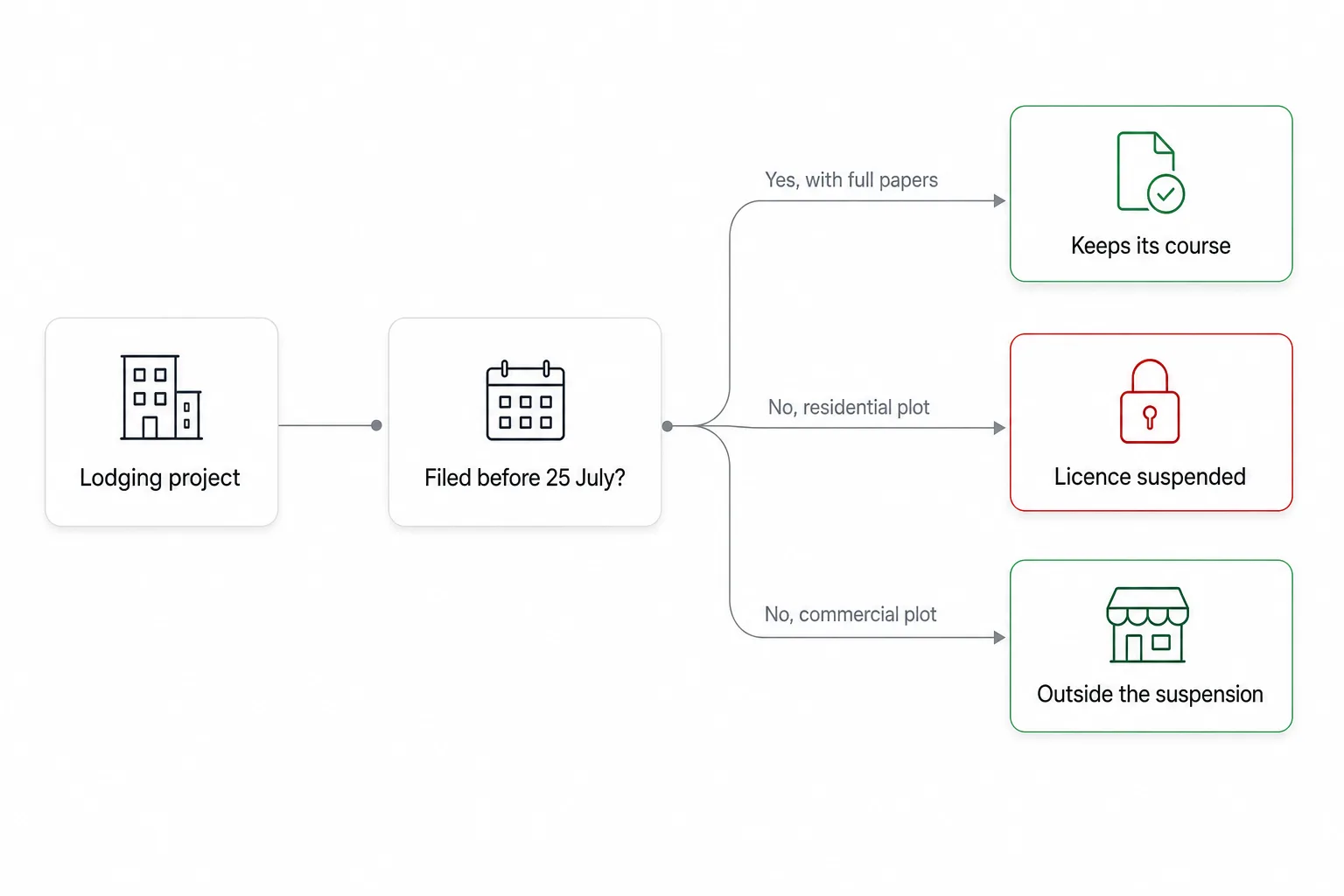
A project can only land in one of three places. Each one has a document that proves it.
- It carries on. The proof is the registry receipt, with its date and its subject, plus the index of what you filed.
- It is suspended. The plot’s planning record shows a residential ordinance, and no earlier file exists.
- It needs a council ruling. This is the grey case: incomplete paperwork, an unclear subject, or a project that may also meet the new rule. Here you ask for a written planning report or certificate.
Do not settle for a verbal answer at a counter or from a sales agent. Ask for the document.
What the moratorium does not do
The limits are worth marking, because exaggerated headlines are circulating.
- It does not withdraw licences already granted. An open hotel stays open.
- It does not cancel entries in the Andalusian tourism registry (Registro de Turismo de Andalucía). How that registration works is in tourist licence in Andalusia.
- It does not ban all new hotels in Málaga. It only reaches plots with the residential ordinances on the list.
- It does not necessarily run to 2029. Three years is the ceiling, not the forecast.
- It does not touch guest registration. Reporting your guests’ details to SES.Hospedajes works exactly as before, in Málaga or anywhere else.
It also replaces no other authorisation. The Andalusian tourism registry entry, the number you need to advertise, the planning licence and the guest reporting account all solve different things. A live listing on a platform does not prove that the use is acceptable under planning rules.
How to check your case in five steps
- Find the plot. Get the exact land registry reference for the building.
- Ask for the planning record. You need the ordinance assigned to the plot, not the neighbourhood name.
- Date your file. Find the registry receipt for each application or self-certified filing, with its date and subject.
- Check what you filed. See whether it came with the substantive paperwork, not just the form.
- Get an answer in writing. If there is doubt, ask the planning authority for a report or certificate before you commit money.
If you run a portfolio, do the same on a spreadsheet: property, land registry reference, ordinance, accommodation type, filing date and the document that proves it. Flag any unit that depends on a title now suspended, and keep it out of revenue forecasts.
This is not the 2025 holiday-let moratorium
Three different Málaga files get mixed up. They are not the same.
| File | What it did | Status |
|---|---|---|
| PL 51/2024 | Limited new holiday lets in saturated areas | Finally approved in May 2025 |
| August 2025 | Suspended new holiday lets across the municipality | Earlier measure, holiday lets only |
| PL 7/2026 | Removes lodging from residential ordinances | Initial approval, in progress |
The wider picture of holiday-let zoning in Málaga, next to other Spanish cities, is in the article on Cuenca’s suspension of holiday-let licences. We do not repeat it here.
If what you need is the general permit framework by region, start with the guide to the tourist licence in Spain.
What is still missing before the rule is final
The plenary agreement opened a twenty-day public consultation for objections, announced in the provincial gazette, on the planning authority’s noticeboard and on its website.
At the same time, the council asked the regional government’s territorial delegation for housing and planning for a binding prior report, due within three months.
The agreement also requires this modification to be coordinated with file PL 43/2025, modification number 26, which will regulate residential and tourist use together.
Two associations filed objections in September 2026. Aehcos, the Costa del Sol hotel association, argues that «una moratoria no crea vivienda», a moratorium does not create housing, and warns about the effect on investment. The holiday-let professional association disputes that holiday lets belong automatically inside the planning category of lodging use.
Neither objection suspends the measure. They are administrative submissions, and the suspension stays in force while the file moves on.
Frequently asked questions
Can I open a new hotel in Málaga?
It depends on the plot. If it carries one of the residential ordinances on the list and you had no file submitted before 25 July 2026, the licence is suspended. On commercial land, a different regime applies.
I bought the building in June. Does that protect me?
No. What counts is the date your file entered the council, with its substantive paperwork. A purchase, an enquiry or a draft project without a registry receipt is not a protected file.
Will my existing tourist apartment be closed?
Not by this measure. The suspension targets new planning titles, not the ones already granted. Any works, extension or change of category may still need a fresh planning check, and that check can fall inside the suspension.
How long does the suspension last?
Three years at most from publication, or until the new rules come into force, whichever happens first.
Do I still have to file the guest report?
Yes. The moratorium is a planning measure and changes nothing about guest registration. If your accommodation is open, you must still send your guests’ details to SES.Hospedajes.
Details and sources
The measure rests on article 78.2 of Andalusian Law 7/2021 (LISTA) and article 103 of its General Regulation. Under that framework, the suspension is no longer an automatic effect of initial approval, as it was under the previous LOUA and the 1978 planning regulation. It is now a power the council must justify and define expressly, showing that it is necessary and proportionate.
Point THREE of the plenary agreement sets the scope: the suspension of every kind of approval, authorisation and planning licence, including self-certified filings, «que sean contrarias al régimen urbanístico previsto en el presente instrumento de innovación», that run against the planning regime in this instrument, effective from the day after publication in the provincial gazette and for a three-year term.
The modification touches articles 12.4.7, 12.5.4, 12.6.5, 12.7.4, 12.8.5, 12.9.6 and 12.10.6 of the plan, creates an article 12.4.7 bis for subzones C-2, C-3 and C-4, adjusts articles 12.2.27 and 12.2.37, and adds a fourth additional provision. A second goal of the file, which we do not cover here, limits converting ground-floor commercial units into housing.
Article 103.4 of the General Regulation gives anyone who applied for a licence before the suspension was published the right to compensation for project costs and a refund of municipal taxes paid, from the moment the instrument comes into force. That right is held back until the loss is proven, so treat it with a lawyer rather than as automatic compensation.
The plenary approved the proposal with 17 votes in favour from the Partido Popular group, 4 against (2 from Vox and 2 from Con Málaga) and 10 abstentions from the Socialist group.
The facts in this article come from the PL 7/2026 file documents published by Málaga’s planning authority. The file is still being processed and its content can change. Always check current requirements through official channels before making an investment decision.
- Málaga planning authority, file PL 7/2026, with the plenary agreement, the report, the executive summary and the annexes.
- Andalusian Law 7/2021 (LISTA), article 78.
- LISTA General Regulation, article 103.
- Málaga College of Architects, notice of 10 September 2026.
- Hosteltur, Aehcos objections of 14 September 2026.
- Teleprensa, holiday-let association objections of 14 September 2026.