

Illegal vacation rentals are one of the flashpoints of Spain’s tourism sector: neighbors who suffer the nuisance, operators who play by the rules and compete against those who don’t, and owners who, sometimes without realizing it, expose themselves to very serious penalties. Knowing how to spot an accommodation operating outside the law and how to report it correctly is useful whether you are an affected neighbor or a host who wants to make sure they are compliant.
In this guide I explain, in plain language, what makes a vacation rental illegal, how to check it using official tools, how a complaint is filed and with whom, and what risks someone takes by renting without complying. And, above all, how to put yourself on the right side of the rules without losing hours every week.
What an illegal vacation rental is
An illegal vacation rental is any property marketed for short-term tourist stays without meeting the legal requirements that apply to it. The owner does not need to be acting in bad faith: many properties operate irregularly simply because they are unaware of the rules or have not kept up with them.
In Spain, vacation-rental regulation has three distinct layers that should not be confused, because breaching any of them can make your activity illegal:
- Regional tourism rules: each autonomous community regulates tourist housing (VUT, VFT, HUT, ETV, and so on, depending on the region) and requires registration in its tourist registry.
- Public-safety rules: traveler registration and the submission of the guest report to SES.Hospedajes (Royal Decree 933/2021).
- Zoning and community rules: municipal licenses, permitted building uses, and homeowners’ association agreements.
The signs that give away an illegal vacation rental
Spotting an irregular property is easier than it sounds. These are the most common signs:
1. No registry number in the listing
Most autonomous communities require the tourist registry number to be displayed in any listing (Airbnb, Booking, own website). If a listing shows no registry code, or shows one that cannot be verified, that is the first red flag.
2. It does not appear in the regional tourist registry
Even if the listing shows a number, that number must actually exist in the autonomous community’s official registry. A made-up or expired code is just as irregular as having none.
3. It breaches the building’s or municipality’s rules
Some buildings whose homeowners’ association has banned tourist rentals, and some municipalities that limit or veto new licenses in certain areas. A property operating there is outside the law even if it had a tourist registry number.
4. Signs of opaque activity
A constant flow of people with suitcases, lockboxes in entrances, listings that avoid giving the exact address or that ask for payments outside the platform: these are signs of an activity trying to stay under the radar.
How to check whether a vacation rental is legal
Before reporting (or before booking, or before putting your own property up for rent), it is worth verifying the situation with official sources:
- Look for the registry number in the listing. It must appear visibly on the property’s page.
- Look it up in the autonomous community’s tourist registry. Most regions have a public search tool where you can enter the license number or address.
- Check local restrictions. Ask the city council whether the area allows tourist use and whether there are moratoriums or quotas.
- Check the building’s situation. In homeowners’ associations, review the bylaws and agreements on tourist rentals.
How to report an illegal vacation rental step by step
Anyone (a neighbor, a homeowners’ association, a competitor, or a guest) can report a property operating irregularly. Broadly, the process is this:
Step 1: Gather evidence
A well-documented complaint moves much faster. Gather everything you can:
- Screenshots of the listing (Airbnb, Booking, website), with date, price, and the registry number if shown.
- Photos or videos of the guest turnover, lockboxes, or signage.
- Homeowners’ association minutes reflecting complaints or bans.
- Any communication (messages, emails) evidencing the activity.
Step 2: Identify who to report to
Depending on the breach, there are several routes, and it is often worth using more than one:
| Body | When to turn to it |
|---|---|
| Tourism department (regional) | Lack of tourist license or registry |
| City council | Zoning breach, noise, or non-permitted use |
| Platform (Airbnb / Booking) | Listing without a registry number or illegal content |
| Tax Agency | Signs of undeclared rental income |
| Homeowners’ association | When the building bans tourist use |
Step 3: File the complaint
The main route is usually the tourism department of the autonomous community where the property is located, normally via an official form (in person or online). Provide your details, the property’s details, and the evidence gathered. In parallel, you can inform the city council, the marketing platform (through its listing-report channel), and, if you suspect tax fraud, the Tax Agency.
Step 4: Follow-up
Keep the complaint receipt. Some procedures let you check the status of the case file; if you also reported on the platform, check whether the listing has been removed.
In the Balearic Islands the seal comes before the fine
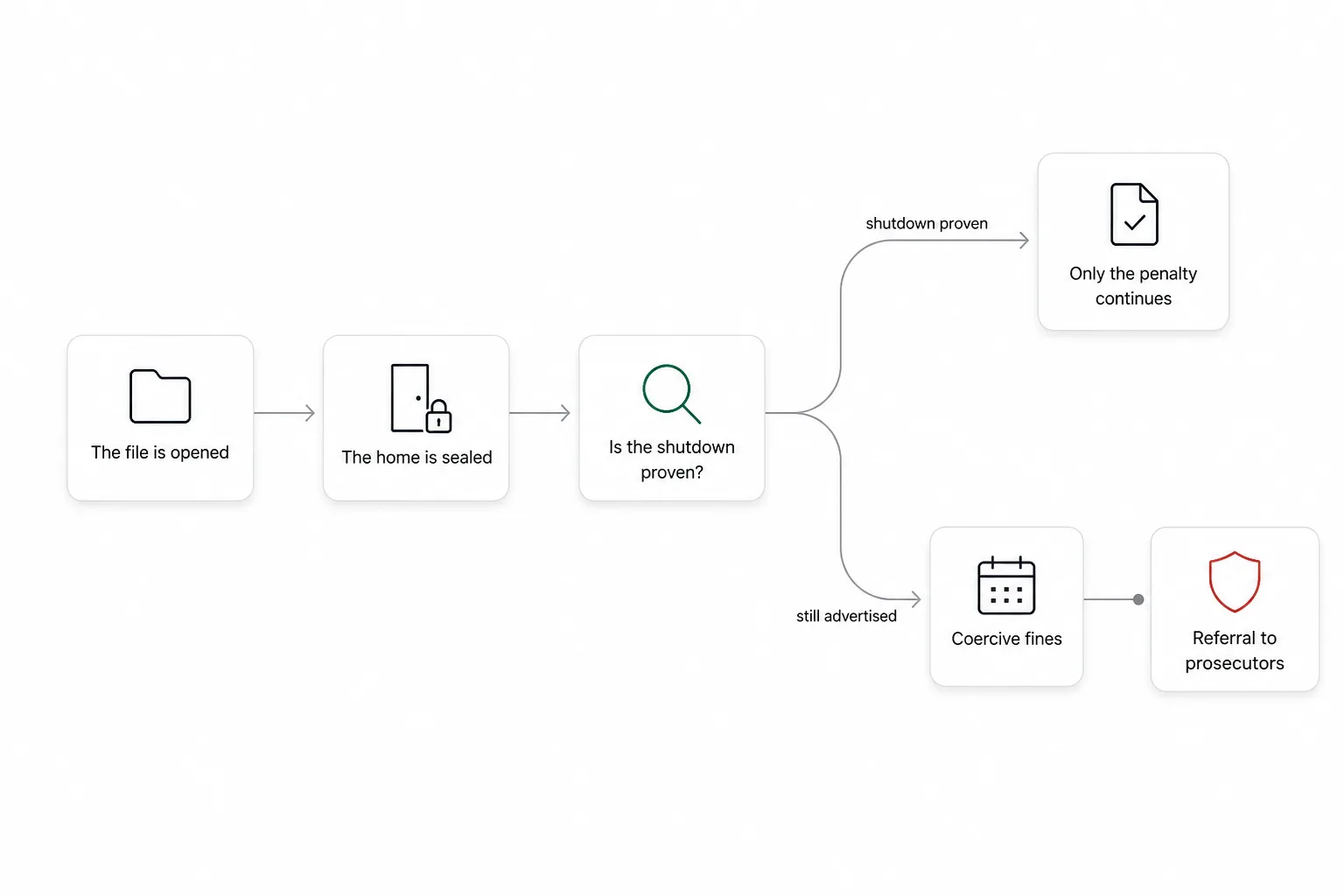
For years the punishment arrived at the end: first the file, then the fine. In Ibiza that has changed. The home is now sealed while the case is still open.
On 17 September 2026, the Consell d’Eivissa and the local police of Eivissa sealed a home on calle Gregal, in the town of Eivissa. The resolution that opened the case is dated 8 July 2026. It targets two people: the person marketing the home and its owner. The file contemplates a penalty of 220,001 euros for a very serious infringement.
A month earlier, in August, something similar happened in Santa Eulària des Riu. There the file contemplates 275,001 euros and reaches more people: the person marketing the home, the host who published the listing, the tenants taking part in running it, and two owners.
These are not one-off cases either. On 16 April 2026 the Consell d’Eivissa reported 262 sanctioning files opened since January 2025, 10 homes sealed (4 more in progress), and more than 700 listings removed that year, under an arrangement with the platforms to block listings within 48 hours.
A case has stages, and the fine is the last one
Knowing which stage your case is in matters, because each one lets you do different things. This is the usual path in the Balearic Islands:
- Complaint or inspection. It can start with a neighbour’s report, a street inspection, or a sweep of online listings.
- Opening of the file. The administration opens the case, states the facts it is investigating and against whom.
- Provisional measure. This is where the seal appears. Before it is taken, the interested parties get a hearing, with a maximum of seven days to submit arguments and documents.
- Proposed decision. The case officer proposes the infringement found and the penalty sought.
- Decision. This is when the fine actually exists. The administration has one year to decide and notify; after that, the file expires.
- Appeals. The notification itself states which appeals are available.
The administration can serve the shutdown order on whoever runs the activity, on the owner, or on the tenant. You do not have to be the person who published the listing to receive it.
The planning track is a separate case
The same rental can open two separate cases, and they should not be confused:
- The tourism track penalises advertising, contracting, or marketing tourist stays when the property type, the zone, or the tourist places do not allow it. It is run by the island council.
- The planning track penalises using the building, or changing its use, without the planning title that allows it. It is run by the town hall, and the fine is a percentage of the value of the building.
On 1 June 2026, the town hall of Eivissa imposed a planning penalty of 793,443.74 euros for a change of use from residential to tourist without a title, applying 75% of the property’s value. The case came out of a joint inspection by the local police and the planning department.
A visible registry number does not prove everything
The quick check (does the listing show a code) still catches the obvious cases. For your own portfolio it falls short. Go property by property and confirm that:
- the responsible declaration exists and is still valid;
- the home and the number of places match what is registered;
- the zone and the property type allow the activity;
- the planning use is authorised for that tourist use;
- each listing shows the number for that home, not one from another property of yours.
A valid code from another property, an entry in a national registry, or a listing that is still live prove none of the above. On the national identifier and its journey through the courts, we cover it in the article on the Supreme Court annulling the NRUA.
Liability is not only the owner’s
In the September case, the owner and the marketer were on the hook. In the August one, five different profiles were, including tenants who were subletting.
Having a lease or a management contract does not leave you out on its own. Before assigning blame, look at who publishes the listing, who takes the money, who confirms the booking, who hands over the keys, and who knew what the home was being used for.
What to do in the first 24 hours
If you get an inspection, a notification, or a seal, do this the same day:
- Open a record for each home and each person served. Note the authority, the file number, the facts, the measure, the hearing deadline, and how it reached you.
- Keep everything that documents the activity: listings, contracts, bookings, bank statements, messages, and titles. Do not delete or edit anything after a notification.
- Close availability for that home in your PMS, your own booking engine, and every OTA. Stop campaigns and automated replies too.
- Identify the affected bookings and resolve them in writing: relocation or refund, with proof of what you offered.
- Suspend only the affected home, unless the decision says otherwise.
- Tell the owner, the manager, the insurer, and your advisers the same day.
- Keep proof of the real shutdown date. That is what lets you evidence it later.
- Review the rest of your portfolio against the same criteria, before the second letter arrives.
The 80% and 60% reductions are not a shortcut
Balearic law allows the fine to be cut if, while the case is being processed, responsibility is acknowledged and the home is handed over:
| Reduction | What it takes | Minimum term |
|---|---|---|
| 80% | Hand the home over to social or price-capped rental, or another public-interest use | 5 years |
| 60% | Hand it over to a public affordable-rental programme | 7 years |
It sounds good, but there is small print. You have to acknowledge responsibility, the handover lasts years and takes the home out of your hands, and a cut on the tourism track does not erase a planning case. Talk to a lawyer before acknowledging anything.
Risks for those who rent without complying
If you are a host, this is the part that matters most to you: operating irregularly does not pay off. The risks go far beyond a one-off fine:
- Administrative penalties for lacking a tourist license or registry (the amount varies by autonomous community).
- Listing removal by the platforms, which increasingly verify the registry number.
- Public-safety penalties if you do not submit the traveler registration to SES.Hospedajes.
- Tax problems if you do not declare the rental income.
- Conflicts with the homeowners’ association, which can take legal action if the building bans tourist use.
How to make sure your rental is 100% legal
The good news is that getting compliant is perfectly manageable if you tackle it layer by layer:
- Tourist license and registry. Register your property in your autonomous community’s registry and display the number on all your listings.
- Traveler registration. Identify your guests and submit the report to SES.Hospedajes on time (Royal Decree 933/2021). We explain it in detail in our traveler registration guide.
- Tax obligations. Declare the rental income according to your situation.
- Community and municipal rules. Confirm that your building and your area allow tourist use.
Frequently asked questions about illegal vacation rentals
How do I know if a tourist flat is illegal?
Check whether the listing shows a tourist registry number and verify that number in the official registry of the autonomous community. If it does not appear, or the code does not exist, it is very likely illegal. Also check whether the building or municipality allows tourist use.
Who can report an illegal vacation rental?
Anyone: a neighbor, the homeowners’ association, a competitor, or even a guest. You do not need to be an affected party to file a complaint with the tourism department.
Where do you report an illegal tourist apartment?
The main route is the tourism department of the autonomous community. In addition, you can turn to the city council (zoning, noise), the platform where it is advertised (listing-report channel), and the Tax Agency if you suspect tax fraud.
What evidence do I need to report?
Screenshots of the listing (with date and price), photos or videos of the guest turnover, homeowners’ association minutes, and any communication evidencing the activity. The more documentation, the better.
What fines are there for renting without a license?
Penalties for illegal tourist rentals are set by each autonomous community and can be very high. Since the amounts and the classification of offenses change, verify the figures in force through the official channels of your region.
Does a seal mean I have already been fined?
No. The seal is a provisional measure that stops the home being used while the case is processed. The fine, if it comes, is decided in the final decision, and it can be appealed. What is immediate is the duty to stop: carrying on despite the order triggers separate coercive fines.
If I lease my flat to a tenant who sublets it to tourists, am I liable?
You can end up in the file. In the Santa Eulària case of August 2026, the procedure reached the tenants running the home, the host who published the listing, the person marketing it, and two owners. Having a lease does not exclude you on its own: what counts is who publishes, who takes the money, and who knew about the use.
Does having a tourist license exempt me from traveler registration?
No. They are different obligations. The license is a tourism matter (regional) and traveler registration is a public-safety matter (national, via SES.Hospedajes). You must comply with both.
In summary
Spotting an illegal vacation rental comes down to checking two things: that the listing shows a registry number and that the number actually exists in the autonomous community’s tourist registry. Reporting it is within anyone’s reach, as long as you provide evidence and turn to the right body.
If you are a host, that quick check no longer protects you. The Balearic Islands have shown two things this year: the home can be closed while the case is still open, and far more people than the owner can end up in it. Complying across all three layers (tourism, public safety, and tax) is still cheaper and calmer than the alternative.
Related resources
- Traveler Registration 2026: the complete guide and SES.Hospedajes
- The Supreme Court annuls the NRUA: what changes for your rental
- Tourist registration code: how to check it in 2026
- Tourist license in Spain: how to get it in 2026
Details and sources
The exact wording, in case you need to quote or check it:
- Very serious infringement: article 120.i) of Ley 8/2012 on Tourism of the Balearic Islands, covering the advertising, contracting, or marketing of tourist stays in homes whose type does not allow it, in zones that are not suitable, or without acquired tourist places.
- Amount: article 123.3 of the same law, a fine of 50,001 to 500,000 euros for very serious infringements, with temporary or permanent closure possible as an additional penalty.
- Reductions: article 123.5, of 80% (handover to social or price-capped rental or other public-interest uses, minimum five years) and 60% (public affordable-rental programmes, minimum seven years), both requiring acknowledged responsibility evidenced while the case is being processed.
- Seal: article 128.1.b), temporary closure of the establishment or the home as a provisional measure; article 128.3, prior hearing of the interested parties within a maximum of seven days; article 128.4, service on whoever runs the activity, on the owner, or on the tenant, indistinctly.
- Ignoring the shutdown order: article 128.4, successive coercive fines over minimum periods of fifteen days and minimum amounts of 6,000 euros each, with referral to the public prosecutor if it continues; article 128 bis, coercive fines of between 500 and 5,000 euros per day after a prior warning, with referral to the prosecutor after at least two assessments. These are different situations with different calculations: check which one your notification cites.
- Expiry: article 127, one year to decide and notify the sanctioning procedure.
- Planning track: articles 167.3 and 167.4 of Ley 12/2017 on planning in the Balearic Islands. Use without a title is fined at 25% to 50% of the property’s value if the use is permitted, and 50% to 100% if it is not; a change of use without a title is fined at the higher of the two amounts the article sets out.
- Cases cited: the calle Gregal seal in Eivissa of 17 September 2026 (resolution of 8 July 2026, file contemplating 220,001 euros); the Santa Eulària des Riu seal of August 2026 (file contemplating 275,001 euros); the planning penalty imposed by the town hall of Eivissa on 1 June 2026 of 793,443.74 euros; the Consell d’Eivissa enforcement report of 16 April 2026 (262 files since January 2025, 10 homes sealed, more than 700 listings removed in 2026).
Amounts in ongoing files are proposals, not final penalties. The laws cited were consulted in their consolidated version as of 13 June 2026.
This guide is informational and does not constitute legal advice. Always verify the requirements in force (licenses, registries, deadlines, and penalties) through the official channels of your autonomous community and the Ministry of the Interior.