


The Pontevedra provincial gazette published the full text of the ordinance on 11 September 2026. It has been in force since the day after, and charging starts on 1 October 2026. Hotels, guesthouses, tourist apartments, tourist-use dwellings (VUT), campsites, rural accommodation and hostels in Vigo will charge each guest a surcharge per person per day.
What everyone calls the “Vigo tourist tax” is not technically a tax on the accommodation. It is a municipal surcharge on the Galician tourist stay tax, created by regional Law 5/2024 and switched on voluntarily by the city council through a fiscal ordinance. That distinction matters in practice. It explains why the amount is calculated on a regional rate that nobody currently pays, and why collection, penalties and filing sit with the city council rather than with the regional government.
For whoever runs the property, the consequence is direct. The guest is the taxpayer, but you are the substitute taxpayer: you charge it, you document the exemptions, you keep the evidence and you file the return. If something goes wrong, it is not the traveller’s problem. This article follows the published ordinance and the FAQ guide the council published before 1 October, which explains how VAT works.
It is a surcharge on a tax that is currently 100% rebated
Law 5/2024 created the Galician tourist stay tax as a regional tax. Its article 16 sets a rate in euros per day or part-day by accommodation type. But article 17 grants a 100% rebate, and article 20.3 adds that the filing obligations for the tax are not effective while that rebate remains total.
The regional tax exists, it has a published rate, and the amount payable is zero.
Article 24 changes that. Galician municipalities may voluntarily establish a surcharge on that tax, having first approved a fiscal ordinance with consultation of the tourism sector. Its paragraph 3 defines the surcharge as a percentage of up to 100% of the gross tax liability before the rebate is applied.
Vigo is not the only Galician city that charges it: Santiago and A Coruña have done so since autumn 2025. Rates for every region and city are in the tourist tax in Spain. The Basque Country starts in 2027 with a different model, explained in the Bilbao, San Sebastián and Vitoria tourist tax.
Article 24 has another practical consequence. Applying the surcharge, imposing penalties and reviewing decisions belong to the city council, not to the Galician tax agency. Your contacts, forms and deadlines are municipal ones. In Vigo the rules live in Fiscal Ordinance no. 54.
Timeline: the rules are final, the form is not
A local fiscal ordinance takes effect once its full text is published in the provincial gazette. That has now happened. Issue 175 of the BOP of Pontevedra, dated 11 September 2026, published the complete text of Fiscal Ordinance no. 54. Its second final provision states that it enters into force the next day and starts applying on 1 October 2026.
| Milestone | Date | Status |
|---|---|---|
| Prior public consultation (art. 24.2 of Law 5/2024) | 25 Aug to 22 Sep 2025 | Closed |
| Draft approved by the governing board | 17 Apr 2026 | Closed |
| Initial council approval and public exposure | May 2026 | Objections from hoteliers and the Port, rejected |
| Final council approval | 7 Sep 2026 | Approved |
| Full publication in the BOP of Pontevedra | 11 Sep 2026 | Published in issue 175 |
| Entry into force | 12 Sep 2026 | In force |
| Surcharge page and FAQ guide | September 2026 | Published on the portal, with the declaration form |
| Charging starts | 1 Oct 2026 | Set in the second final provision |
| First return (Oct to Dec 2026) | By 31 Jan 2027 | Set in the third transitional provision |
| Surcharge oversight committee | Before August 2027 | Ten months from the start of application (art. 11) |
How much is charged per person per day
Article 7 sets the surcharge at 72.75% of the gross liability under the regional rate, 27.25 points below the maximum the law allows. It then turns that into a table of amounts per day or part-day. This is the published table, as it stands:
| Accommodation type | Before VAT | With VAT (council guide) |
|---|---|---|
| Hotels, 5-star, 5-star superior and 4-star superior | €1.82 | €2.00 |
| Hotels, 4-star, 3-star superior, 3-star and 2-star superior | €1.46 | €1.60 |
| Tourist-use dwellings (VUT) | €1.46 | €1.60 |
| Hotels, 2-star, 1-star superior, 1-star and guesthouses | €1.09 | €1.20 |
| Hostels, campsites, rural tourism, tourist apartments, tourist dwellings | €0.73 | €0.80 |
| Cruise-ship stays (from 1 July 2027) | €1.09 | €1.20 |
The ordinance only sets the rate before VAT. The with-VAT column comes from the council’s FAQ guide, which adds 10% and rounds.
The 72.75% is a political choice by the council and it can be revisited in future ordinances. Santiago and A Coruña have set their surcharge at 100% of the regional rate, and the BNG voted against in Vigo precisely because it does not go to the maximum. Do not assume the figure will be the same in two years.
Rate, VAT and total: three different figures
Almost all the press coverage says “between €0.80 and €2”. Those are the rates with VAT added, and the council uses them in its FAQ guide. The guide says the property charges the guest the amount plus VAT. To keep them apart, separate three figures on every invoice:
- The surcharge rate. The before-VAT figure from the ordinance (€1.46 for a tourist-use dwelling). This is what you declare and pay to the council in your return.
- The VAT. The VAT on your invoice for that rate. It is not paid to the council: it goes in your VAT return with the rest of the invoice.
- What the guest pays. The two added together (€1.60 per person per day for a tourist-use dwelling).
A tourist-use dwelling pays double what a “vivienda turística” pays
This is the most expensive mistake you can make when configuring rates, and it happens because Galicia has two distinct legal categories that sound identical in English.
Article 2 lists viviendas turísticas and viviendas de uso turístico separately. And the table in article 7 prices them differently: €0.73 for the first and €1.46 for the second. Double.
The same applies to apartamentos turísticos (tourist apartments), which sit in the €0.73 band even though in everyday commercial language many people use “apartment” and “tourist flat” interchangeably.
The category that counts is not how you advertise the property, but the figure it is registered under in the Registro de Turismo de Galicia, the regional tourism register. That is the register the ordinance names, in article 7.4, to define what a “regulated establishment” is. If you are not sure, start by checking your tourist registration code and verify the exact category recorded in the entry.
How many days are charged, and why the law does not say “nights”
Almost all the coverage talks about “per night”. The rules do not. The ordinance defines a stay as the enjoyment of the accommodation service per day or part-day, whether or not the guest sleeps over, and article 7.2 adds that the maximum number of days countable per stay is five.
On top of that maximum, the first transitional provision sets a phased introduction. Its exact wording is that the third, fourth and fifth nights carry a 0% surcharge until 30 June 2027, and that from 1 July 2027 up to five nights are counted.
| Period | Nights charged per stay | Rest of the stay |
|---|---|---|
| 1 Oct 2026 to 30 Jun 2027 | The first two | 0% surcharge |
| From 1 Jul 2027 | Up to five | 0% surcharge |
For the first nine months, in practice, you charge two nights per stay and nothing more. A ten-day stay never pays more than five days of surcharge under any scenario.
The ordinance does not say how to treat a stay starting on 29 June 2027 and ending on 3 July. The surcharge accrues at the start of the stay (article 8), which points to applying the regime in force on that day, but it is worth asking the council before summer 2027.
Cruise ships have their own calendar (second transitional provision) and do not start until 1 July 2027, so they stay out of an accommodation provider’s day-to-day.
Who pays, who collects and who is liable if it is not paid over
Article 6 of the ordinance mirrors article 14 of the law, and it is worth reading in full because each paragraph reaches more people than it first appears.
- Taxpayer. The individual staying at the property or the person or entity in whose name the invoice is issued. That second limb matters. If a company books and invoices an employee’s accommodation in its own name, the company is the taxpayer.
- Substitute taxpayer. The individual or legal entity (or unincorporated body) that operates the establishment. It takes on every substantive and formal obligation.
- Jointly liable parties. The owner of the tourist establishment who is not the taxable person, and anyone who contracts directly in the taxpayer’s name acting as intermediary between the guest and the accommodation.
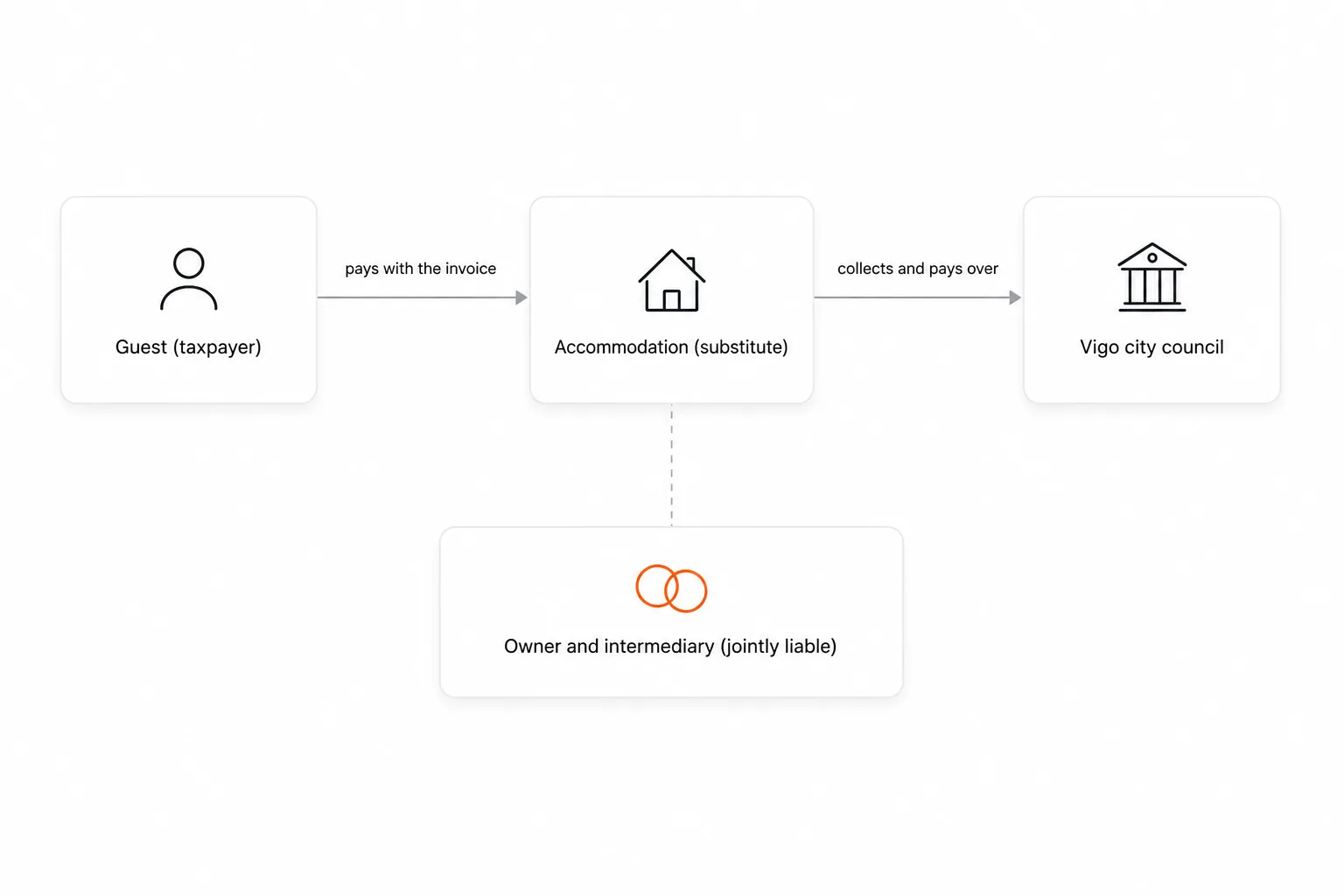
That last paragraph affects two very common arrangements. An owner who hands their property to a management company is not out of the picture. If they are not the taxable person, they are jointly liable for payment. And a manager or intermediary contracting in the guest’s name may end up answering for amounts they assumed were someone else’s.
If you manage third-party properties, this allocation belongs in the management agreement: who charges the surcharge, who files it, who keeps the exemption evidence and what happens if the authority comes asking.
When it accrues: at the start of the stay
Article 8 places accrual at the start of each stay. That has three consequences at the front desk:
- Prepaid bookings. You can collect the surcharge with the deposit if you disclose it before booking, but the obligation arises when the guest checks in. Until then it is a payment on account.
- Cancellations and no-shows. With no stay there is no taxable event, so there is no surcharge to pay over. If you collected it with the deposit, the reasonable course is to refund it or not charge it, even if you keep the accommodation amount under your cancellation policy. The ordinance does not address this case expressly. It is our reading, and worth confirming with the council.
- Early departure. The surcharge accrues on the days actually stayed, up to the applicable maximum. If you charged five days and the guest left after three, adjust the invoice.
Exemptions, out-of-scope stays and zero-rate stays: none applies on its own
The ordinance distinguishes three concepts that work the same way in practice (the guest does not pay) but are legally different. The third, the zero rate, is specific to Vigo and does not exist in the regional law.
Out of scope (article 3.1), where the stay does not even trigger the taxable event:
- Stays for health reasons, and those of accompanying persons, provided receipt of healthcare covered by the Galician public health service (SERGAS) is evidenced.
- Stays by federated athletes attending official competition fixtures, duly evidenced.
- Stays due to duly evidenced force majeure. The ordinance adds that accommodation arranged through the municipal social services counts as force majeure.
Exempt (article 3.3), where the taxable event occurs but the charge is removed:
- Unemancipated minors.
- People with a certified disability of 65% or more.
- Stays subsidised by social programmes run by a public administration of any EU member state. This applies when the booking or the invoice is in the name of the entity running the programme and the programme is identified.
- Stays in public hostels run by the regional government through S.A. do Plan Xacobeo.
- Stays in youth hostels.
Zero rate (article 4), new in Vigo’s ordinance:
- Stays by Vigo residents as a result of rehousing, works on their main home in Vigo and similar situations.
- Stays paid for by a public-law entity or under the official travel-allowance rules of Royal Decree 462/2002 (per-diem rules for public-sector staff on official duty) or an equivalent rule.
That second case is more common than it sounds in a city with a referral hospital, a university, courts and a port: civil servants, seconded health or teaching staff, experts and technicians whose stay is paid by a public body. On corporate bookings, ask who is paying for the stay.
The signed declaration your guest will have to complete
This is the part that will cost your front desk the most work. For six cases, article 5 requires the person staying to complete and sign a declaration form (“declaración responsable”). The form is an annex to the gazette, and the council has now published its updated version on the surcharge page. Print that one.
It is a single page. It asks for the guest’s name and ID or passport number, has one tick box per case (health, federated athlete, force majeure, disability, a public body paying, and rehousing or works) and a space for the details each case requires. At the bottom there are two signatures: the guest’s and the establishment’s. Yours, or whoever is on the desk.
| Case | Signed declaration? | Supporting evidence |
|---|---|---|
| Health reasons (and companions) | Yes, with the patient’s details | Certificate from the health centre or medical report showing the care is covered by SERGAS |
| Federated athlete at an official competition | Yes | Competition details (club, sport, competition) on the declaration itself |
| Force majeure | Yes, stating the event | Document evidencing the event or the public measure activated, issued by the local authority, unless it is common knowledge |
| Disability of 65% or more | Yes | Showing the certificate or document evidencing the degree |
| Zero rate for rehousing or works (resident) | Yes | Address of the main home in Vigo on the declaration itself |
| Zero rate for public body or RD 462/2002 | Yes | Identification of the public-law entity paying for the stay |
| Unemancipated minors | Not required by art. 5 | Documentary evidence by any means (the ID and date of birth from the traveller register) |
| EU social programmes | Not required by art. 5 | Booking or invoice in the name of the entity running the programme, with the programme identified |
| Plan Xacobeo and youth hostels | Not required by art. 5 | The nature of the establishment itself |
The substitute taxpayer must keep for four years a copy of the documents or declarations used to justify each case (article 5.3). Article 3.4 adds that every case, including those that do not need a declaration, must be evidenced by any means accepted in law. And article 3.5 requires you to keep that evidence “for the limitation period”. Both rules land in the same place, because the general tax limitation period is also four years. It runs from the filing deadline, not from the night the guest slept there.
If you do not file, the council estimates using your traveller register
Two articles of the ordinance that almost nobody has commented on explain how the council will check what you file.
Article 7.4 lets the municipal tax office apply indirect estimation if the substitute does not file, files an incomplete or inaccurate return, or fails to provide occupancy data. To fix the number of stay units it may use occupancy statistics for the same type of establishment in Vigo, a sample of regulated establishments in the same area, sector studies and, expressly, the police register of people staying in the city’s lodging establishments.
Article 12 completes the mechanism. The council may ask the Directorate-General of Police, under an agreement and by electronic means, for the register data strictly necessary to apply the surcharge: identification of the establishment and its operator, the number and type of each guest’s ID document and their date of birth, the check-in date and the planned number of days.
What you report to SES.Hospedajes under Royal Decree 933/2021 is the same dataset the council can cross-check against your return: people, check-in dates, planned days and age (for the minors exemption). If the traveller report is right and the return reconciles with it, there is no problem. If either is wrong, the difference will show in an inspection.
Showing it on the invoice, in the PMS and across channels
The surcharge is calculated per person and per day, not per booking or per room. That breaks the logic of quite a few PMS configurations, which are built around supplements per accommodation unit.
Points to resolve before 1 October:
- Breakdown. The surcharge must be identifiable as its own line on the invoice, separate from accommodation and other supplements, with the before-VAT ordinance rate, the VAT if any, and the number of people and days behind it.
- Headcount. You need a reliable count of occupants per day, not just the booking figure. An early departure or a no-show changes the base.
- Minors. If your booking engine does not distinguish adults from minors, you cannot apply the exemption automatically or evidence it afterwards. The date of birth from the traveller register is the natural proof.
- Channels. Check, channel by channel, whether the OTA collects the surcharge, displays it as a local tax payable on arrival, or ignores it. Do not assume. There is no public agreement between the council and the platforms today, and paying it over remains your responsibility as substitute taxpayer.
- When it is disclosed and charged. The amount must be known before booking (terms and booking engine), and it can be collected with the deposit or at the start of the stay. A surprise charge at check-in ends in a bad review.
- Reconciliation. Each month, match the people and days invoiced against the PMS, against what was collected at the desk and through each channel, and against the traveller report.
If you are reworking your season numbers, this surcharge is a management cost and a conversion friction, not revenue. It is worth recalculating your holiday-rental profitability under the new scenario before setting winter rates.
Filing: half-yearly, online, first deadline 31 January 2027
Article 24.6 of the law leaves the obligation to self-assess the surcharge, along with the deadlines and the method, to the municipal ordinance. Article 9 of Vigo’s ordinance spells it out:
| Period | Amounts accrued | Filing and payment |
|---|---|---|
| First period (third transitional provision) | 1 Oct to 31 Dec 2026 | By 31 January 2027 |
| Half-year 1 (every year) | 1 Jan to 30 Jun | By 31 July of the same year |
| Half-year 2 (every year) | 1 Jul to 31 Dec | By 31 January of the following year |
Three more rules from the same article:
- The return is filed online on the council’s electronic portal, using the form that will be available there.
- Anyone operating more than one establishment may file and pay for all of them in aggregate, in a single return. For a manager with ten properties in Vigo, that is the difference between one filing and ten.
- Management, inspection and collection follow the General Tax Law and the council’s General Fiscal Ordinance; so do infringements and penalties (articles 10 and 14).
Whatever the form looks like, the data you will need per establishment is the same, so you can start accumulating it from day one:
- Chargeable stay days, by accommodation category.
- Number of people and days exempt, out of scope or zero-rated, with the ground applied to each.
- Amounts actually collected, reconciled against the desk and the channels.
- An archive of declarations and supporting evidence, linked to each booking.
Where the money goes, and where the sector gets a seat
Two articles in the published text that almost nobody has commented on give the sector something to hold the council to later.
Article 13 earmarks 80% of what is collected, after deducting the cost of running the surcharge, for investment and spending on sustainable tourism. Checking that the money goes where it says is the job of the tourism and finance departments, and the detail has to appear in the municipal budget.
Article 11 creates a municipal advisory and monitoring committee, with representatives of the council, of businesses in the sector and of residents’ associations. The council must set it up within ten months of the start of application, so before August 2027. The committee tracks occupancy, bed places and revenue per place, and approves an annual impact report published on the council’s transparency page.
If the surcharge affects you, that is the channel for arguing about rates or paperwork. Your trade association is who can claim the seat.
Checklist for 1 October
Map.
- Verify the exact category each property is registered under in the Registro de Turismo de Galicia and assign its before-VAT rate (€1.82 / €1.46 / €1.09 / €0.73).
- Allocate the roles by contract between owner, manager and intermediaries, given the joint liability.
- Review channel by channel how the surcharge is displayed and who collects it.
- Download the updated declaration form from the surcharge page and leave it at the front desk.
Configure.
- Set up the surcharge as a per-person, per-day item in the PMS, booking engine, POS and invoice, with the before-VAT ordinance rate and, if your invoice carries VAT, the VAT on a separate line.
- Enable the two-night cap (until 30 June 2027) and schedule the switch to five.
- Enable the minors exemption linked to the date of birth.
- Update booking conditions, pre-arrival emails and on-site notices.
Rehearse.
- Prepare a front-desk script for the exempt cases, with the declaration and the evidence each one needs.
- Decide where declarations and evidence are stored, who can access them and when they are deleted (four years).
- Test a multi-night booking, a group booking, one with a minor, a cancelled prepaid booking and an early departure, and check the invoice and reconciliation in each case.
- Diarise the first return (31 January 2027) and assign someone to watch the portal until it publishes the form.
Four worked examples
Tourist-use dwelling, 4 nights in November 2026. Two adults and one minor. The minor is exempt (the date of birth on the traveller report evidences it). We are inside the transitional period, so only the first two nights are charged. Surcharge: 2 people × 2 days × €1.46 = €5.84, which is what you pay the council. If you invoice with 10% VAT, the guest also pays €0.58 of VAT.
Four-star hotel, one guest, 6 nights. In March 2027, inside the transitional period: 1 × 2 × €1.46 = €2.92 of surcharge, plus €0.29 of VAT. The same stay in August 2027, now with the five-night maximum: 1 × 5 × €1.46 = €7.30 of surcharge, plus €0.73 of VAT. The booking is identical and the surcharge is two and a half times larger, which is worth flagging to whoever sets summer rates.
Tourist apartment, 3 nights for health reasons. One person receiving care from SERGAS, plus one companion. Both stays are out of scope, the companion included. Surcharge: €0, provided the guest signs the declaration with the patient’s details and provides the certificate or report from the health centre, and you keep both for four years. Without that proof, out-of-scope status will not survive an inspection.
Guesthouse, two adults, 2-night prepaid booking, cancelled. The guest never arrives. There is no stay, so no taxable event and no accrual: €0 to pay over, and the 2 × 2 × €1.09 = €4.36 collected on account with the deposit should be refunded or not charged, even if you keep the accommodation amount under your cancellation policy. That is our reading of article 8; confirm it with the council.
Frequently asked questions
Does the guest or the property pay the Vigo tourist tax?
The guest pays it, as the taxpayer. The property acts as substitute taxpayer: it charges it, documents it and pays it over. As far as the council is concerned, the party obliged to file and pay is the property, not the traveller.
Is it already in force?
Yes. The BOP of Pontevedra published the full text on 11 September 2026, so the ordinance has been in force since the 12th. Charging starts on 1 October 2026: that is the date from which you have to pass it on to your guests.
Is it charged for children?
No. Stays by unemancipated minors are exempt. No signed declaration is needed, but you must be able to evidence it. The date of birth you already collect for the traveller register will do.
Do I need the exempt guest to sign anything?
In most cases, yes: health reasons, federated athletes, force majeure, disability and the two zero-rate cases require the declaration form annexed to the ordinance, signed by the guest and by the establishment, with the corresponding evidence. Minors, social programmes and public hostels do not.
How many nights are charged on a long stay?
Until 30 June 2027, only the first two nights of each stay. From 1 July 2027, up to five. Never more than five, however long the stay.
Does the amount include VAT?
The ordinance sets the rate before VAT: €1.82, €1.46, €1.09 or €0.73 depending on the property. The council’s guide says the property charges that rate plus VAT, and gives totals of €2.00, €1.60, €1.20 and €0.80. You only pay the council the before-VAT rate. If your rental is VAT-exempt, the guide does not say what to do: ask your adviser.
Does it apply to tourist-use dwellings?
Yes, and in the upper band. A VUT is charged €1.46 per person per day before VAT (€1.60 with VAT), the same as a four-star hotel and double what a tourist apartment or a “vivienda turística” pays. Check which figure your property is registered under before assuming the lower band.
When is the first return due?
Amounts for October, November and December 2026 are filed and paid by 31 January 2027, online on the council’s portal. From 2027, two returns a year: by 31 July (first half) and by 31 January (second half).
What if the booking comes through Airbnb or Booking?
It depends on what each channel does, and it is not consistent between platforms or between municipalities. An OTA not collecting it does not shift the obligation to the guest. As substitute taxpayer, you are still the one who must declare and pay it over. Review each channel’s settings and, where it is not collected, charge it on arrival with the correct breakdown.
Is it connected to the traveller register?
They are separate obligations. The surcharge is a municipal tax matter, while traveller registration is a public-security obligation under Royal Decree 933/2021. They are met separately. But the ordinance authorises the council to request the police register of people staying in order to check and, if needed, estimate the surcharge, so it pays to keep both consistent.
Sources
- BOP of Pontevedra no. 175, full text of Fiscal Ordinance no. 54 (11 September 2026), the primary source for every article, the transitional provisions, entry into force and the declaration form in the annex.
- BOP of Pontevedra, index of the 11 September 2026 issue, identifying the notice and the issue number.
- Galician Law 5/2024, consolidated text in the BOE (articles 9 to 24), the primary source for the regional tax, its rates and the enabling provision for the municipal surcharge.
- Vigo city council, note of 7 September 2026 on the final approval, the primary source for the council vote.
- Vigo city council, tourist surcharge page, with the published documents and the return form listed as “coming soon” at the end of September 2026.
- Vigo city council, surcharge FAQ guide, the source for the with-VAT amounts and the rule that the property charges the amount plus VAT.
- Spanish tax agency, tourist apartment rentals and VAT, on when a rental is exempt and when it is taxed at 10%.
- Dirección General de Tributos, binding ruling V0507-26 of 5 March 2026, as reported by Fiscal Impuestos, on the inclusion of the Galician tourist stay tax in the VAT base.
- El Correo Gallego, comparison of Santiago, Vigo and A Coruña, context on the municipalities applying 100% of the regional rate.
- Galiciapress, report on the 7 September council session and The Objective, objections from hoteliers and the Port, press context for the decision.