


Yes, Bilbao has a tourist tax. It starts on 1 January 2027, as it does in San Sebastián (Donostia in Basque) and Vitoria-Gasteiz. The guest pays a set amount per person per night. You collect it before they leave and declare it to the city council every three months.
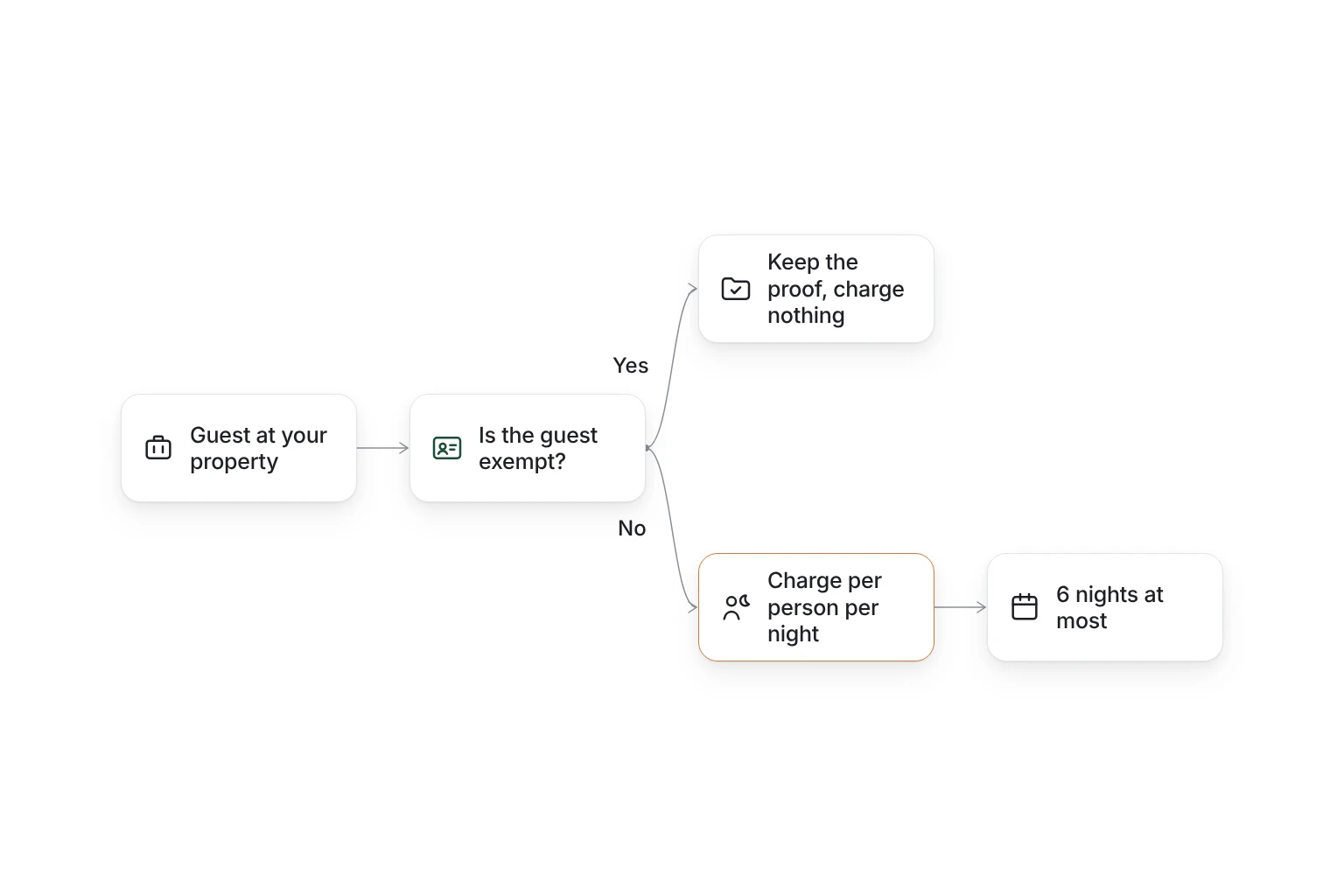
In a holiday rental in any of the three cities it is €6.50 per person per night. Guests pay for 6 nights at most. Under-18s pay nothing.
When the Basque tourist tax starts
It applies to stays that start on or after 1 January 2027. A booking made before 5 February 2026 does not pay, even if the stay is in 2027. That rule applies in all three provinces: Bizkaia, Gipuzkoa and Álava.
It is not a Basque Government tax. In June 2026 each province passed its own law, called a norma foral. Each law sets a minimum and a maximum rate for every type of accommodation. Then each city council picks its rate inside those limits in a local tax bylaw (ordenanza fiscal).
What counts is the city where the property is. It does not matter where the guest lives or where your company is based.
The three bylaws are still going through approval. This was their status on 26 October 2026:
| City | What has been approved | What is still missing |
|---|---|---|
| Bilbao | Provisional approval, 24 Sep 2026 | 30 days for objections from the notice in the Bizkaia Official Gazette on 29 Sep. With no objections, it becomes final |
| San Sebastián | Initial approval, 24 Sep 2026 | Public consultation and final approval |
| Vitoria | Provisional approval, 25 Sep 2026 | Objections until 16 Nov. The council plans final approval on 27 Nov and publication on 4 Dec |
A city without a bylaw on 1 January does not escape the tax. All three provincial laws say the maximum rate then applies.
Tourist tax rates in Bilbao, San Sebastián and Vitoria
Rates are in euros per person per night, for 6 nights at most. Bilbao and Vitoria publish their figures in the text they voted. San Sebastián says it applies the maximum rates of the Gipuzkoa law, without the extra surcharge the law allows.
| Type of accommodation | Bilbao | San Sebastián | Vitoria |
|---|---|---|---|
| Whole holiday rental | €6.50 | €6.50 | €6.50 |
| Holiday rental let by the room | €6.50 | €6.50 | €6.50 |
| Tourist apartment | €3.50 | €3.50 | €1.50 |
| 5-star hotel | €5.00 | €6.50 | €6.50 |
| 4-star hotel | €4.00 | €5.50 | €3.50 |
| 3-star hotel | €2.00 | €3.50 | €1.50 |
| 2-star hotel | €1.50 | €2.50 | €1.00 |
| 1-star hotel | €1.00 | €1.75 | €0.75 |
| Guesthouse (pensión) | €1.00 | €1.75 | €0.75 |
| Rural house | €1.00 | €1.75 | €0.75 |
| Farm stay (agroturismo) | €1.00 | €1.25 | €0.50 |
| Hostel | €1.00 | €1.75 | €0.75 |
| Campsite | €1.00 | €1.75 | €0.75 |
| Other tourist accommodation | €2.00 | €3.50 | €1.50 |
Cruise passengers pay too: €6 in Bilbao and €7 in San Sebastián.
The table covers these three cities only. Other towns in Bizkaia, Gipuzkoa or Álava may set different rates within the same limits. Rates for the rest of Spain are in the tourist tax in Spain by region and city.
Two examples. A couple with two children spend 4 nights in a Bilbao holiday rental. Only the adults pay: 2 × 4 × €6.50 = €52. One person stays 9 nights in a Vitoria holiday rental. They pay for 6 nights, not 9: 6 × €6.50 = €39.
Who pays the tax and who declares it
The guest pays the tax. You, as the operator of the property, do the rest:
- Tell the guest the amount before they arrive.
- Collect it at any time before the stay ends.
- Keep the proof when someone is exempt.
- File the return every three months and pay the money in.
The law calls you the taxpayer’s “substitute” (sustituto del contribuyente). It means you answer to the city council, even though the money is the guest’s. If you do not collect it, you pay it.
Who is the operator? The council checks the Basque register of tourism businesses (REATE). Whoever is listed there for the property is presumed to run it, unless they prove otherwise. If you are not registered yet, start with how to register a holiday rental in the Basque Country.
Platforms and agencies that take the booking or the payment can also be held liable for the debt. That does not remove your duty to declare.
Who does not pay the Basque tourist tax
All three provincial laws have the same exemptions. The guest’s word is not enough: each one needs proof.
| Exempt | What the guest shows you |
|---|---|
| Under-18s | Their ID card, passport or family book. If they have none, a statement signed by the adult with them |
| Disability of 65 % or more, or dependency grade II or III, plus one companion | The certificate and a signed statement |
| Travelling for treatment covered by Osakidetza, the Basque Health Service, plus one companion | A certificate from the health centre or a medical report saying Osakidetza covers the treatment, and a signed statement |
| Study, research or talent programmes run by the Basque authorities | A document that proves it |
| Social tourism programmes paid by a public authority in the EU or EEA | The booking or invoice from the programme, with the list of guests |
| Force majeure: a disaster or an emergency. Also someone whose home is unusable after works or damage and who stays in their own town | A signed statement, with a document from the emergency or public safety authority that proves the event. No document is needed if the event is officially declared or widely known, such as a declared disaster |
| Bookings made before 5 February 2026 | The booking with its date |
Keep the proof the law asks for, and nothing more. For a child, seeing their ID and noting the exemption is enough; if they have none, keep the statement the adult signs. In every other case, keep the signed statement and the document that goes with it: the health certificate, the programme invoice or the emergency authority’s document. The city council can ask for them for years, and Vitoria’s bylaw says so explicitly. For a health trip, keep the certificate saying Osakidetza covers the treatment, not the medical history. Storing health data you do not need is a data protection problem.
Long stays and back-to-back bookings: the 6-night cap
Each day or part of a day counts as one unit, even without an overnight stay. A stay of under 24 hours counts as one. Guests pay for 6 units at most per stay in the same property.
The count does not restart with a new booking. If a guest extends their stay or books twice in a row without leaving, it is one stay. Moving to another room in the same property is still one stay.
There is one exception for people who stay for work every week. If they leave for the weekend and come back to the same place, the days off do not break the stay.
How to charge the tax: in your booking software or at the card terminal
You can charge it through your property management software (PMS), your card terminal or by hand. What matters is getting it right and being able to prove it. For each stay, keep:
- The city and the type of accommodation.
- How many guests there are, and which ones are exempt and why.
- The real arrival date and the nights that count.
- The booking date, for the 5 February 2026 cut-off.
- The amount collected and when.
If you use software, ask it to calculate per person, not per room. The 6-night cap and the cut-off date should be settings you can change, not numbers fixed in the code. And it should merge back-to-back bookings into one stay.
Before December, test these cases and write down the result:
- A family with two children.
- A 9-night stay. It should charge 6.
- A booking extended by two nights.
- A guest who moves room.
- Arrival and departure on the same day. It should charge 1.
- A health trip with a companion.
- A booking made before 5 February 2026.
- A no-show, and a guest who leaves early.
The law does not settle some cases, such as a no-show. Ask your city council and note its answer. Do not code a guess.
Show the tax as a separate line on the guest’s bill. Ask the council or your accountant how it should appear on the invoice or receipt, and how VAT treats it. The bylaws we read do not say.
When to declare it: every three months
The return is called an autoliquidación (self-assessment). You file it online every three months, using the official form each city council will publish.
In Vitoria you have 25 calendar days after the quarter ends. So tax from January to March 2027 is declared between 1 and 25 April. Bilbao and San Sebastián will set their deadline in the bylaw or the form. If a city passes no bylaw, the provincial laws give the same 25 days.
If you run several properties in the same city, you can declare them together and pay once. But each property goes with its REATE code and its own detail.
The council can ask you for the list of stays: how many guests, which dates and which exemptions you applied. That is almost the same data you already send in guest registration. If the two do not match, it shows.
What to do before 1 January 2027
- List your properties. Note the city, the type and the REATE code of each one.
- Follow your city’s bylaw. Check when it becomes final and whether any rate changes.
- Decide how you will charge. In your booking software, at the card terminal or with a payment link.
- Test the cases above before your first 2027 guest arrives.
- Tell your guests. Put the amount in your listing, in the booking confirmation and in your pre-arrival messages.
- Prepare for exemptions. Keep a signed statement ready for each case. Show whoever checks guests in what to look for.
- Do a practice return. Take one month of stays, add up what you collected and check it matches.
- Choose who will file the first return, in April 2027.
Frequently asked questions
Is there a tourist tax in Bilbao? Yes, from 1 January 2027. A holiday rental pays €6.50 per person per night, for 6 nights at most. A hotel pays from €1 to €5, depending on its stars.
How much is the tourist tax in the Basque Country? It depends on the town and the type of accommodation. The provincial laws allow from €0.50 to €6.50 per person per night, and up to €7 on a cruise ship. For a holiday rental, Bilbao, San Sebastián and Vitoria charge €6.50.
Who pays the tourist tax, the guest or the owner? The guest pays it. But the operator of the property collects it, declares it and pays it in. If they do not collect it, they are liable.
Do children pay the Basque tourist tax? No. Under-18s do not pay. Seeing their ID card, passport or family book is enough.
What is the maximum number of nights charged? Six per person per stay in the same property. Extending the booking or making two bookings in a row does not restart the count.
Details and sources
Provincial laws. The tax on tourist stays (impuesto sobre estancias turísticas) is set by Bizkaia’s Norma Foral 3/2026 (Bizkaia Official Gazette no. 120, 26 Jun 2026), Gipuzkoa’s Norma Foral 3/2026 (Gipuzkoa Official Gazette no. 112, 17 Jun 2026) and Álava’s Norma Foral 13/2026 (BOTHA no. 71, 22 Jun 2026). All three follow the same pattern. Article 9 sets the range for each type of accommodation (€4.50 to €6.50 for holiday rentals) and a cap of 6 units per person per continuous stay. Article 11 allows discounts of up to 100 % in towns with very few beds, and surcharges of up to 50 % in towns with 750 beds or more, or with 5,000 residents or more and a tourism intensity of 10 % or more. One additional provision applies the maximum rates and a 25-calendar-day filing window after each quarter if a town has no bylaw in time; another excludes stays booked before 5 February 2026. The preamble of the Bizkaia law mentions 5 units, but its article 9.3 says 6, which is what Bilbao’s bylaw applies.
Bilbao. The city council approved the bylaw on 24 September 2026, with the rates in the table, the 6-night cap, the exemptions for minors and for bookings made before 5 Feb 2026, and quarterly returns. The public notice appeared in the Bizkaia Official Gazette on 29 September, with 30 days for objections (reported by Bilbao Hiria). With no objections, the provisional decision becomes final without a new vote.
San Sebastián. The council gave initial approval on 24 September 2026 and will apply “the ordinary maximum rates” of the provincial law; the figures in the table are those maximums from article 9 of Gipuzkoa’s Norma Foral 3/2026. An amendment makes student halls subject to the tax only when they offer tourist accommodation open to the public. The council expects €7.01 million a year. That it will not apply the surcharge comes from the local press (Noticias de Gipuzkoa, 24 Sep 2026). At the time of writing we had not found the public consultation notice in the Gipuzkoa Official Gazette.
Vitoria-Gasteiz. The council gave provisional approval on 25 September 2026; the notice appeared in BOTHA no. 113 on 2 October and objections are accepted until 16 November. The rates, the exemptions and their proof, the recurring-work rule, the 25-calendar-day window and identification by REATE code come from the bylaw text (articles 5, 8, 9, 11 and 12). Its approval timetable plans final approval on 27 November and publication on 4 December.
Checked on 26 October 2026. The city sources do not yet say how the tax should appear on the invoice or whether VAT applies.