

If your hotel, guesthouse or apartment business in Spain issues invoices with software, that software has to change. From 2027, every invoice it produces leaves a record that cannot be deleted. The software either keeps that record itself or sends it to the Spanish tax office, the AEAT, the moment the invoice is issued.
Your deadline depends on how you pay tax. A company has until 31 December 2026. A self-employed owner has until 30 June 2027. The first step is the same for both: list every place in your property that issues invoices.
What VeriFactu actually is
VeriFactu is the short name everyone uses for a long regulation: Real Decreto 1007/2023. The AEAT itself calls the name “colloquial” and “inexact”. The regulation sets rules for invoicing software so that nobody can delete or change an invoice without leaving a trace.
Each time your software issues an invoice, it also creates a short summary of it. That summary is called a registro de facturación, or invoicing record. It carries a digital fingerprint and a link to the previous record, so a missing one shows. The invoice also gets a QR code the customer can scan with a phone.
There are two ways to handle those records. You get to choose.
| Mode | What the software does with each record |
|---|---|
| VERI*FACTU | Sends it to the AEAT at the moment the invoice is issued. |
| Non-verifiable system | Keeps it, signed, along with a log of everything done in the system. |
So it is wrong to say that “every business will have to send each invoice to the tax office in real time”. Only businesses that pick the first mode do that. There is also no official program called VeriFactu to install. There are many programs, and each one either complies or does not.
Your date depends on how you pay tax
It does not depend on the size of the business. It depends on which tax you pay on your profits.
| Who issues the invoices | Software must be compliant from |
|---|---|
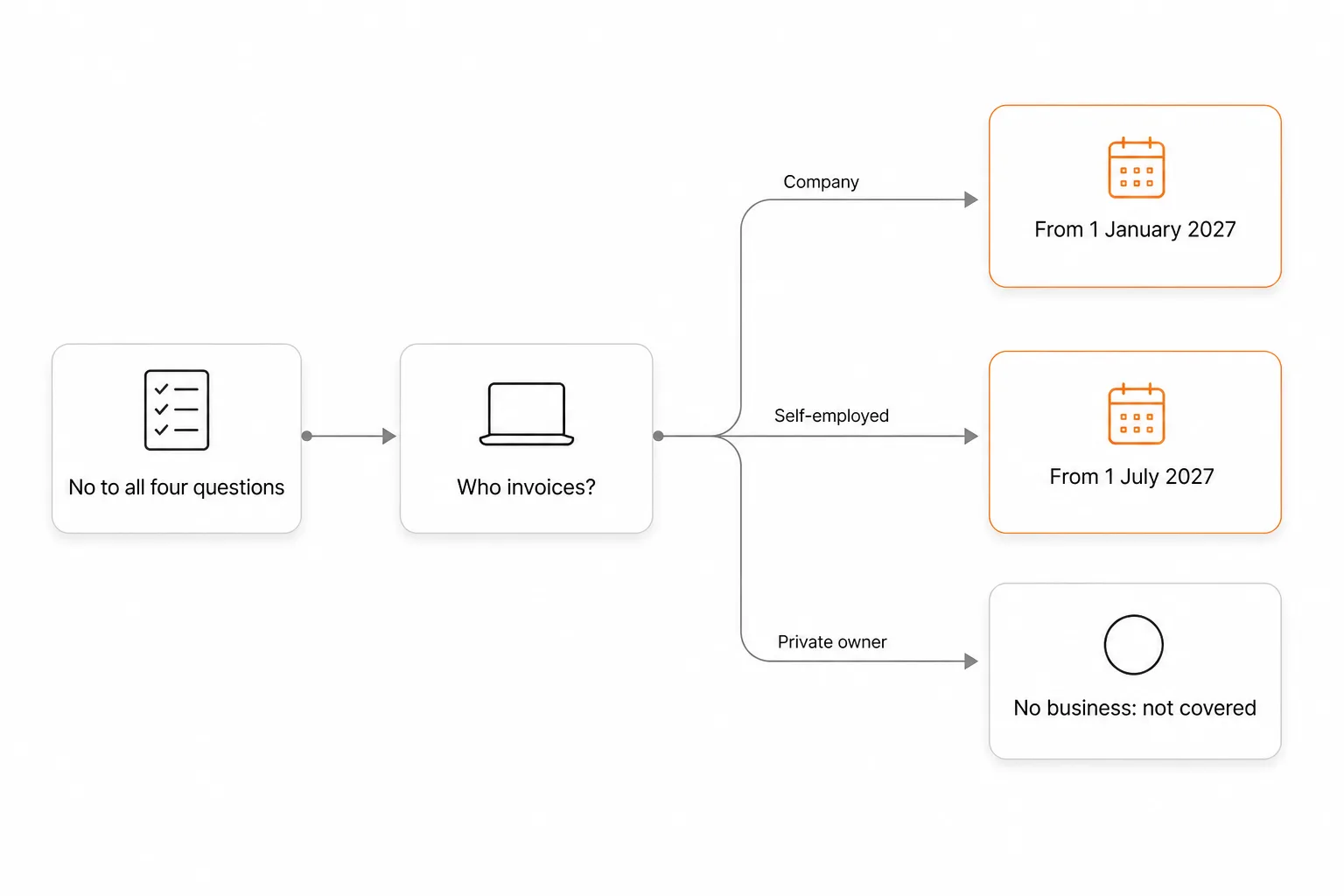
| A company (pays Spanish corporate tax) | 1 January 2027 |
| A self-employed person with a business (pays income tax) | 1 July 2027 |
An example. A four-room guesthouse run as a limited company gets the January date, however small it is. A rural house with a restaurant run by a self-employed owner gets the July date, even if it turns over more.
The dates come from Real Decreto-ley 15/2025, which pushed back the earlier timetable. Until your date, you can trial the system without being locked into it.
Four questions to see if it applies to you
The AEAT sums it up as four conditions. You are covered if you answer “no” to all four:
- Do you issue every invoice by hand, from a paper invoice book? If you use software for even part of your invoicing, the answer is no.
- Are you in the SII, the system that already sends your VAT books to the AEAT almost in real time? It mostly covers businesses with more than 6 million euros in yearly turnover, plus anyone who joined voluntarily.
- Are you taxed in the Basque Country or Navarre? Those regions have their own rules, such as TicketBAI.
- Do you hold a tax office ruling that exempts you? This is rare.
A “yes” to any of them means this regulation does not apply to that business. It does apply in the Canary Islands, Ceuta and Melilla, the same as everywhere else.
A private owner letting a holiday flat
This is the question hosts ask most. The AEAT answers it in its official FAQ, and the answer depends on what you offer.
- You let the flat with no hotel-style services and nobody employed full time. For Spanish income tax this is usually rental income, not a business activity. In that case you do not need to adapt.
- You offer services typical of a hotel, such as cleaning during the stay, fresh linen or a reception. Then it is a business activity, and the invoices for that letting fall under the regulation if you issue them with software.
We have already covered what counts as a “hotel-style service” in our post on VAT for holiday flats. If your case is borderline, ask your tax adviser before you buy anything.
For a company, hotel-style services do not matter. A company that lets holiday flats is covered even if it is a holding company, because the regulation includes every company, whatever it does. It is only left out if one of the four exceptions above applies: it invoices everything by hand, it is in the SII, it is taxed in the Basque Country or Navarre, or it holds an exemption ruling.
List everything that issues invoices
This is where most properties get a surprise. In a hotel, invoices do not come from one program but from several. Take a sheet of paper and write down every point that hands out an invoice or a receipt:
- Front desk, or the PMS (the property management system).
- The till in the bar, café or restaurant.
- The spa, shop, car park or laundry, if they charge separately.
- Events, weddings and meetings.
- The booking engine on your website, if it issues the invoice as well as taking the booking.
- Your accounting software, if you issue any invoice from it.
- Your accountant, if they issue invoices on your behalf.
A booking engine that only handles dates and rates is not covered for that alone. It is covered once it also issues the invoice. And if your accountant invoices for you, the responsibility is still yours.
Bar receipts count too. In Spain they are simplified invoices, and the regulation treats them the same way. If your till runs in VERI*FACTU mode, it sends each receipt one by one. The end-of-day summary does not replace those records.
What to ask each vendor
There is no official tax office seal for this software. Whoever makes the software signs a declaración responsable: a statement in which it declares, on its own responsibility, that the product complies. It has to be visible inside the software, in every version.
Write to each vendor on your list and ask for five things:
- The declaración responsable for the version you will run in 2027.
- The date they will install that version at your property.
- Which mode it supports: VERI*FACTU, non-verifiable or both.
- How it handles corrections: cancellations and corrective invoices.
- How you can export your records if you ever switch software.
Keep the replies, the contract and the statement in one folder. If a vendor does not answer or has no date, that is your biggest risk, and you need to know it in October, not December.
Test with your real cases
A demo with one perfect invoice proves nothing. Ask for a test environment and run a normal week through it:
- A booking with a deposit and the balance paid on arrival.
- An invoice to a company and a receipt for a walk-in guest.
- Extras charged during the stay: minibar, dinners, parking.
- An early departure with nights refunded.
- A cancellation and a charged no-show.
- A receipt the guest asks to swap for a full invoice.
- A stay with a tourist tax, if your city charges one. In Catalonia it goes on a separate invoice line. Rates for each place are in the tourist tax in Spain.
- The daily till close.
For each case, check which program issues the document, which numbering series it uses and whether it comes out twice. Duplicates appear when the PMS and the till invoice the same thing, or when an online travel agency or payment gateway sends data you then invoice again.
Correcting an invoice without deleting it
This changes a habit at many front desks. An issued invoice can no longer be deleted or edited. If it is wrong, the software creates a cancellation record and you issue a new invoice, or you issue a corrective invoice. The wrong invoice keeps its number, and both show up in the list.
A draft or a pro forma is not an invoice. You can prepare the guest’s bill and show it to them before you close it. But the system that prepares those bills must be linked to the one that issues the invoice, so each one can be traced to the other.
Explain this to front desk and restaurant staff before January. “I’ll just delete it and redo it” used to be normal. From your date, it is exactly what the rules are there to stop.
VERI*FACTU or non-verifiable: how to choose
No single answer fits everyone. Here is what changes day to day:
| Point | VERI*FACTU | Non-verifiable |
|---|---|---|
| Sending to the AEAT | Every record, straight away | Not sent, unless the AEAT asks for it |
| Who keeps the records | The AEAT already has them | You, for the tax retention period |
| Extra technical requirements | Fewer: no signature, no event log | Signature, event log and an accurate clock |
| If the internet goes down | Keep invoicing; records are sent later | No change |
| Switching mode | You stay in it until 31 December | You can move to VERI*FACTU at any time |
If the internet fails, keep invoicing. The software holds the records and retries once the connection is back. The AEAT says so in its own FAQ.
You can run several programs and each can use its own mode. For example, the PMS in VERI*FACTU and the till in non-verifiable. What you cannot do is switch mode within the same program from one invoice to the next.
Three rules that are not the same thing
These three get mixed up in almost every conversation. Keep them apart:
| Rule | What it covers |
|---|---|
| VeriFactu (Real Decreto 1007/2023) | How the software that issues your invoices works inside. |
| Business-to-business e-invoicing | The format invoices must use when one business bills another. |
| SII | How large businesses keep their VAT books with the AEAT, almost daily. |
Mandatory e-invoicing between businesses is set out in Real Decreto 238/2026. Its deadlines are already running, because the Ministry of Finance order that started them came into force on 6 October 2026. If your turnover is above 8 million euros, you issue and receive e-invoices from 6 October 2027. Otherwise, from 6 October 2028. It only covers invoices between businesses and professionals, not the ones you give to private guests.
Software that is ready for VeriFactu is not automatically ready for e-invoicing, or the other way round. Ask your vendor about each one separately.
Your plan to January
If your date is 1 January, this is a realistic order:
| Month | What to do |
|---|---|
| September | Finish the list of invoicing points and write to each vendor. |
| October | Choose the mode with your tax adviser and set up a test environment. |
| November | Test all your real cases and reconcile the figures with accounting. |
| December | Train front desk and restaurant staff, and write down what to do if something fails. |
If your date is July, follow the same order at a calmer pace. But write to your vendor today. In June, every one of their customers will call at once.
Split the work too. Management picks the mode and the budget. The back office checks series, taxes and reconciliations. The vendor adapts the software and signs its statement. Your tax adviser confirms whether you are covered and what they invoice for you. Front desk and restaurant staff learn to correct without deleting.
The fine, without the panic
The law sets a fine of 50,000 euros per year for anyone holding invoicing software that should comply and does not, or that has been tampered with. That is the figure the AEAT itself quotes.
It is not a fine per invoice, and it is not triggered automatically by any technical glitch. The tax office first weighs how you have behaved. What triggers it is carrying on invoicing with software that has not been adapted after your date.
You can keep your old software to look up past invoices, as long as it can no longer issue new ones. The safest route is to export the data and uninstall it.
Frequently asked questions
Do I have to send every invoice to the tax office in real time?
Only if you choose VERI*FACTU mode. In non-verifiable mode, the software keeps the records and does not send them unless the AEAT asks.
Is the AEAT’s free invoicing app enough for a hotel?
For most, no. It only issues full invoices with a named customer, so it cannot issue receipts. You also cannot move its records into other software. It may suit a small business that sends a few invoices to companies.
Does it apply if I invoice with Excel or Word?
Not if you only type and print invoices. If the spreadsheet uses that data to produce your VAT books or accounts, for example with a macro, the AEAT treats it as invoicing software.
Do the invoices Airbnb or Booking.com send me count?
The invoices they issue you for their commission are invoices you receive. This regulation covers the invoices you issue. What you need to check is your own software.
Does the VAT on my stays change?
No. VeriFactu does not touch VAT rates or when an invoice is required. It only changes how the software that issues it works.
Details and sources
- Main regulation. Real Decreto 1007/2023, consolidated text, which approves the Reglamento de requisitos de los sistemas informáticos de facturación (RRSIF). It implements article 29.2.j) of the General Tax Law, added by the 2021 anti-fraud law (Ley 11/2021).
- Dates. The fourth final provision of the RRSIF, as worded by Real Decreto-ley 15/2025, sets 1 January 2027 for corporate taxpayers and 1 July 2027 for the other obligated parties in article 3.1, including income-tax payers with business activities.
- Technical specifications. Orden HAC/1177/2024: record content, fingerprint (hash), signature, QR code, event log and the declaración responsable.
- Scope and the four conditions. AEAT, scope FAQ (Spanish). It includes the answer on lettings by individuals: without at least one person employed full time on an employment contract there is no business activity for income tax, while a tourist apartment with complementary services typical of the hotel industry does produce business income. It also covers simplified invoices, spreadsheets and invoicing by third parties.
- Modes. AEAT, VERI*FACTU systems FAQ (Spanish): differences from the non-verifiable system, staying in the mode until the end of the calendar year, several systems with different modes, and connection failures.
- Declaración responsable. AEAT, certification FAQ (Spanish): it is a self-certification by the producer (article 13 RRSIF), with no external certification and no prior registration of the software.
- Penalties. Article 201 bis of the General Tax Law: 50,000 euros per financial year for holding systems that are not certified when they must be, or that have been altered, with separate penalties for producers and sellers. Summarised in the AEAT general FAQ (Spanish), together with its position on keeping old software that can no longer invoice.
- Free app. AEAT, free invoicing app (Spanish): every invoice needs a named customer (no simplified invoices), only one customer per invoice, and records cannot be exported to other software.
- B2B e-invoicing. Real Decreto 238/2026: its obligations apply 12 months (turnover above 8 million euros) or 24 months (everyone else) after the ministerial order for the public e-invoicing solution comes into force. That order is Orden HAC/1028/2026, published in the BOE on 5 October and in force since 6 October 2026. The AEAT implementation calendar gives 6 October 2027 and 6 October 2028 for issuing and receiving, and separate dates for reporting invoice status and payment.
- SII. Article 3.3 RRSIF excludes businesses that keep their VAT books through the AEAT’s online office (article 62.6 of the VAT Regulation). It is mandatory above 6,010,121.04 euros of turnover, and also for VAT groups, businesses on the monthly VAT refund register (REDEME) and those who opt in.