


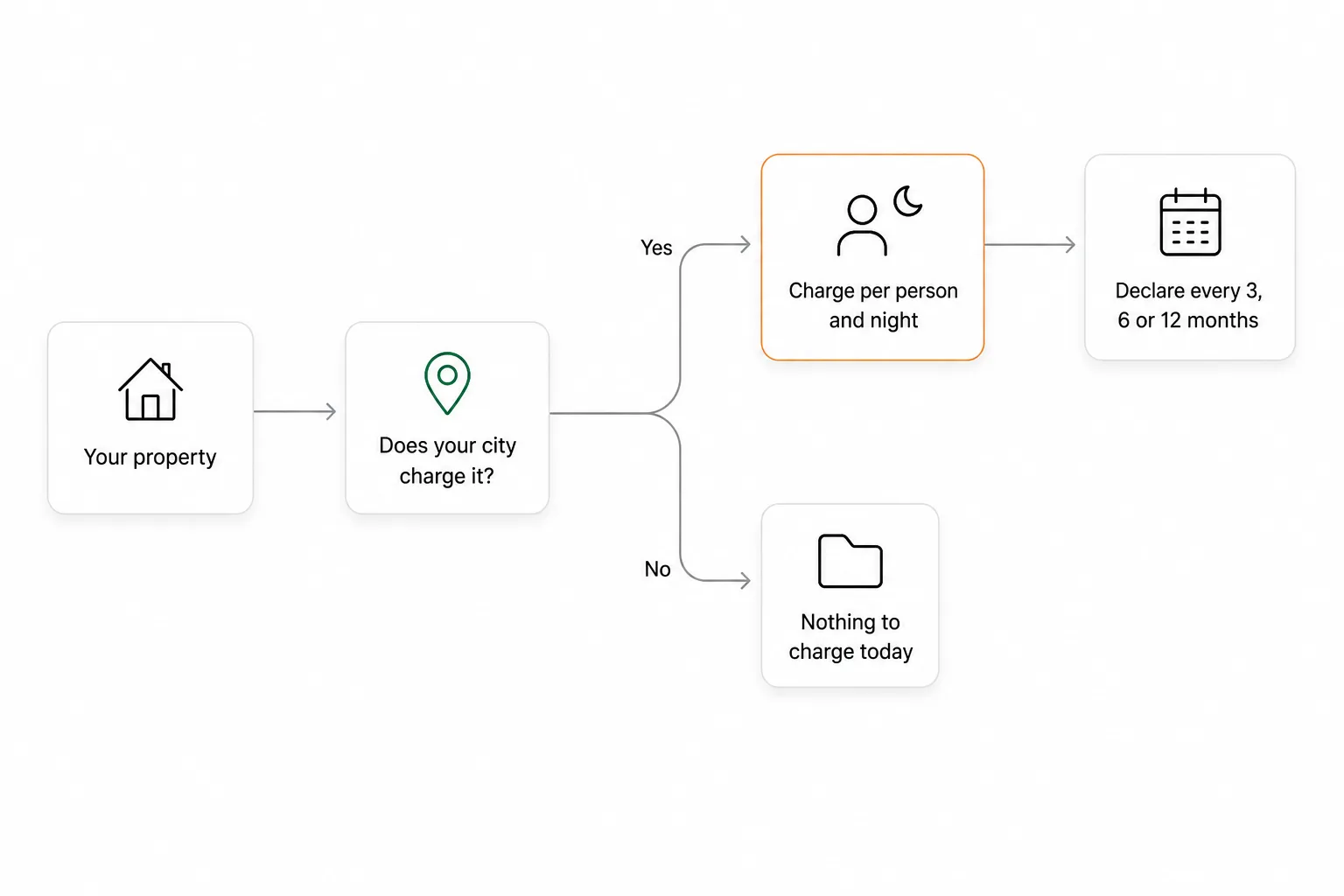
Spain has no national tourist tax. Catalonia and the Balearic Islands charge one, and so do three Galician cities: Santiago, A Coruña and Vigo. The Basque Country starts on 1 January 2027. Each guest pays an amount per person and night, and the host collects it and declares it.
If you rent out a holiday home in one of those places, the tax is your job. Find your city in the table and check three things: how much to charge, the maximum number of nights and when to declare it.
Where Spain charges a tourist tax
These places charge it today:
- Catalonia, across the whole region. Barcelona and seven other towns add their own surcharge.
- The Balearic Islands, on all four islands. Many people call it the ecotasa.
- Galicia, only in Santiago de Compostela, A Coruña and Vigo.
- Mogán, on Gran Canaria. A court struck it down in July 2026, but the town says it will appeal and keeps charging it.
One more region starts soon:
- The Basque Country, from 1 January 2027, in the towns of Bizkaia, Gipuzkoa and Álava.
The rest of Spain has no tourist tax in October 2026. Madrid, Andalusia and the Valencia region do not charge one. Asturias has a bill, but it has not been passed yet.
Tourist tax by region and city
The table shows the rate for a vivienda de uso turístico (VUT), a whole flat or house rented out by the night. Hotels, campsites and hostels pay other amounts. All figures are per person and night.
| Where | Per person per night | Max. nights | Rate since |
|---|---|---|---|
| Barcelona city | €9.50 | 7 | 1 Apr 2026 |
| Rest of Catalonia | €1.75 (€2.50 from Apr 2027) | 7 | 1 Apr 2026 |
| Balearic Islands | €2 (€0.50 from Nov to Apr) | No limit | 1 Jan 2018 |
| Santiago de Compostela | €2 | 5 | 1 Oct 2025 |
| A Coruña | €2 | 5 | 29 Sep 2025 |
| Vigo | €1.46 before VAT | 5 | 1 Oct 2026 |
| Basque Country | €4.50 to €6.50, by town | 6 | 1 Jan 2027 |
| Mogán (Gran Canaria) | €0.15 | Not stated | Struck down, under appeal |
Sources and dates for every row are in “Details and sources” at the end. Checked on 14 October 2026.
Three things can change the figure in your row:
- In Catalonia, seven towns added a surcharge on 1 October 2026: Castelldefels, Esplugues de Llobregat, L’Hospitalet de Llobregat, El Prat de Llobregat, Sabadell, Sant Cugat del Vallès and Sant Just Desvern. In most of them it is €1.75 more per night.
- In Vigo, the third, fourth and fifth nights are free until 30 June 2027. Our guide to Vigo’s tourist tax has the details.
- In the Basque Country, each town sets its own rate. Bilbao, Donostia-San Sebastián and Vitoria-Gasteiz plan €6.50 for a holiday flat. If a town has not approved its rate in time, the maximum applies.
How much guests pay: two examples
The sum is always the same: guests who pay × nights × rate.
Barcelona. A couple stays three nights in your flat in November. They pay 2 people × 3 nights × €9.50 = €57.
Mallorca. Two adults and a 14-year-old stay seven nights in August. The child does not pay. They pay 2 people × 7 nights × €2 = €28. The same stay in January would cost €7, because the low-season rate is €0.50.
For long stays, check the night limit. In Catalonia only the first seven nights count. In Galicia, the first five. The Balearics have no limit, but the rate halves from the ninth night.
Who collects the tax and who declares it
The guest pays the tax. But you, as the operator, collect it and pay it over. Spanish law calls you the sustituto del contribuyente, the person who stands in for the taxpayer. If you fail to collect it, you still owe it.
Each place has its own way to declare it:
| Where | Who you pay | How often |
|---|---|---|
| Catalonia | Agència Tributària de Catalunya | Every six months, form 950 |
| Balearic Islands | Agència Tributària de les Illes Balears | Once a year for a holiday home |
| Santiago and A Coruña | The town hall | Every six months, 1 to 20 January and July |
| Vigo | The town hall | Every six months |
| Basque Country (2027) | The town hall | Every three months |
In Catalonia you file form 950 from 1 to 20 October (stays from April to September) and from 1 to 20 April (stays from October to March). You need your Registre de Turisme de Catalunya number.
In the Balearics, a holiday home usually uses a simplified system. You register on form 017 and the tax office works out what you owe from your number of beds. You pay it between 1 May and 30 June of the following year. Check your own case with the tax office: properties outside that system file every quarter on form 700.
Who does not pay the tourist tax
Exemptions look alike everywhere, but they are not the same:
- Children. In the Balearics, under-16s do not pay. In Catalonia, guests aged 16 or under do not pay. In Galicia, Santiago and A Coruña exempt minors.
- Health. A patient and a companion, when the stay is for medical treatment.
- Force majeure. For example, a guest who stays on because a flight was cancelled.
- Social programmes. Stays paid for by public programmes.
In the Basque Country, bookings made before 5 February 2026 do not pay in the first year.
Exemptions are not automatic. You usually need proof, such as a medical certificate or a form signed by the guest. Keep it. In Catalonia you must keep it for four years.
How to charge the tourist tax in a holiday rental
Follow these steps before your first booking:
- Check whether it applies to you. Look for your town and also your region in the table. In Catalonia and the Balearics every town charges it, even if yours is not named. If neither your town nor your region is there, you charge nothing today.
- Register. In Catalonia, with your tourism registration number on form 950. In the Balearics, on form 017. In Galicia, on your town hall’s website.
- Tell guests before they book. Show the price with the tax included, or say how much you will charge on arrival.
- Count guests and nights. Note each guest’s age and the exact dates. That tells you who pays and for how many nights.
- Put it on the invoice. In Catalonia you must show it as a separate line: nights and rate.
- Declare on time. Put your region’s or town’s deadlines in your calendar.
Step 4 comes almost for free if you already handle guest registration well. Each stay’s record has the dates and every guest’s date of birth. That is exactly what you need to work out the tax. Some councils, such as Vigo’s, can use those records to check what you declare.
If you invoice with software as a business or self-employed host, that software may have to meet VeriFactu, Spain’s new invoicing rules, from 2027. A private owner who rents without hotel services is usually left out, and so is anyone taxed in the Basque Country or Navarra. Check whether it applies to you with the four questions in VeriFactu for hotels and holiday rentals.
Recent changes to Spain’s tourist taxes
We update this section every time a rule changes. Last checked: 14 October 2026.
- 1 October 2026. Vigo starts charging. Seven Catalan towns add their surcharge.
- September 2026. Bilbao and Donostia-San Sebastián give initial approval to their 2027 rates. Vitoria-Gasteiz reaches a deal on its own. Final approval is still pending.
- July 2026. The Canary Islands high court strikes down Mogán’s tax. The ruling is not final.
- June 2026. The three Basque provinces publish their tax rules, which apply from 1 January 2027. The government of Asturias sends its bill to the regional parliament.
- May 2026. The Valencian parliament votes against bringing the tax back.
- 1 April 2026. Catalonia raises its tax (Law 2/2026). Barcelona raises its surcharge to €5.
If you have a property in the Basque Country, start now: see also how to register a holiday rental in the Basque Country. And if you do not have a licence yet, start with the tourist licence in Spain.
Frequently asked questions
Where is there a tourist tax in Spain? In Catalonia, the Balearic Islands and three Galician cities: Santiago, A Coruña and Vigo. Mogán, on Gran Canaria, also charges one, although a court has struck it down in a ruling that is not final. The Basque Country starts on 1 January 2027.
Who does not pay the tourist tax? Children, with a different age limit in each place: under 16 in the Balearics and 16 or under in Catalonia. Stays for health reasons, force majeure or public social programmes are usually exempt too. The guest must prove it with a document.
Is the tourist tax legal? Yes, when a law creates it. Spain’s regions can create their own taxes, and some let their towns add a surcharge. The court struck down Mogán’s tax because the town created it on its own, without a law that allowed it.
When is the tourist tax paid? The guest pays it with the stay, when booking or on arrival. You pay it over later: every six months in Catalonia and Galicia, once a year for a Balearic holiday home and every three months in the Basque Country.
Does Madrid charge a tourist tax in 2026? No. Neither the Madrid region nor the city charges a tourist tax in 2026. If that changes, we will add it to the recent changes section.
Details and sources
Catalonia. The tax on stays in tourist establishments was created by Law 5/2017. Law 2/2026 of 6 March raised the rates from 1 April 2026 and repealed decree-laws 6/2025 and 10/2025 and the additional provision of 21/2025. For a holiday flat (HUT), the rate is €4.50 in Barcelona city plus a city surcharge of €5 (€6 from 1 April 2027 and €7 from 1 April 2028, under Barcelona’s tax bylaw 2.2; the law caps it at €8), and €1.75 in the rest of Catalonia (€2.50 from 1 April 2027). Other towns’ surcharges can reach €4 and may not exceed the regional rate. Each guest pays for at most 7 nights. Guests aged 16 or under, health stays with a companion, social programmes and force majeure are exempt. The operator stands in for the taxpayer, must show the tax on the invoice and files form 950 every six months. Sources: ATC pages on the rate, taxable base, exemptions, who must pay and filing periods, checked on 14 October 2026.
Balearic Islands. The tax on tourist stays comes from Law 2/2016. Article 13 sets €2 for holiday homes and stays in homes (ETV), at the rates of Law 13/2017 in force since 1 January 2018. There is a 75% reduction in low season (1 November to 30 April) and a further 50% from the ninth night, which stack. Under-16s, force majeure, health stays and social programmes are exempt. Decree-laws 4/2025 and 5/2025 only changed how the revenue is spent, not the rates. How it is managed (forms 017, 700 and 790): the ATIB guide for holiday homes and the 2026 tax calendar.
Galicia. Law 5/2024 creates a regional tax with a rate (€2 for a holiday flat, art. 16) but a 100% rebate (art. 17). What guests actually pay is the town surcharge of article 24, only where the town approves it, for at most five days per stay (art. 15.2). Santiago charges it since 1 October 2025, according to Santiago Turismo’s questions and answers. A Coruña approved tax bylaw no. 34 (A Coruña provincial gazette, 26 September 2025); the press puts the first day of collection at 29 September 2025. Vigo has its own guide.
Basque Country. This is not a regional tax. It is a town tax that each Basque province regulates with its own law (norma foral): Bizkaia, NF 3/2026 (BOB, 26 June 2026), Gipuzkoa, NF 3/2026 (BOG, 17 June 2026) and Álava, NF 13/2026 (BOTHA, 22 June 2026). All three set €4.50 to €6.50 per night for holiday flats, at most six nights per person, quarterly returns and the top of the range if a town approves no bylaw. Some towns may add a surcharge of up to 50%. Bilbao, Donostia-San Sebastián and Vitoria-Gasteiz voted on their bylaws in September 2026; their rates come from the press and from Vitoria’s council agreement, pending final publication.
Mogán. The Canary Islands high court struck down the €0.15 per person per night tax in July 2026, according to the press (RTVC, 14 July 2026). The town announced an appeal to the Supreme Court and keeps charging it while the ruling is not final. We could not confirm this in a town hall source.
Valencia region and Asturias. The Valencian Law 7/2022 was repealed before it took effect, by Decree-law 12/2023. The Asturian bill on tourist stays (approved by the regional government on 29 June 2026) proposes an optional town tax of €0.50 to €3 per night, from June to September and at Easter. It is still going through parliament.
VAT. Binding ruling V0507/2026 from Spain’s Directorate-General for Taxes, dated 5 March 2026, says the tourist tax is part of the VAT base of the stay and is not a pass-through amount.