

Registering a tourist rental in the Basque Country (Euskadi) is not something you apply for. You declare it. There is no licence to wait for and no resolution arriving by post: you file a declaración responsable (a binding self-declaration of compliance) with the Basque Government’s tourism department and, from that moment, you are on the register and you can start renting.
That sounds easy, which is exactly why people come unstuck. The hard part is not the filing: it is everything you must already comply with before you sign it, because signing is a statement that you comply. And in 2026 there are two new filters that most guides on the topic predate: an automatic suspension in stressed residential market zones (which covers Bilbao, Donostia and Vitoria-Gasteiz, among others) and the extension of the regime to properties on rural land.
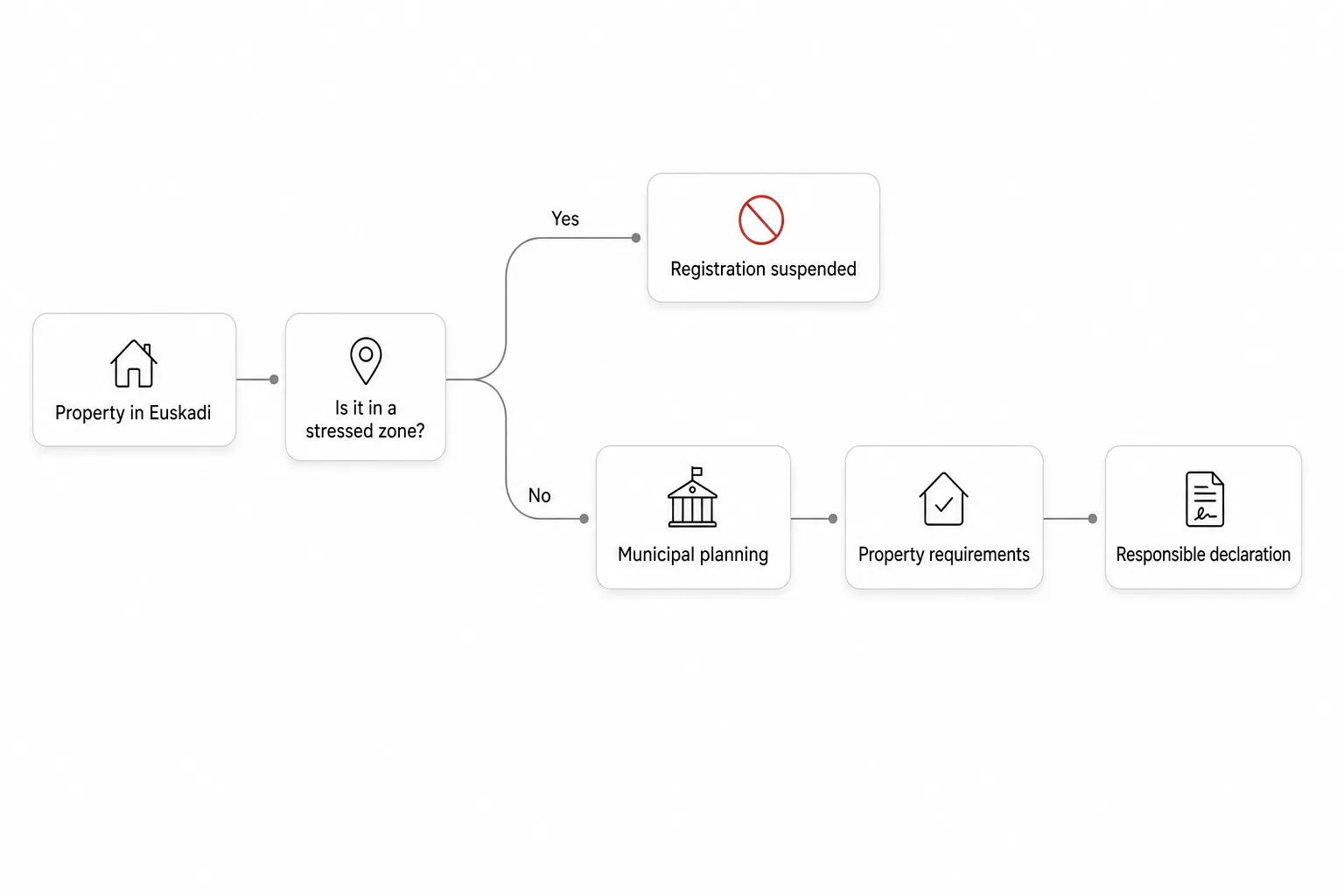
Here is the whole path, in order: which category you fall into, whether your municipality lets you start at all, what the property must meet, how the declaration is filed, and what obligations remain afterwards, including the one thing that works differently in the Basque Country than anywhere else in Spain: traveller reporting to the Ertzaintza.
What counts as a tourist-use dwelling in the Basque Country
Decreto 101/2018, de 3 de julio regulates two categories that look alike but carry very different requirements:
- Vivienda para uso turístico (VUT), the whole dwelling: the property is let in its entirety, temporarily, repeatedly and for payment, on an immediately available basis. This is the typical flat listed on Airbnb or Booking.
- Habitaciones de viviendas particulares, rooms in a private home: individual rooms are let inside a dwelling where someone actually lives. The rules here are far stricter: the holder must be registered on the municipal padrón and genuinely resident in that same dwelling, and must remain so for as long as the activity continues. Only a natural person may hold the activity, and the let room must be separate from the resident’s own bedroom.
Losing that effective residence while letting rooms is not a technicality: the decree treats it as a serious infringement.
Both categories apply to flats under horizontal property rules and to detached houses alike. Since Decreto 52/2025 they also apply to properties in rural settlements and on non-developable land, which previously sat in a regulatory gap. If you have a village house you have been letting for years, this reaches you.
First of all: check whether your municipality is a stressed zone
This is the step almost everyone skips, and the one that can invalidate the whole registration.
Ley 6/2025, de 11 de diciembre, on urgent measures in housing, land and planning, passed by the Basque Parliament and in force since 30 December 2025, added a new paragraph to the Tourism Act: in areas declared by the competent housing department as zonas de mercado residencial tensionado (stressed residential market zones), an automatic suspension applies to the activity of new tourist dwellings and rooms for as long as that declaration lasts. The practical consequence is blunt: no entry in the REATE register.
This is not a municipal moratorium or a recommendation. It operates by itself, by virtue of your municipality being declared.
As of 6 October 2026, the Basque Government has declared these 21 municipalities stressed zones:
| Province | Declared municipalities |
|---|---|
| Bizkaia | Bilbao, Barakaldo, Galdakao (district 2), Basauri, Urduliz and Sopela (BOPV, 14 August 2026) |
| Gipuzkoa | Donostia-San Sebastián, Irun, Errenteria, Lasarte-Oria, Astigarraga, Usurbil, Hernani, Lezo, Tolosa, Pasaia, Zumaia, Zestoa, Arrasate and Bergara (BOPV, 23 September 2026) |
| Álava | Vitoria-Gasteiz |
Urduliz, Sopela and Bergara are the three latest declarations and are not yet on the official stressed-zone viewer, which lags behind. The law does not wait for the viewer: the suspension applies as soon as the housing department declares the zone, and each order takes effect on publication in the BOPV (the Basque official gazette). All three cover the whole municipality and last three years, renewable each year. New tourist dwellings and rooms cannot be registered in Urduliz and Sopela since 14 August, or in Bergara since 23 September.
If your property sits in one of those zones and you want to register it as new, today the short answer is that you cannot. If you were already registered before the declaration, the suspension targets new activity, but confirm your specific position with the territorial tourism office for your province.
This is why the order matters: the four filters are not a to-do list you can work through in parallel, they are a sequence. If the first one closes the door, the other three are irrelevant.
What the property must meet
When you sign the declaración responsable you are stating that all of this is already true. It is not a list of good intentions: it is what an inspection will check.
Capacity and floor area
- A maximum of 8 guest places per dwelling.
- Minimum usable floor area: 25 m² for 1 person, 33 m² for 2 and 15 m² per person from the third onwards.
Equipment and services
- Kitchen, bathroom and sleeping area.
- Furniture, appliances, kitchenware, and bed linen and towels for each guest place.
- Hot and cold water, electricity and heating.
- Cleaning guaranteed before every arrival.
Safety
- Evacuation plan, emergency numbers, fire extinguisher and first-aid kit.
Insurance
- A civil liability policy covering damage arising from the activity, with a minimum of 35,000 € per guest place.
Identification
- An official plaque on the outside of the property and an information plaque inside.
- The registration number must appear in all advertising and marketing of the accommodation, on your own site and on any platform.
Planning compatibility
This is where the town hall comes in. The decree provides for a binding municipal report on the residential character of the building, its conformity with municipal land-use rules and the maximum occupancy on municipal records. The response deadline is three months, and silence counts as favourable. A property meeting every technical requirement is worthless if tourist use is not permitted on that floor, in that building or in that neighbourhood.
The declaración responsable, step by step
1. Gather the documentation
The declaration is filed on the official form set out in the decree itself, accompanied by:
- Identity document of the person signing.
- Civil liability policy and the latest payment receipt.
- Photographs of the facade and the interior.
- Scaled floor plan showing the layout, usable square metres and maximum occupancy.
- If you are not the owner: title evidencing your right to use or manage the property.
- If the holder is a legal entity: incorporation deeds, power of attorney and proof of the signatory’s authority.
- If you are letting rooms: a padrón certificate evidencing effective residence.
2. File it
Two routes:
- Online, through the Basque Government’s electronic office. You need an accepted electronic identification method (digital certificate, BakQ or equivalent).
- In person, at the territorial offices of the department responsible for tourism.
| Province | Territorial tourism office | Contact |
|---|---|---|
| Álava | Samaniego 2, Vitoria-Gasteiz | 945 01 70 55 · turismoa-araba@euskadi.eus |
| Bizkaia | General Concha 23, Bilbao | 944 03 14 78 · turismoa-bizkaia@euskadi.eus |
| Gipuzkoa | Easo 10, Donostia-San Sebastián | 943 02 25 64 · turismoa-gipuzkoa@euskadi.eus |
3. REATE entry and registration number
Filing a complete declaration enters the property in the Registro de Empresas y Actividades Turísticas de Euskadi (REATE), the Basque register of tourism businesses and activities, and authorises the activity to begin immediately. The administration assigns a registration number per dwelling, and that is the number that goes on the plaque and in every listing you publish.
Being able to start the same day does not mean the file is closed: administrative verification comes afterwards, and a declaration with inaccurate or incomplete information can end with the authorisation withdrawn.
4. Changes and cessation
Any material change (capacity, ownership, layout) requires a declaration of modification before it takes effect. And when you stop, you must file a declaración responsable de cese. Taking the listing down is not enough: until you report the cessation, you remain on the register as active, with every obligation that entails.
Municipal planning: Bilbao and Donostia set their own rules
The regional registration is only half of it. The larger town halls have spent years tightening tourist use through planning rules, and those rules override whatever you intend to do.
Bilbao has processed an amendment to its General Urban Development Plan (PGOU) governing where tourist accommodation may be established. In the most concentrated areas (Casco Viejo, Bilbao La Vieja, Matiko, Abando, Indautxu and Olabeaga), tourist dwellings are confined to the lowest residential floor of the building, with independent street access and an accessible route, and one per building. Elsewhere in the city, ground or first floor with independent access.
Donostia-San Sebastián divided the city into zones through its tourist-dwelling ordinance, with a saturated zone where no new ones are authorised and restrictions on floor level and access in the rest, followed by a moratorium on new licences.
Traveller reporting in the Basque Country goes to the Ertzaintza
This is the difference that causes the most confusion, and the most expensive one to get wrong.
In the rest of Spain, Real Decreto 933/2021 channels traveller data to the Interior Ministry’s SES.Hospedajes platform. In the Basque Country, the registration and reporting duties of individuals and companies carrying out accommodation activities are discharged to the Ertzaintza (the Basque autonomous police), under the Orden de 25 de noviembre de 2022 of the Basque security minister (BOPV no. 235, 12 December 2022), issued under article 25.1 of Ley Orgánica 4/2015 on citizen security.
What does not change is the substance of the obligation:
- Reporting must be immediate and in any case within 24 hours of the booking being formalised or the service starting.
- The information must be kept for three years.
- Communications are made electronically, after registering on the Basque Government’s electronic office.
If you are coming from managing accommodation in another region, this is the point to settle before your first arrival, not after. There is more on the substance of the obligation in our guide to the traveller registration app and on turning arrival into an experience with online check-in.
What comes after registration
The registration number on the platforms. Airbnb and Booking require a registration number in the listing. After Spain’s Supreme Court annulled the national single register, the number to use is the regional one. We cover it in detail in which registration number to enter on Airbnb and Booking and in our analysis of the judgment that annulled the NRUA.
Complaint forms and pricing. You must keep the official complaint forms (hojas de reclamaciones) available to guests and disclose, before booking, the total price including taxes, the entry and exit procedures, the cancellation terms and the house rules.
The tourist stay tax. The three provincial governments have approved a tax on overnight stays that starts applying on 1 January 2027. The accommodation passes it on to the guest, collects it and settles it with its provincial tax authority, with scope for municipal adjustment. Check the foral rule for your province and your municipality’s ordinance for the exact rate that will apply to you. The ranges for the three provinces and what Bilbao, Donostia and Vitoria have voted are in the tourist tax in Spain.
If you are comparing regions or managing properties across several, the full map is in our guide to tourist licences in Spain and in how to obtain a tourist licence.
Frequently asked questions
Do I need a licence before renting my property to tourists in the Basque Country? No. The regime is a declaración responsable: you file the official form with its documentation at the Basque Government’s tourism department and you are entered in the REATE from that moment. What you do need is to meet every requirement before signing, because that is precisely what you are declaring.
Can I register a tourist dwelling in Bilbao or Donostia in 2026? If your property is in a municipality declared a stressed residential market zone, Ley 6/2025 applies an automatic suspension to new tourist dwellings and rooms for as long as the declaration lasts, which blocks entry in the REATE. Bilbao, Donostia-San Sebastián and Vitoria-Gasteiz are declared, and Urduliz, Sopela and Bergara among others joined in 2026. Check your specific address in the official viewer and in the BOPV, because the viewer is slow to add new declarations and some cover only part of a municipality.
Do I have to be registered as resident in the property? Only if you let rooms in a private home: in that category the holder must be on the municipal padrón and genuinely resident there throughout the activity. If you let the whole dwelling as a VUT, no residence requirement applies.
Where do I report guest data, SES.Hospedajes or the Ertzaintza? In the Basque Country the registration and reporting duties for accommodation activities are discharged to the Ertzaintza, under the Orden de 25 de noviembre de 2022. The deadlines are the ones you already know: immediate and within 24 hours at the latest, with the information kept for three years.
What happens if I stop renting and say nothing? You remain on the REATE as an active business, with everything that implies. You must file a declaración responsable de cese; pulling the listing from a platform is not the same as deregistering.