


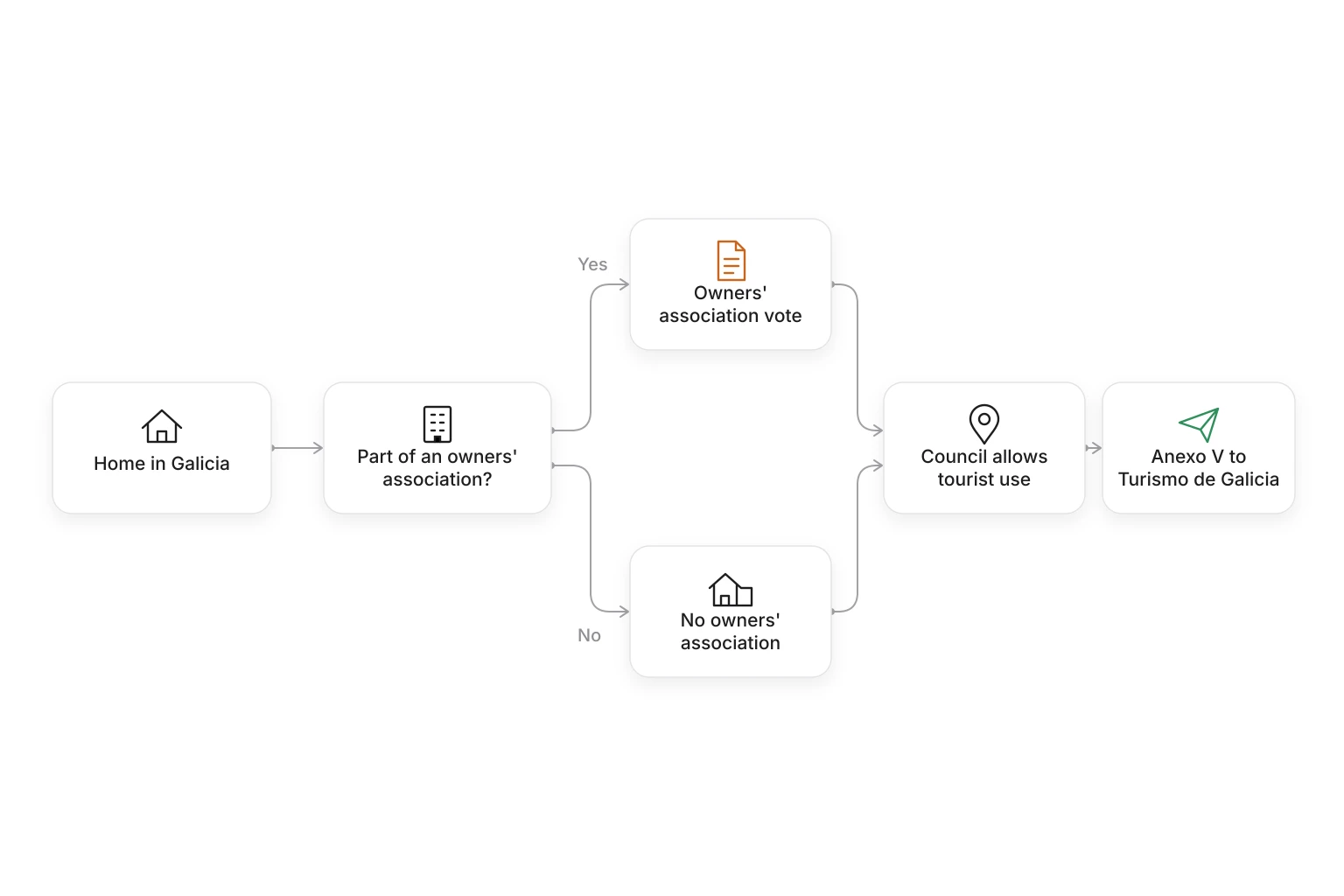
You do not apply for a tourist licence in Galicia and wait. You file a statement with Turismo de Galicia, the regional tourism agency, and you can rent from that day. Before that, check two things: that your council allows tourist use at that address and, if the home belongs to an owners’ association, that the association approves it.
The procedure is called TU986D. You only pay a fee when you file it. This guide covers what to check first, which papers you need and what to do once you have your number.
What to check before you register the home
Nobody inspects your home before you register. You sign that everything is in order. If it turns out not to be, you can be struck off. So check these three things before you sign:
- The council (concello). Ask the planning department whether a holiday let is allowed at your address. Each council can set limits per building or per area. Every council also needs a prior notice of activity (comunicación previa): your entry with Turismo de Galicia does not replace it.
- The owners’ association. If the home belongs to one (a flat in a block, or a house in a development with shared areas), the general meeting must approve it explicitly. It takes the votes of three fifths of the owners, who must also hold three fifths of the shares. Bylaws that say nothing are not enough. If your home was already running as a registered VUT before 3 April 2025, you can carry on without that vote.
- The home’s papers. If you file as a company, you need the document that proves it legally exists, such as its deed of incorporation. For the home, you need the first occupancy licence, the habitability certificate or the certificate of completion of works. If you have none of them, two other papers are accepted: a council certificate that the building meets the technical and planning conditions for a home, or a report from the council or the Xunta that no planning enforcement measures were taken against it. You also need a paper proving you can use the home (deed or contract), the document by which you authorise another person or company to market it, if you do not do it yourself, and liability insurance that covers your guests.
If any of the three fails, your statement does not protect you. The regional decree is clear: a home cannot be used for tourists if local planning or the registered bylaws of the building forbid it.
Requirements for a holiday let in Galicia
These requirements come from Decree 12/2017, the Galician rule on tourist homes. They apply across Galicia:
- You rent the whole home. No single rooms.
- Short stays. Each stay lasts less than 30 days in a row.
- Furnished and ready to move into, clean and in good condition.
- Heating in the areas guests use. Not needed if you only rent from June to September.
- A 24-hour phone number for guests and any problem.
- Maintenance and assistance for the home during the stay.
- A visible notice that complaint forms are available, and a copy of your statement showing its filing stamp (registro de entrada).
- Liability insurance that covers harm to guests.
The decree sets no maximum number of guests for a VUT. You state it in your statement, based on the size of the home.
VUT, vivienda turística and apartamento turístico in Galicia
Galicia has three names that sound alike. Make sure you know which one is yours before you fill in the form.
| Type | What it is | Procedure |
|---|---|---|
| Vivienda de uso turístico | Your flat or house, rented whole twice a year or more | TU986D statement (anexo V) |
| Vivienda turística | Detached house, up to 10 guests, run as a business | Its own procedure |
| Apartamento turístico | A building or complex used entirely for tourist stays | Its own procedure |
If you rent out your city flat or your family’s house on the coast, it is almost certainly a VUT. That is the case this guide covers. A “vivienda turística” is a separate type of business with its own rules, despite the similar name.
Documents and filing the TU986D
The official name is “start of activity of homes for tourist use” (“inicio de actividad de viviendas de uso turístico”). Its code on the Xunta (Galician government) website is TU986D. It is open all year. The owner, or someone acting for them, files it. A representative must be able to prove they act for the owner, for example with a power of attorney or a signed authorisation. The permission to market the home is not enough for this.
To register a tourist home in Galicia:
- Pay the fee at the online office of ATRIGA, the Galician tax agency. Look for code 31.19.01. Keep the receipt.
- Fill in anexo V. This is the signed statement (declaración responsable). You give your details, the number of guests, a phone number for problems and who markets the home.
- Add one anexo VIII per marketer only if several people or companies list the home at once.
- File everything online on the Xunta’s e-office. You need a digital certificate or Chave365, the Galician login. As a private individual you can also print it and take it to a registry office. A company, or someone filing for one, must file online: if it files on paper, the filing date is the day it corrects this online.
The statement goes to the Turismo de Galicia office of the province where the home is: A Coruña, Lugo, Ourense or Pontevedra.
The procedure page does not say how much the fee is. Check the amount on ATRIGA on the day you pay.
When you can start renting
You can start the day you file a complete statement, as long as you have already filed the council’s prior notice and have any other permits it requires. The procedure page mentions three months to decide, but you do not have to wait. That period is for the authorities to review the file.
Until your REAT number arrives, your listings must show the code that proves you filed the statement. Galician tourism law requires it in all advertising, on any channel.
If a document is missing or wrong, you get 10 days to fix it. If you do not, or if something you signed is false, Turismo de Galicia can shut the activity down. It can also bar you from filing again for two to six months.
Your REAT number and what to do after you register
REAT is the Galician register of tourism businesses and activities (Rexistro de Empresas e Actividades Turísticas). Turismo de Galicia adds you to it without you asking. It must tell you within 15 days of your statement. That notice brings your register number.
From the day you start renting, even before the number arrives:
- When the number arrives, show it in your listings instead of the filing code, on Airbnb and Booking too. See how to add your registration number on Airbnb and Booking.
- Send the guest report for every guest to SES.Hospedajes, the national police system. This is a Spain-wide rule. It is explained in our guide to guest registration.
- Send occupancy data every quarter to Turismo de Galicia. Galician tourism law requires it, separately from the guest report. Ask your provincial office how to send it.
- Follow the Galician rules on prices and bookings. Final prices, with all taxes included, in writing and on display. Confirm each booking in writing with dates, price, deposit and cancellation terms. Give an invoice itemised by day.
- Keep complaint forms and hand one over if a guest asks.
- Report any change (number of places, marketer or closing down) through the same TU986D procedure, within 10 days of the change.
- If a guest breaks the house rules on living with neighbours, ask them to leave.
Which number is the regional one and which is not is covered in how to check a tourist registration code.
Council permits and local taxes
Your statement to Turismo de Galicia does not replace council permits. The decree says so itself. That is why the council is the first thing to check.
Two examples from large cities:
- Santiago de Compostela allows no new holiday lets in its historic centre. It decided this in a February 2023 change to its general plan, which the Galician High Court (TSXG) made final in June 2026. In other districts it limits them, usually to ground and first floors where the plan allows lodging. Its 2024 ordinance asks for the prior notice and a certificate from the owners’ association. Since March 2026, for one year at most, it has also suspended some lodging permits that replace a home in several zones.
- A Coruña approved a holiday-let ordinance in June 2025. It allows them only in whole buildings used that way, or on ground and first floors where the plan allows commercial-type uses. Never above a home: a first floor only qualifies if the ground floor is not a home. Some zones allow them only in a dedicated building. It also asks for a notice to the council. The Galician High Court (TSXG) upheld it in 2026.
Do not apply these examples to another council. Each one has its own plan. Ask the planning department in writing whether your address allows the use, before you buy or renovate.
Tourist tax in Santiago, A Coruña and Vigo
Three Galician cities charge a nightly tourist tax: Santiago, A Coruña and Vigo. The guest pays it and you declare it, for five nights per stay at most. In Vigo, until 30 June 2027, only the first two nights are charged. The rates are in our guide to tourist tax in Spain, and Vigo has its own tourist tax guide.
Frequently asked questions
When do you need a tourist licence? In Galicia, when you rent a whole home to tourists for less than 30 days in a row, twice or more in a year, for money. If you only rent it once a year, or for 30 days or more, it is not a VUT. Even so, if you list it on a tourist channel, the listing must say it is not regulated tourist accommodation. A mid-term let needs a real reason, such as work or study.
How do I register a tourist property in Galicia? With the signed statement of procedure TU986D, on the Xunta’s e-office. You pay the fee at ATRIGA, fill in anexo V and file it. Turismo de Galicia adds you to the REAT and gives you the number.
What is the difference between a holiday let and a tourist let? In everyday speech they are the same: renting to tourists for a short time. Galician rules call it a vivienda de uso turístico. A mid-term let for study or work is a different contract and does not need this procedure.
How much tax do you pay on a holiday let? It depends on your income and your situation, so there is no fixed figure. What may change is VAT: from 1 December 2026, if Congress approves the decree. See VAT on holiday lets in Spain.
How do I check a tourist licence in Galicia? Ask the owner or host for the REAT registration document. Then confirm it with the Turismo de Galicia provincial office: its phone numbers are on the TU986D procedure page. Which number to look for is in how to check a tourist registration code.
If you have homes in other regions, each one’s licence name is in our guide to tourist licences in Spain. The steps they share are in how to get a tourist licence. If you are starting from zero, also read how to start managing a holiday rental.
Details and sources
- Procedure. TU986D page on the Xunta e-office, checked on 23 October 2026: signed statement on form anexo V, by the owner or a representative, to the Turismo de Galicia provincial area where the home is; proof of payment of fee 31.19.01 (paid at ovt.atriga.gal); one anexo VIII per marketer if more than one person or company markets the home; open all year; preferably filed online (certificate with Autofirma, or Chave365); three-month resolution period with positive silence. The page does not publish the fee amount.
- Definition and requirements. Decree 12/2017 of 26 January on tourist apartments, tourist homes and homes for tourist use (DOG no. 29, 10 February 2017), read on Lex.gal on 23 October 2026, with no later amendments listed. Article 3: tourist apartments. Article 4: tourist homes, detached, up to ten guests. Article 5: repeated letting (twice or more in a year), for a price, of the whole home, for stays under 30 days in a row; on residential land, with limits per building or area the council may set (art. 5.6). Article 39: equipment, heating unless open only June to September, 24-hour phone, maintenance and assistance, complaint-form notice and a copy of the statement with its filing stamp. Article 40: operating rules, with prices and bookings under Decree 179/2011 (all-inclusive prices, art. 3, on display, art. 4; written booking confirmation, art. 11.3; itemised invoice, art. 10.2), complaint forms, guest register and asking guests to leave for breaking the rules on living together. Article 41.2: contents of the statement, with first occupancy licence, habitability certificate, completion certificate, a council certificate of technical and planning conditions or a report that no restoration measures were taken, and liability insurance. Article 41.2.e) 1º: proof of the applicant’s legal personality. Anexo V: representation must be reliably proven. Article 41.2.e) 2º and 3º: title to dispose of the home and title to market it. Article 41.3: changes and closure within 10 days. Article 27.1: online filing compulsory for legal persons and their representatives; a paper filing counts from the date it is corrected online. Article 41.5: the use is barred if local planning or the building’s registered bylaws forbid it. Article 42: the statement allows the activity from filing and does not replace other permits; 10 days to correct it. Article 43: automatic entry in the REAT and notice within 15 days. Article 44: closure and a ban on refiling for two to six months. Article 45: penalties under Law 7/2011 on the owner and the marketer alike. Article 13: register number in advertising.
- Tourism law. Article 65 bis of Galician Tourism Law 7/2011, BOE consolidated text: section 3, occupancy data every quarter to the regional tourism body; section 6, a let that is not a VUT cannot be promoted as tourist accommodation without an express notice that it is not regulated; section 5, in all advertising, the REAT code or, until there is one, the code proving the statement was filed.
- Owners’ association. Articles 7.3 and 17.12 of the Spanish property owners’ law (Ley 49/1960), as worded by Organic Law 1/2025 (from 3 April 2025): prior explicit approval by three fifths of the owners, who also hold three fifths of the shares. Second additional provision: anyone already running the activity under the tourism rules before it came into force may continue.
- Municipal prior notice. Article 9 of Decree 144/2016 (single regulation on economic activities): every economic activity in Galicia needs a prior notice to the council. Article 33.1.d) of Decree 12/2017 lists it among what Turismo de Galicia checks. The DGSJFP resolution of 16 April 2026 (BOE-A-2026-15544) confirms, for a VUT in Ourense, that a REAT entry is not enough without it.
- Santiago. Santiago council interpretative instruction, DOG no. 121 of 26 June 2018: hotel use and municipal prior notice. The historic-centre ban (plan change of 16 February 2023, final since 25 June 2026), the limits in other districts and the November 2024 ordinance with the owners’ certificate, according to Moncloa.com, 7 July 2026 and El Correo Gallego, 28 July 2026; we could not read the rulings or the current plan text. Suspension of group I lodging permits that replace a residential use, agreed on 26 February 2026, in the DOG of 6 March 2026, for one year at most; it does not affect prior notices under article 364.2 of the land-law regulation.
- A Coruña. Holiday-let ordinance, BOP de A Coruña no. 113 of 16 June 2025, finally approved on 5 June 2025: dedicated buildings, ground and first floors where the zoning allows tertiary uses, a ban above residential floors, zones with dedicated buildings only, and a prior notice as the municipal title. The TSXG ruling, according to El Español, 13 May 2026; we could not read the ruling.
- Tourist tax. Municipal surcharge under Galician Law 5/2024, five days per stay at most; details and sources in our guide to tourist tax in Spain.
- Guest registration. Real Decreto 933/2021.