

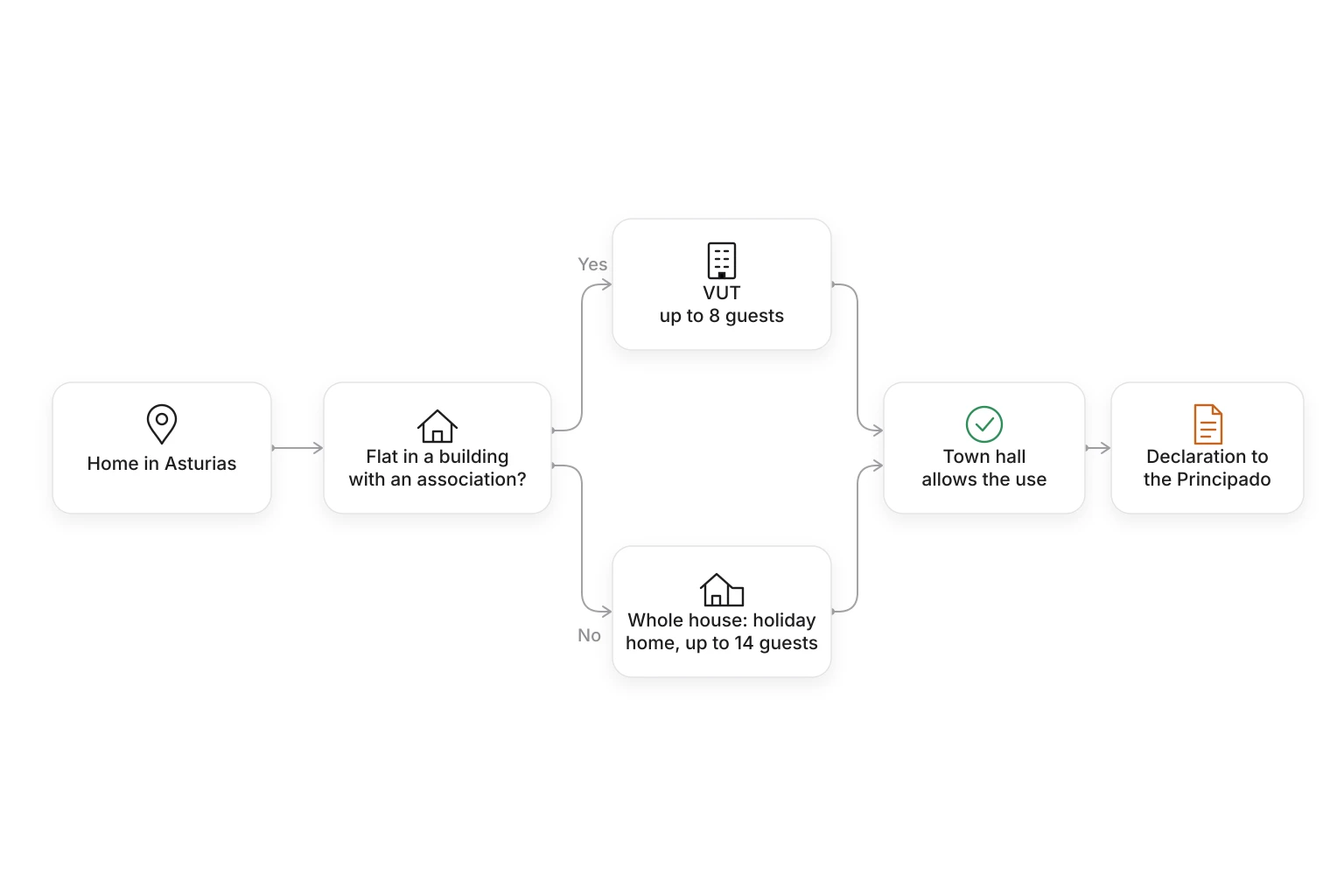
Asturias changed its holiday rental rules in March 2026. To rent to tourists, you first pick the right type: a flat is a VUT, and a whole house is a vivienda vacacional. Then you file a declaration online with the regional government, the Principado. You can start renting that same day, once you have done what your town hall asks for to open.
If your flat was already registered, you have new work to do. Some of it was due in September 2026. The rules on space and bathrooms apply from March 2027.
Holiday home or VUT: pick the right type
Asturias has two names for a home you rent to tourists. Each one has its own rules. Pick the right one before you fill in the form.
| What you rent | What it is called | Most guests |
|---|---|---|
| A flat in a building with an owners’ association | Vivienda de uso turístico (VUT) | 8 |
| A whole house that is not a flat | Vivienda vacacional (holiday home) | 14 |
In both cases you rent the whole home, never single rooms. Social housing (vivienda de protección oficial) cannot be used, nor homes in areas your town hall declares unsuitable. A flat in a single-owner building with no owners’ association fits neither type well: check with the Principado which procedure applies. Both follow the same regional decree, Decreto 48/2016, as changed by Decreto 4/2026.
When your rental falls under these rules
It counts as a tourist rental if you host tourists for money, however you offer it: a platform, an agency or your own website. It is assumed if you do it at least once a year. It does not count if you rent for more than four months in a row to the same person. Lending the home for free does not count either.
Check the town hall and the neighbours first
Nobody inspects your home before you start. You sign that everything is in order. So check two things before you file anything.
- The town hall (ayuntamiento). Ask the planning department whether your address allows tourist use. Each town hall can limit it by area. After you register, the Principado asks the town hall for a report, and that report decides.
- The owners’ association. If your home has one (a flat, or a house on an estate with shared areas), you need a certificate from the association saying tourist use is allowed. Since April 2025, Spanish law also asks for a vote in favour by three-fifths of the owners, who must also hold three-fifths of the shares. If you were already renting to tourists on 3 April 2025 under the tourism rules, you do not need that new vote, though you still need the certificate Asturias asks for.
If either one fails, your declaration does not protect you. Your activity can be closed even if you are already listed.
What a VUT flat needs
These are the requirements for a VUT since the reform. They apply across Asturias.
- Space. At least 25 m² of usable floor for one person and 33 m² for two. From three people, 15 m² per person. Terraces, balconies and drying areas do not count.
- Bedrooms. 6 m² for a single, 10 m² for a double and 13 m² for a triple. Never more than three guests per room.
- Living room of at least 8 m². With a sofa bed, 11 m².
- One bathroom for every four guests, with a basin, a toilet and a shower or bath. A bathroom inside a bedroom only counts for the people sleeping there: everyone else needs another one.
- Safety. A 6 kg fire extinguisher, an emergency light and a first-aid kit.
- A floor plan on display, with the exits and the beds in each room.
- A noise monitor in the living room. It warns you when noise goes past the town hall’s limit.
- A notice in Spanish and English, with a 24-hour phone number and the emergency numbers, including 112.
- The VUT sign outside, with your registration number.
You must also offer daily cleaning, except the kitchen and the dishes. Sheets and towels are changed every four days. And you give guests tourist information about the area.
What a holiday home needs
A whole house has its own list of equipment. The reform adds two items: a 6 kg fire extinguisher on every floor and an internet connection, unless there is no coverage. You also need one bathroom for every four guests, with the same rule for a bathroom inside a bedroom, and a plate by the front door.
Papers and the declaration
You register with a declaración responsable. It is a form where you sign that you meet the rules and hold the papers. You file it online on the Principado’s website, under the procedure for your type of home. Do it before your first guest arrives.
You do not have to upload every paper. But you must hold them, because you can be asked for them at any time. You then have 15 working days to send them. Keep these ready:
- Proof that you can use the home, such as the deeds or a contract. If the home has several owners, the express authorisation of the others too.
- The town hall’s occupancy licence or the habitability certificate (cédula de habitabilidad).
- A floor plan at 1:100 scale.
- The owners’ association certificate, if the home has an association.
- Liability insurance for the rental business, covering harm to guests, of at least €150,250 and with an excess of no more than €602. Ordinary home insurance may not cover this: check with your insurer.
- The energy certificate.
What happens after you file
You can start renting on the day you file, once you have done what your town hall asks for to open. Then the Principado asks your town hall for its report. If the town hall does not answer within three months, the check counts as passed.
If a paper is missing, you get 15 working days to fix it. If something you signed is false, you must stop. You may also be barred from filing again for six months to four years.
Your registration number and your listings
Once you file, the home goes into the Asturias register of tourism businesses (Registro de Empresas y Actividades Turísticas). You get a registration number.
- Put that number and the exact location of the home in every listing, on Airbnb and Booking too. We show how in adding the registration number on Airbnb and Booking.
- Do not mix up the type. A flat is not listed as a house, or the other way round.
- Give guests a 24-hour phone number for any problem.
To tell which number is the Asturias one, see how to check a tourist registration code.
Welcoming guests and guest registration
In a VUT, the rules say how you welcome the guest. Someone must welcome them within 24 hours of arrival. It can be in person or remote, for example by video call. If the stay is shorter, it must happen before they leave.
What is banned is leaving the keys in a box in the street. A box fixed to the front of the building, over the pavement, is not allowed either. In a holiday home, if you are not there at arrival, agree in advance how you hand over the keys.
Welcoming the guest is not the same as guest registration. They are two different duties:
- The welcome is an Asturias rule. You, or whoever runs the home, must do it.
- Guest registration is a rule for all of Spain. You send each guest’s details to SES.Hospedajes, the Interior Ministry’s system. We explain it in guest registration in Spain.
What to ask each guest, and why you do not need a copy of their ID, is in copying guests’ ID cards.
If your home was already registered
The reform came into force on 3 March 2026. If your home was already on the register and you were already renting that day, you do not need to register again. But you must adapt.
| What you must adapt | Deadline |
|---|---|
| Extinguisher, first-aid kit, floor plan, noise monitor, internet, cleaning and linen | Six months: already over, around September 2026 |
| Space, guests per room, the 8-guest limit and bathrooms | Twelve months: until 3 March 2027 |
If your flat sleeps more than 8 or has one bathroom for six people, work out now what to change. Building work or a new layout takes time. If you change the number of guests, tell the Principado.
Frequently asked questions
How do I get a tourist licence in Asturias? You do not apply and wait. You file a declaration on the Principado’s website, under the holiday home or VUT procedure. You can rent from that day, once your town hall’s requirements are met. You are then added to the register and given your number.
How much does a tourist licence cost in Asturias? We found no regional fee for the declaration. The costs you will have are others: the insurance, the energy certificate, the floor plan and whatever your town hall asks for. Check on the website, on the day you file, whether the procedure asks for a payment.
How long does a tourist licence last in Asturias? The decree sets no expiry date. It lasts as long as you meet the rules. If you change something important, such as the number of guests, or if you close, you must report it. To report a closure you have 30 days.
Can I welcome guests remotely in Asturias? Yes. In a VUT the welcome can be remote, within 24 hours of arrival. What you cannot use is a key box in the street or fixed over the pavement.
Is registration enough to list the home? No. The town hall must also allow the use and, for a flat, the owners’ association must agree. And your registration number must appear in every listing.
If you have homes in other regions, the name and the rules in each one are in the tourist licence in Spain. If you are starting from scratch, read how to start managing a holiday rental.
Details and sources
- The rule. Decreto 4/2026, of 2 February, the first amendment of Decreto 48/2016, of 10 August, on holiday homes and homes for tourist use (BOPA no. 28, 11 February 2026). Final provision two: it comes into force twenty days after publication, on 3 March 2026. The BOPA would not open on 5 and 6 November 2026; we read the text on La Administración al Día (INAP). Original text of Decreto 48/2016.
- Scope. Article 1: tourist use is presumed when the home is marketed through tourism intermediaries or digital channels that read as tourist offers; or by any other means of communication, booking or sale; lending without payment, renting for more than four months in a row to the same tenant, publicly protected housing and homes in areas the town hall declares unsuitable fall outside (art. 1.4). Article 3.c): regular activity is presumed if the service is provided at least once a year.
- Types. Article 4 (unchanged): a vivienda vacacional is let as a whole, not by rooms, and excludes flats. Article 10: up to 14 guests. Article 11: a standard plate by the main entrance. Article 12.1: a vivienda de uso turístico is a self-contained home in a multi-storey building under horizontal property (propiedad horizontal).
- VUT requirements. Article 13.1: supplies, a 6 kg ABC powder extinguisher and emergency lighting (c), one bathroom per four guests or fraction, an en-suite bathroom being for that room’s guests only, with another for the rest (e), the VUT sign with the registration number outside as in annex II (f), first-aid kit (h), a plan with exits and beds per room (i), a noise monitoring system in the living rooms that alerts the holder above the thresholds (j), information on emergency services and 112 (l), phone or internet unless there is no coverage (m). Article 13.3: repairs and maintenance, daily cleaning except kitchen and dishes, linen changed every 4 days and tourist information. Article 13.4: 25 m² for one person, 33 m² for two and 15 m² per person from three. Article 13.5: bedrooms of 6, 10 and 13 m², at most three guests per bedroom and 8 per home, living room of 8 m², or 11 m² with a sofa bed at least 1.35 m wide.
- Holiday home. Article 5, letters f) and g): a 6 kg ABC powder extinguisher per floor and internet unless there is no coverage. Article 7.2: one bathroom per four guests or fraction; an en-suite bathroom is for that room’s guests only, with one or more for the rest.
- Welcome and keys. Article 13.2: in-person or remote reception within 24 hours of arrival, or before departure for a shorter stay; key handover through key boxes or similar devices placed in the street, or projecting over it, is banned. Article 17: check-in at 17:00 and check-out at 12:00 unless agreed otherwise; if the holder is not present, the key handover must be arranged in advance.
- Information and listings. Article 14: the registration number and exact location in all advertising, without confusing the type of home. Article 15.1: a notice in at least Spanish and English, with a 24-hour phone number and emergency numbers.
- Duties. Article 27: owners’ association certificate (c), use not banned by planning rules (b), a phone to solve incidents straight away (d), registration number in advertising (e), control of arrivals and departures (h), guest registration and reporting under Real Decreto 933/2021 (l) and proof of payment (m).
- Declaration and papers. Article 29: electronic declaración responsable to the tourism authority, using the forms on the Principado’s e-office; it allows activity from the day of filing unless a prior administrative authorisation is required, and opening requires the town hall’s procedures (art. 29.3). Article 30.2: the declaration states that the holder has the papers, among them title to the home (letter b), the express authorisation of the other owners if there is more than one (letter f; lacking it bars a new declaration for 6 months, art. 31.6.l), town hall compliance, a 1:100 plan, the occupancy licence or habitability certificate, the association certificate for homes under horizontal property (letter g), operating liability insurance covering harm to guests (letter h) and the energy certificate; the authority may ask for them at any time, with 15 working days to provide them. Article 26 (unchanged): liability insurance of at least €150,250 with an excess of at most €602.
- Checks. Article 31: a mandatory, binding town hall report within three months at most, deemed positive if it does not arrive; 15 working days to fix gaps; a false or inaccurate declaration stops the activity and may bar a new one for six months to four years. Article 33: closures reported within 30 days. We found no regional fee for the declaration; the Principado’s registration page does not mention one and the procedure page would not open on 6 November 2026.
- Homes already registered. Single transitional provision, for operators providing services in registered homes when the decree came into force: twelve months from entry into force for articles 7.2, 13.1.e), 13.4 and 13.5, and six months for articles 5 f) and g), 13.1 c), h), i), j), l) and m) and 13.3. The calendar dates (around 3 September 2026 and 3 March 2027) are our calculation from 3 March 2026.
- Owners’ association. Articles 7.3 and 17.12 of Spain’s horizontal property law, Ley 49/1960, as worded by Ley Orgánica 1/2025 from 3 April 2025: express approval by three fifths of the owners holding three fifths of the shares. Second additional provision: whoever was already carrying out the activity when it came into force, under the tourism rules, may continue without that approval.
- Guest registration. Real Decreto 933/2021 and the Interior Ministry’s accommodation page. The national short-term rental register was struck down: see the Supreme Court ruling on the NRUA.