

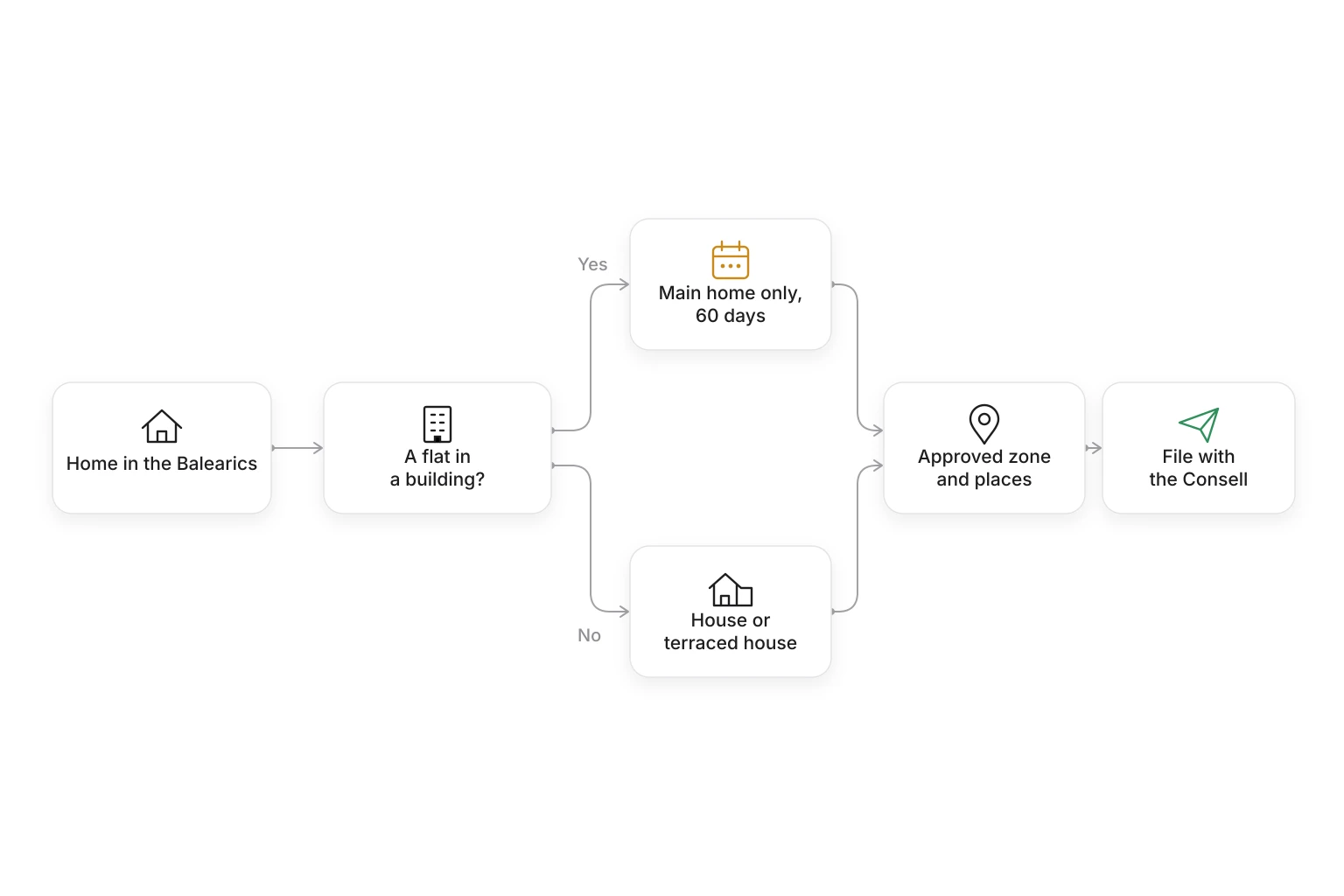
To get a tourist licence in the Balearic Islands, start with the type of home. Since April 2025, a flat in a building cannot open as a new holiday let. The only way in is if it is your main home and you rent it 60 days a year or less. Either way, the home must be in an approved zone and have tourist places.
Then you file a declaration with your island’s Consell (the island council). Each island has its own Consell and its own places. This guide covers what to check in Mallorca, Menorca, Ibiza and Formentera, and what to do if you already have a licence and need to renew it.
Start with the island, the zone and the type of home
Before you buy furniture or pay for places, answer three questions:
- Which island is it on? Each island has its own Consell. The Consell handles registration, places and inspections.
- Is it a flat or a house? A flat in a building with neighbours can almost never open a new ETV. A house, a terraced house or a semi-detached house can.
- Is it in an approved zone? New holiday lets are only allowed in zones the Consell or the town hall has declared suitable (zona apta). Ask the town hall for a certificate.
If all three answers are good, the hardest part is left: getting tourist places. A place (plaza) is the permit to host one guest. A house with four beds needs four places. This applies to a flat with an ETV60 too.
The rule for flats
Decree-law 4/2025 banned new declarations on every island for homes under propiedad horizontal. That means a building with several owners and shared areas, like a block of flats. A law of June 2026 took terraced houses, semi-detached houses and detached houses that share a plot out of the ban.
Flats have one way in: renting your main home (alquiler de vivienda principal). You can use it if you are a private individual, you rent the home you live in and you stay under 60 days a year. The zone must also be approved for this type. This licence is called an ETV60. Like any ETV, it needs tourist places and the declaration to the Consell. In the declaration you pick the whole months you will rent. To change them, you tell the Consell in January.
Requirements for a holiday let in the Balearics
These rules apply on every island. They come from article 50 of the Balearic tourism law, Ley 8/2012:
- You rent the whole home. No renting single rooms, and no two groups with separate contracts at the same time. Under the main-home type you may keep living there while guests stay. If you do, every advert must say so, and residents plus guests must stay within the capacity on the habitability certificate.
- Short stays. By days or weeks. No stay can go over 30 nights.
- A valid cédula de habitabilidad. This certificate says the home is fit to live in and how many people it sleeps. The Consell’s own habitability title or a first-occupancy licence that states the capacity also works.
- The home is at least five years old as a residential home. In Menorca, the island plan (PTI) only asks for this in traditional town centres, not in tourist zones.
- An energy certificate rated F or better (buildings up to 2007) or D or better (from 2008). In Mallorca, a house registering now must also meet article 41 of the PIAT: a C or B rating, class A heating and cooling, renewable hot water, an EV charging point, efficient lighting and water-saving fittings. A technician certifies it. Article 40 adds landscape rules: native plants in any garden, washing lines and bins hidden from view, a facade with nothing out of keeping and, on rural land, traditional fencing without barbed wire. There are exceptions, such as traditional houses built before 1956.
- Separate meters for electricity and gas, where there is gas, and for water if the home is on the public supply.
- Liability insurance covering guests and, in a building, the owners’ association.
- Not social or price-capped housing, now or in the past, and not on protected rural land.
- No unresolved serious planning sanction. A home with a final serious or very serious planning penalty cannot be let to tourists until it is put right.
- Wildfire risk areas. If the home is in a fire-risk prevention area, it must take the measures set by Ley 6/1999.
- Three holiday lets per owner at most. If you already own three or more, you cannot file another DRIAT.
- One bathroom per four places. With five places or more, you need two bathrooms.
- Guest services: cleaning, bed linen, household items and maintenance. You may not serve meals, not even breakfast.
- A 24-hour phone line for guests, also open to neighbours.
- Parties banned in the contract. The guest contract must ban parties and events that disturb others. If one happens, once you know you ask the guest to leave within 24 hours.
- A services logbook approved by the Consell. You note who provides each service (cleaning, bed linen, household items, maintenance) and on what date.
With the declaration you file: your ID, the town hall’s approved-zone certificate (which must also say the town has not reached its cap on places, if it has one), the certificate for the places you bought and, in a building, proof that the owners’ association allows it. You also file Annex 6 of Decreto 20/2015, which certifies the minimum quality standards. For a main home, you also file your census registration (empadronamiento).
The ETV licence and tourist places in Mallorca
In Mallorca, places are sold by the CBAT, the Consell de Mallorca’s tourist places agency (Consorci Borsa d’Allotjaments Turístics). Since Decree-law 4/2025 you cannot simply buy new places. There are two routes:
- The temporary pool. It fills with places from holiday lets that close down, and the CBAT sells them in calls. Hotels have a separate pool.
- Places from another home. If you close one of your own holiday lets, you can move its places to another home you own, with the same number of places or fewer. Places from a home that bought them and closes voluntarily also count. Tell the Consell when you close the old home. You then have six months to file the declaration for the new one. If you buy the places from someone else, you have three months from the closure to hand in proof of purchase. If you miss these dates, the places go back to the pool. If the owner of a home that never had to contribute places closes it, they can name a new owner. That person has one month from the closure to buy the places from the Consell and three months to file the DRIAT.
When the pool has enough places, the CBAT opens a call. A real example: on 19 March 2026 the BOIB, the Balearic official gazette, published a call for 1,069 places in homes. Applications ran online from 23 March to 8 April, after the CBAT extended the original deadline. That call is now closed.
What to do in Mallorca:
- Ask the town hall for the approved-zone certificate for your home.
- Watch the CBAT website and the BOIB. Each call’s rules, price and dates appear there.
- Buy the places when the call opens, through the online form. Late applications are rejected.
- File the DRIAT with the Consell de Mallorca’s tourism department, with the places certificate. You have three months from buying the places. If you miss it, the places go back to the pool and you get no refund.
In six overcrowded tourist areas of Mallorca (the ZTM1 zones, such as Playa de Palma, Magaluf or Cala Millor), a newly registered home can only be let in one of the two peak months: July or August. You choose it in the DRIAT.
The official list of establishments lets you see whether a home already has an ETV. Use it to check a number. It does not let you buy places or register another home.
Applying and checking in Menorca
In Menorca, the Consell Insular de Menorca handles it, through its land planning and tourism department. Menorca also has temporary pools of places, created by Decree-law 4/2025. The Consell set their rules and price in a resolution of June 2025.
Once you buy places in Menorca, the clock starts. You have three months from the notice of purchase to file the declaration. If you miss it, you lose the places and get no refund.
Do this in Menorca:
- Ask the town hall whether your zone is approved and which types of home it allows.
- Check the Consell’s website to see if the temporary pool has places and how to apply.
- Use the new declaration form. If you buy places from the pool, the DRIAT must follow the forms the Consell publishes in the BOIB and on its website.
Who handles it in Ibiza and Formentera
In Ibiza, everything goes through the Consell d’Eivissa. In Formentera, through the Consell de Formentera. On both islands buying places is suspended, as in Mallorca. What remains is the temporary pools created by Decree-law 4/2025 and transfers of places from another home that closes.
Neither island runs dated calls like Mallorca. Since June 2025 you can apply for places at any time, with the form on the Consell’s website. Ibiza decides requests in order of arrival when places are free. Formentera scores requests and keeps them until places come in. If Formentera awards you places, you have 10 calendar days to file the DRIAT and pay. Before you apply:
- Check the list of requests the Consell publishes and how many places are in the pool.
- Ask the town hall for the approved-zone certificate.
- Do not buy a house because an advert says “with licence”. Ask the Consell whether the number exists and whether it can pass to a new owner.
Ibiza is also the island that chases illegal lets hardest. Homes are already being sealed before the case ends. We cover it in what happens if you rent without a licence in the Balearics.
Renewing a licence you already have
Not every ETV expires. It depends on when it was registered and what type it is. This is the CBAT’s table for Mallorca:
| Licence type | Renew? | When to apply |
|---|---|---|
| VT (older holiday home licence) | No | Never |
| 2006 quality ETV (house) | Yes, every 6 years | Two months before it expires |
| ETV filed July 2012 to July 2017 | No | Never |
| House ETV with places (from August 2018) | No | Never |
| ETVPL (flat in a building) | Yes, every 5 years | In the month before it expires |
| ETV60 (main home, 60 days) | Yes, every 5 years | In the month before it expires |
The 2006 quality ETV has its own procedure: a written application two months before it expires. Ask the Consell how to file it.
To renew an ETVPL or an ETV60, the owner files a notice with the Consell. The person who markets the home can file it too, with the owner’s permission. You state that the home still meets every rule and add the certificate showing you can use the places for another period. For an ETV60, you also show it is still your main home.
If you miss the date, you have to stop renting. The home is taken off the register for good and the places go back to the Consell. Put the date in your calendar.
The other islands follow the same law: five years for flats and main homes, renewed in the month before. Confirm your own date with your Consell.
After registering: guest registration and tourist tax
With your ETV in force, the work of each booking begins:
- Show the number in your adverts. The steps for Airbnb and Booking are in how to add your registration number on Airbnb and Booking.
- Send the guest report. In the Balearics it goes to SES.Hospedajes, the police’s online system, as in most of Spain. We explain it in guest registration in Spain.
- Charge the tourist tax. Guests pay it per night and you declare it. Rates are in the tourist tax in Spain.
- Keep your number to hand. To see how it shows in the register, follow how to check a tourist registration code.
If you have homes in other regions, the licence name in each one is in the tourist licence in Spain. The steps they share are in how to get a tourist licence. If this is your first holiday rental, the order of every step, from the owners’ association to registering with the tax office, is in how to start a vacation rental from scratch.
Frequently asked questions
How much does a holiday rental licence cost in Mallorca? Filing the declaration is not the expensive part. The tourist places are, and you pay per place. The CBAT sets the price in the rules of each call, published in the BOIB. There is no fixed fee, so read the rules of the open call.
When do you need a tourist licence? When you rent a whole home to tourists, by days or weeks, with services such as cleaning or bed linen. In the Balearics, a tourist stay cannot go over 30 nights. Renting for 31 nights does not turn it into something else: a seasonal let needs a real non-tourist reason, such as work or study, best stated in the contract. If you rent to tourists without a licence, the Consell can close the home and fine you.
What is the difference between a tourist rental and a holiday rental? In everyday speech they are the same: renting to tourists for a short time. Balearic law calls it marketing tourist stays in homes, and the licence is the ETV. A seasonal let for study or work is a different contract and needs no ETV.
What are the Balearic tourist tax rates for 2026? Rates depend on the type of accommodation and the season. We keep them up to date in the tourist tax in Spain, with every other region’s.
Details and sources
- Requirements. Article 50 of the Balearic tourism law, Ley 8/2012, consolidated text in the BOE updated 13 June 2026. Section 3: new declarations only in zones expressly declared suitable (art. 5) or provisionally delimited (art. 75); in buildings under propiedad horizontal the DRIAT is valid for five years, renewable by a notice filed “during the month before the end of each period”; without it, the home is removed for good and the places return to the managing body. Section 13: no stay may exceed one month, which is exceeded “when thirty nights are exceeded”. Section 20: main-home rental for private individuals, 60 days a year at most, in a zone approved for this type by the island councils or Palma city council. Section 4: no letting while a final serious or very serious planning sanction is unresolved. Section 22.a): the 60 days are set in the DRIAT by whole months, with changes notified in January. Section 22.e): documents filed with the DRIAT, including the town certificate of approved zone and of the municipal cap not being exceeded. Article 52.2: one bathroom per four places. Fourteenth additional provision: transfers of places, notified at closure, six months for the new DRIAT and three months to prove a purchase from a third party. Owners’ association: article 17.12 of the national property law, Ley 49/1960, as amended by Ley Orgánica 1/2025 (from 3 April 2025). Mallorca: articles 39 (ZTM1, July or August) and 41 (energy rating C or B for houses) of the Mallorca PIAT. Three-month DRIAT deadline after the March 2026 call, as reported by Última Hora; we could not open the text of the rules. Article 51: cleaning, linen, maintenance, a logbook since 1 May 2023 and a 24-hour phone line. Section 19: the measures of annex 1.1.a) of Ley 6/1999 in fire-risk prevention areas. Eighth additional provision of Ley 6/2017: no further DRIAT for an owner of three or more homes already let to tourists. Ibiza and Formentera: their Consells’ resolutions in BOIB no. 77 of 19 June 2025 (order of arrival) and BOIB no. 75 of 14 June 2025 (scoring and 10 calendar days). Sections 12 (party ban in the contract and departure within 24 hours), 15 and 22.b) (one contract at a time) and 22.d) (no catering). Article 91.8: designated buyer, one month to acquire the places and three months for the DRIAT. Section 2: the Consell’s analogous habitability title or an occupancy licence stating the capacity also qualify. Section 6: water meter when the home is on the public supply. Article 51.2: the logbook records date and provider of every service in 51.1. Menorca: article 56.4 of the Menorca PTI, five years only in traditional town centres. Mallorca: article 40 of the PIAT (landscape quality).
- Flats. Second additional provision of Decree-law 4/2025 of 11 April, ratified on 8 May 2025: no new declarations for homes under propiedad horizontal on any island, except the main-home type. Ley 4/2026 of 11 June (twenty-second final provision) extends the exception to terraced, semi-detached and detached houses that share a plot with other buildings.
- Places. The same decree amends the first additional provision of Ley 3/2022: in Mallorca, Ibiza and Formentera, buying places and swapping them between private owners is suspended, with exceptions, until each Consell assesses its island’s carrying capacity. The second transitional provision creates two temporary pools per island, one for homes, filled by closures.
- Mallorca. Resolution of the CBAT president, BOIB no. 35 of 19 March 2026: 1,069 places in homes, applications from 23 March (9:00), originally to 30 March and extended to 8 April 2026 (8:59) by BOIB no. 36 of 21 March 2026. The first additional provision of Ley 3/2022, as worded by Decree-law 4/2025, keeps four exchanges of places between private owners, among them moving places between homes of the same owner and places from a home that obtained them for payment and closes voluntarily. The rules, with price and conditions, appeared in BOIB no. 33 of 14 March 2026. CBAT renewal table, checked on 21 October 2026.
- Menorca. Resolution 2026/460 of the Consell Insular de Menorca, BOIB no. 67 of 28 May 2026: three months from notice of the purchase to file the DRIAT; otherwise the places return to the pool with no refund. It amends resolution no. 284 of 6 June 2025 (BOIB no. 75 of 14 June 2025).
- Palma. Final approval of the zoning plan change (PG23), BOIB no. 81 of 27 June 2026, passed by the city council on 28 May 2026: “the whole municipality of Palma is determined as a single zone not suitable” for ETVs (rule 4.2.4). The decision also stops non-permanent ETVs from being renewed and places from being moved to another location in Palma.
- Guest registration. Article 50.11 requires sending stay details to the national police, under Real Decreto 933/2021.