

If Airbnb underlines your guest registration request in red, you have not been penalised. The listing editor is warning you that registering outside Airbnb “is only allowed in certain circumstances”. The registration that Spanish law requires is one of them. You just have to explain it properly in your listing.
This guide is for hosts in Spain who send guests a link to fill in the guest registration form (the parte de viajeros), whether it is Regi’s link or any other. We explain what the warning means, where to write the request, what text to use and what to do if Airbnb asks for more information.
What Airbnb’s warning says, and what it doesn’t
A Regi customer sent us this screenshot in October 2026. In their listing’s requests, they had written that guests should fill in the registration form through Regi’s link. Airbnb underlined the sentence and showed this warning (the app was in Spanish; this is our translation):
Registration outside the platform may not be allowed. This is only allowed in certain circumstances.
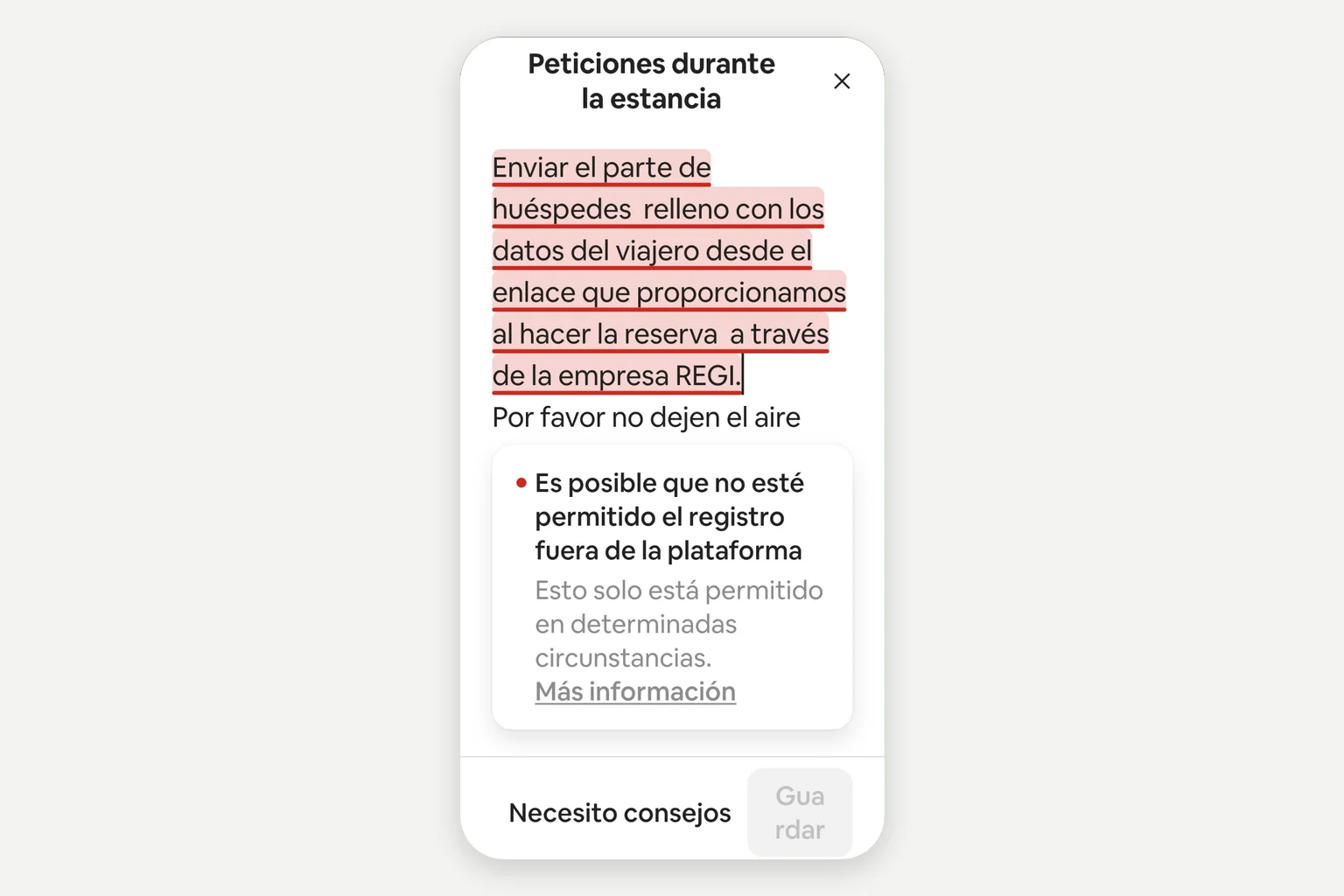
Look at two phrases. “May not be allowed” means Airbnb has not decided anything yet. “Only allowed in certain circumstances” means there are cases where it is allowed.
The warning doesn’t say which part of the text worries it. It could be the link, the word “registration”, or the missing legal reason. Nor does it say that anyone at Airbnb has reviewed your case.
Airbnb explains how this works in its help article on house rules and requests. It flags anything that “may not comply” with its policies and adds a short explanation. If you save without addressing the flagged text, the request goes to “further review” and Airbnb contacts you with next steps.
In the screenshot the “Save” button is grey. Airbnb isn’t blocking it: the button only turns on once you change something in the text.
Why guest registration falls under Airbnb’s exception
Airbnb’s general rule is clear. Hosts may not ask for personal data or make guests register on another website. But the same policy has an exception. Airbnb allows collecting data or using a separate website or app “where necessary to comply with applicable law”. It is in its policy on host-imposed contracts and other requirements.
In Spain, that law exists. Real Decreto 933/2021, a royal decree, requires every tourist accommodation to collect its guests’ details and report them to the authorities. In most of Spain that happens through SES.Hospedajes, the Ministry of the Interior’s system. Every guest aged 14 or over has to sign the form. Our guide to guest registration in Spain explains it in full.
Airbnb acknowledges this in its own page on Real Decreto 933/2021. It explains that hosts keep their duty to report the data, even though the platform also sends information. And it contemplates denying access if a guest refuses to give the details the law requires.
Careful: that is not the same as refusing to use a link. If the guest offers to register properly in person, they are not refusing to identify themselves. And Airbnb’s page doesn’t say what happens to the booking or a refund in that case. If something goes wrong, write down what happened and contact Airbnb support to handle the booking.
Watch the word “necessary”. The exception covers what the law asks for, nothing more. So it helps to keep four things apart:
| What it is | Does the law require it? | On Airbnb |
|---|---|---|
| Registration form and signature | Yes, RD 933/2021 | Allowed if explained before booking |
| A web form to fill it in | No, it’s just a convenient way | Allowed to comply with the law |
| A private contract | No, for a normal stay | Very limited from 20 November 2026 |
| A photo or copy of the ID | No, Spain’s data authority calls it excessive | No, unless a legal exception applies |
The registration form is not a rental contract. It is a legal formality. If you call it a “contract” in your listing, you mix it up with something Airbnb does restrict.
Which policy applies to each booking
Airbnb changes this policy on 20 November 2026. What counts is the date the booking was made, not the arrival date. A booking made on 10 November for Christmas follows the old policy.
| Booking made | Policy that applies | Where you explain registration |
|---|---|---|
| Before 20 November 2026 | Off-Platform Policy (previous) | In the listing description |
| From 20 November 2026 | Limiting host-imposed contracts (new) | In the listing’s “Requests” section |
There is one more detail. According to Airbnb’s help centre, a change to your requests only applies to bookings that come in afterwards. The bookings you already have keep what your listing said when they were made.
So the practical move today is to do both. Explain registration in the listing description and add the request. That covers the bookings you have now and the ones that arrive after 20 November. What changes that day is in Airbnb’s new November rules.
How to write the registration request in your listing
On a computer, the path is: Listings, pick the listing, House rules and requests, then under Requests, Add requests. Airbnb lets you choose whether it applies “During the stay” or “Before checkout”. Our customer’s request was under “During the stay”.
Airbnb asks you to say what information you need and why. A good text answers five things:
- The law. Name Real Decreto 933/2021.
- Which details. Those on the registration form, plus the signature of every guest aged 14 or over.
- When. After the booking is confirmed. Not “when booking”, which sounds like a condition for booking.
- How. Through a link, with nothing to install, no account and nothing to pay.
- The alternative. If the guest doesn’t want to use the link, you do it together on arrival.
This text covers all five. Copy it and adapt it:
By law (Real Decreto 933/2021), in Spain we must register every guest and report their details to the authorities. Every guest aged 14 or over must sign the registration form. Once your booking is confirmed, we’ll send you a secure Regi link through Airbnb to fill in the form and sign it on your phone. There’s nothing to install, no account to create and nothing to pay. If you’d rather do it in person when you arrive, let us know and we’ll do it together. We only ask for the details the law requires and we don’t keep a copy of your ID.
If you use another tool, replace “Regi” with its name or drop it. You don’t need to name the tool. You do need to give the legal reason and the details.
Two honest caveats. Changing the text doesn’t guarantee Airbnb will remove the flag, because it doesn’t explain how it decides. And if the request is still flagged after you change it, you can save it anyway and it goes to review. That isn’t bad news: the review is where you can explain your case.
After the booking, send the link through the Airbnb chat. With Regi you can schedule it as a quick reply a few days before arrival. We explain it in the online check-in link and QR code. If you also sell on Booking.com, the same link works for those bookings; the rest of Booking is in our Booking.com guide for owners.
What to do if Airbnb keeps the warning or asks for more information
If Airbnb writes to you or the warning doesn’t go away, follow these steps:
- Take a screenshot of the warning. Note the date, the listing and the text it flagged.
- Check your request. Make sure it gives the law, the details, when, how, and the in-person option.
- Reply to Airbnb with the sources. Cite its requirements policy (article 4169), its page on RD 933/2021 (article 3376) and the BOE, Spain’s official gazette. There’s a message ready to copy below.
- Keep the conversation. If Airbnb asks again, you have what you said and what they answered.
- Keep registering your guests. The law doesn’t pause while Airbnb reviews. If in doubt, collect the details, check the ID and get the signature in person on arrival, before the stay starts.
Here is the message for Airbnb support:
Hello. My listing [listing name or link] received a warning about the information on guest registration. I am not asking guests to sign an additional rental contract, make payments or book outside Airbnb.
As the holder of accommodation in Spain, I must collect the required details and the signatures on the registration forms under article 4 of Real Decreto 933/2021, and make the reports set out in its article 6.
Please review the warning in light of the legal-obligation exception in your policy 4169 and the host obligations described on your page 3376.
In [the listing’s requests section, or the description for bookings made before 20 November] I explain which details are requested and why. The external form makes collecting them easier, but I also offer to complete registration in person on arrival. [I attach the listing text and the warning.]
Could you review the case and tell me which specific requirement you consider unmet and what change would be needed? Thank you.
What not to do: delete the request without replacing it, hide the link, or spell it oddly so the editor doesn’t catch it. If Airbnb finds out, it looks like you’re hiding something. And if you remove the request, guests only learn about registration after they’ve booked.
What you should never ask for, whatever tool you use
The legal exception has limits. Airbnb says you may not collect “more data than the law calls for”. Spanish data protection law points the same way.
- Don’t ask for a photo or copy of an ID card or passport. Spain’s data protection authority, the AEPD, says it is excessive. A form with the registration details is enough. We explain why in why you shouldn’t ask guests for a copy of their ID.
- Don’t ask for payments, deposits or contracts outside Airbnb using registration as a reason.
- Don’t use the registration data for anything else. No offers, no newsletters, no reviews on another site.
- Don’t ask for the guest’s contact details before booking. Before the booking, everything goes through Airbnb.
The registration form’s fields, one by one, are in the guest details for the registration form.
How Regi fits Airbnb’s policy
Airbnb has not approved or certified any registration tool, Regi included. What counts is how you use it and how you explain it in your listing. What we can tell you is what Regi asks for and what it doesn’t:
- The guest fills in the registration details and signs on their phone. Guests aged 14 or over sign. For children under 14, an adult gives their details and they don’t sign.
- No app to install, no account, nothing to pay.
- The guest can scan their ID instead of typing it. The image never leaves their phone. Regi only receives the form fields. See how the document scanner works.
- If they’d rather do it on arrival, you can open the same link on your phone or tablet and fill it in with them.
- When the guest finishes, Regi sends their registration form (the parte de viajeros) to SES.Hospedajes. Regi doesn’t send the booking report. The Interior Ministry’s SES.Hospedajes team told us in writing that, for non-professional hosts, the platform sends it for bookings made through Airbnb, Booking.com or similar, and the host sends it for direct bookings. It hasn’t said the same for professional hosts, and Airbnb’s help page on RD 933/2021 says hosts must also report the booking data. If you host professionally or take direct bookings, check how to report it in SES.Hospedajes. In Catalonia and the Basque Country the form goes to the Mossos d’Esquadra and the Ertzaintza, the regional police forces, and Regi doesn’t connect to them yet.
- Regi keeps the forms for the three years from the end of the stay that article 5.3 sets for professional hosts.
If you host on a non-professional basis, the law doesn’t require you to keep the register for three years, but it does require you to report the details. We explain it in the guest register and the registration form.
Frequently asked questions
Can I put an external link for guest registration on Airbnb? Yes, if it is to comply with the law and you explain it in the listing before the booking. Airbnb allows it as an exception. Send the link through the Airbnb chat after the booking is confirmed.
Can I require guests to register before they arrive? RD 933/2021 doesn’t require guests to fill in a form online or days before the trip. You can offer early registration to speed up arrival. If they can’t or won’t use the link, we recommend letting them complete the details, the ID check and the signature on arrival, before the stay starts. That doesn’t delay the reports you owe from the booking.
Do I need a photo of the guest’s ID for registration? No. The AEPD says asking for a copy of an ID card or passport is excessive. The registration details are enough and, in person, you look at the document.
What do I do if Airbnb threatens to suspend my listing? Reply quickly and with the sources: RD 933/2021, Airbnb’s article 4169 and its page on RD 933/2021. Check that your request gives the details, the reason and the in-person option. If the problem continues, talk to an adviser, because Airbnb decides how it applies its rules.
Do bookings made before 20 November follow the old rule? Yes. Bookings made before 20 November 2026 follow the previous policy, which asks you to explain registration in the listing description. Bookings made from that day follow the new one, which asks for it under “Requests”.
Details and sources
Checked on 27 October 2026. Airbnb can change its policies and its editor at any time. Check the official pages before acting.
Airbnb’s new policy. It applies to bookings made on or after 20 November 2026. It says: “We allow collection of personal information or registration on a separate website or app where necessary to: Comply with applicable law […]”. The host “must clearly disclose what information is required of guests, and why, in the requests section of their listing page so that guests can review it before booking”. Hosts “may not collect more data than the law or rule calls for”, and Airbnb “may ask hosts to provide evidence that one of the exceptions above apply”.
Airbnb’s previous policy. It applies to bookings made before 20 November 2026. It allows asking for additional information required “for legal or compliance reasons” that the host can verify in writing when Airbnb asks. In that case it must be explained in the listing description.
Airbnb’s house rules and requests. From 20 November 2026, requests must be “disclosed in the designated section of the listing page at the time of booking”. Hosts “may not communicate new house rules or requests […] after booking, including by message”. That’s why registration must be in the listing beforehand; the message with the link just puts it into practice.
Real Decreto 933/2021. Article 4.1 requires collecting guests’ details. Article 4.2 requires every person over fourteen to sign the form; for younger children, the accompanying adult gives their details. Article 4.3 makes the accommodation responsible for the details matching the identity documents. Article 6.3 sets reports within 24 hours of the booking or its cancellation and of the start of the stay. Article 5.4 exempts non-professional hosts from keeping the register, but not from reporting the details.
The AEPD note. Dated 17 June 2025. It says that asking for a copy of an ID card or passport breaches the data minimisation principle, and that a form with the registration details, filled in online or in person at the accommodation, “could be sufficient”.
- Airbnb: limiting host-imposed contracts and other requirements (new and previous policy)
- Airbnb: house rules and reasonable requests
- Airbnb: add house rules and requests to your listing
- Airbnb: FAQ on Real Decreto 933/2021
- Real Decreto 933/2021, consolidated text (BOE)
- AEPD: note on copies of ID documents in accommodation (PDF, Spanish)