


From 11 to 13 September 2026 Madrid hosts the Spanish Formula 1 Grand Prix for the first time, at Madring, the circuit built on the IFEMA fairground. In the week before the race, the press picked up listings for houses beside the track at more than 17,000 euros for three nights, a complaint by the Socialist municipal group, and an exchange between the Ayuntamiento (city council) and the Ministry of Consumer Affairs over whose job it is to act. A high price proves nothing on its own. What the episode does prove is that several layers of control coexist in Madrid and that very few people can tell them apart.
This article sorts them out for 2026: the municipal Plan RESIDE, which since September 2025 decides where a vivienda de uso turístico (VUT, a whole dwelling let to tourists) can exist, and the regional Decreto 27/2026, which since 26 April 2026 changed who declares, what it vouches for, which floor areas and capacity it requires, and how long already-registered dwellings have to adapt.
What the license is called in other regions is in tourist license in Spain. It is not a universal checklist but a verification route. It informs and orients; it does not replace planning or legal advice on a specific property.
Six questions before you look at any requirement
The regional tourism declaration is permanently open. That does not make any flat viable: viability is decided earlier, by six questions.
- Madrid city or another municipality? Plan RESIDE belongs to the Ayuntamiento de Madrid; in another municipality the same regional decree applies with local planning rules and licence.
- Whole dwelling, or a room or a seasonal let? A VUT is a dwelling let in its entirety for tourist purposes without permanent residence (Decreto 79/2014). Rooms and seasonal leases follow other rules.
- New registration or an existing VUT? An existing one enters the three-year transitional regime; a new one complies with everything from day one.
- Residential or non-residential building? In the historic centre this is the decisive question. Any building with housing in it is residential, unless more than 66% of its built floor area is tertiary.
- Which zone, use level and floor? Inside or outside the perimeter, use-compatibility level A to E, and ground, below-ground, first or upper floor.
- Who is the operator of the activity? The declaration is signed by whoever runs the dwelling; the owners’ association approval is requested by whoever owns it.
The four documentary layers
Each layer is controlled by a different body. Holding one does not prove the others, and a regional number does not legalise a use that planning does not admit.
| Layer | Who controls it | What it proves |
|---|---|---|
| Municipal planning licence | Ayuntamiento (or an ECU) | That lodging fits that building, floor and zone |
| Responsible declaration and registration | Region of Madrid (Tourism) | That the activity has been notified and meets the decree |
| Owners’ association approval | Owners’ meeting | That the activity is authorised in the building (LPH 7.3, 17.12) |
| Operating duties | Region, Interior, Consumer Affairs | Guest information, insurance, complaint forms, traveller report |
The fourth layer includes traveller registration under Real Decreto 933/2021, which article 5 of Decreto 79/2014 recalls and which does not depend on Madrid. How to comply is in the traveller registration and SES.Hospedajes guide.
Plan RESIDE: where a VUT fits in Madrid city
Plan RESIDE is the amendment of the General Urban Plan (PGOUM) to protect residential use, given final approval on 27 August 2025 and published in the BOCM (regional gazette) on 4 September (decision) and 22 September 2025 (rules). It replaces the three rings of the 2019 Plan Especial de Hospedaje with two areas: the historic-centre perimeter (Área de Planeamiento Específico 00.01) and the rest of the city. For the city a VUT is the lodging class of tertiary use, not housing.
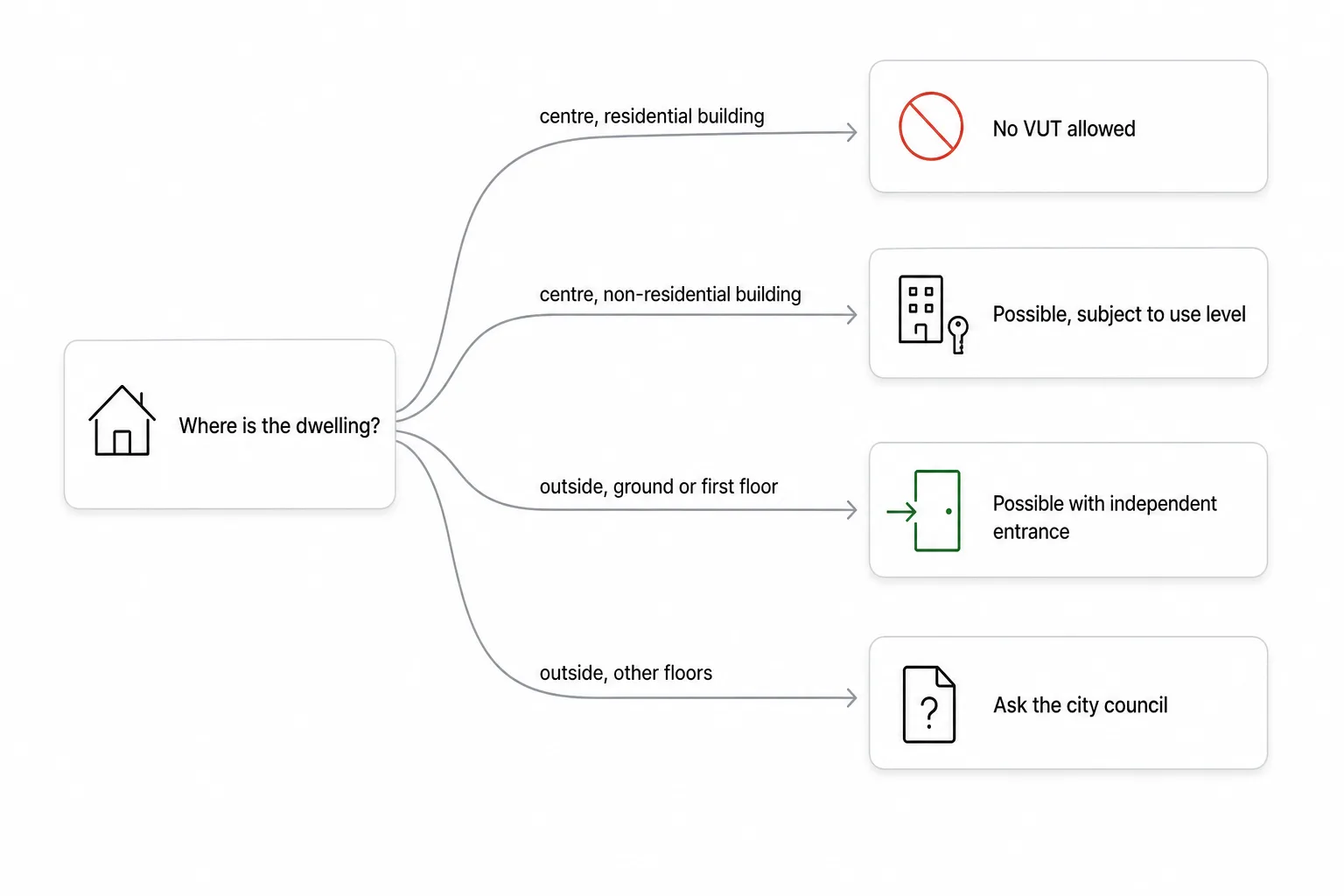
Inside the historic-centre perimeter
Article 7.6.3 bis of the planning rules takes precedence over the zoning rule on residential plots:
- Existing residential building: lodging is not admitted on any floor, not even the ground floor.
- Existing non-residential building: admitted as an alternative use for the whole building and as a complementary use in part of it (any position at levels A and B, upper floors only at C and D). Buildings listed at protection level 1 or 2 need a special plan.
- Temporary exception: a residential building listed at level 3 may convert entirely to VUT with the restoration works the catalogue requires. After fifteen years the licence lapses without any express declaration and the building returns to collective housing; both conditions are recorded in the Land Registry.
- Level E (historic housing estates): not admitted in any form.
Outside the perimeter
In the rest of the city, lodging in residential buildings is admitted as a complementary use only on the ground floor, below ground or the first floor, and article 7.6.3.4 requires premises inside residential buildings to always have an independent entrance, without using the common areas. The outcome depends on the zoning rule, the plot’s use level and whether the premises already have a non-residential use. In a whole building, lodging is an alternative use.
How to check before you invest
- Locate the dwelling on the municipal Geoportal, which publishes the map and list of VUT with a planning licence.
- Note the area (inside or outside APE 00.01), the zoning rule, the use level, the building’s existing use and the floor.
- Before buying, refurbishing or signing a management contract, file a formal enquiry with the Ayuntamiento or an entidad colaboradora urbanística (ECU, a licensed private body that processes municipal licences in Madrid).
Decreto 27/2026: what the Region of Madrid now asks
Decreto 27/2026, of 25 March, amends Decreto 79/2014. It was published in the BOCM on 6 April 2026 and entered into force twenty days later, on 26 April. It corrects articles annulled by the Madrid High Court in 2021, incorporates the reformed Ley de Propiedad Horizontal (LPH, the condominium act) and updates the technical minimums.
Who files the declaration, and how
It is filed by the operator of the tourist accommodation activity, on the electronic office’s standard form and exclusively by electronic means (article 17); the obligation that used to fall on owners who did not run the dwelling is gone. On a change of operator the new one files their own declaration. If the tourism authority finds inaccuracies it has six months to rule that the activity cannot continue.
What it must state (article 17 bis)
Besides identifying the operator, the tax address and the number of bedrooms and berths, the declaration states:
- The number and date of the municipal planning title.
- That the dwelling meets every requirement of the decree, or holds an exemption (requested beforehand and decided within six months).
- That it holds a certificate that the bylaws do not prohibit the activity and a certificate that the owners’ meeting has approved it.
- That the dwelling is not social housing (article 17 ter prohibits it).
- That it holds the other sectoral and municipal authorisations.
- That it holds the CIVUT.
The regional online procedure adds a civil liability policy in force and a document proving availability of the dwelling.
Minimum requirements of the dwelling (article 18)
Every VUT has, at minimum, a living-dining room, kitchen, bedroom and bathroom; it is a “studio” when kitchen and bedroom are integrated in the living room.
| Room | Minimum usable area | Minimum content |
|---|---|---|
| Bedroom | 12 m² | Lighting, ventilation, full blackout, two 0.9 x 1.9 m beds or one 1.35 x 1.9 m bed, wardrobe |
| Bathroom | 1.5 m² and 2.2 m ceiling height | Bath or shower, washbasin, toilet, natural or forced ventilation |
| Living-dining room | 10 m², or 14 m² with an open kitchen | Area proportional to berths, lighting, ventilation, blackout |
| Kitchen | 5 m² | Extractor hood, two or more rings, oven, sink, fridge, storage for cookware |
Also required: a permanently staffed phone number, an emergency notice in at least Spanish and English, and delivery furnished with bed, table and bath linen, crockery, cutlery, glassware and cookware.
Maximum capacity
Article 18.4 sets a scale, not a single figure: between 25.5 and 40 m² usable, up to 4 people in at least two habitable rooms; for every additional 12 m² usable in one more independent habitable room, 2 more people. Two berths in convertible beds are allowed in the living room if its area permits, and they count. The decree sets no capacity below 25.5 m²; if your dwelling is smaller, ask before declaring.
What the CIVUT certifies (article 17 quáter)
The CIVUT (Certificado de Idoneidad para Vivienda de Uso Turístico) is issued by a qualified technician after an on-site check (since 2021 it is not reserved to architects) and certifies seven points: heating and hot and cold water; lighting, ventilation and blackout in bedrooms and living room; lighting and ventilation in the kitchen; ventilation in bathrooms; an extinguisher no more than 15 metres from the exit; basic emergency signage; and a visible evacuation plan. It is not a licence or a registration and does not examine planning. The process with the technician is in the post on the CIVUT in Madrid.
Guest information
Before the booking, the operator informs guests about accessibility, emergency numbers, restricted areas, pets, smoking, waste and noise rules (article 18.5); it places the evacuation plan on the door, keeps official complaint forms and provides a coexistence-rules form that the guest accepts expressly (article 5.4).
Transitional regime: three years to adapt
The single transitional provision gives VUT that had already filed a responsible declaration three years from entry into force to adapt to articles 10, 14, 17 quáter and 18, with the option of an exemption. It does not apply if the establishment carries out a substantial refurbishment earlier: then the decree applies immediately. The count (entry into force on 26 April 2026, and a period in years running date to date) puts it at around 26 April 2029; confirm the date with the Region before scheduling works. The period covers only those articles: it does not shelter a use incompatible with Plan RESIDE and does not replace the association’s approval.
The owners’ association approval
Since 3 April 2025 article 7.3 of the Ley de Propiedad Horizontal requires an owner who wants to use a dwelling for tourist letting to obtain “previously the express approval of the owners’ association”. Article 17.12 requires, to approve, limit, condition or prohibit the activity, the favourable vote of three fifths of all owners representing three fifths of the shares.
Approval is prior and is requested by the owner, even if another operator runs the dwelling. The resolution has no retroactive effect, as the preamble of Decreto 27/2026 recalls, so its scope over earlier activities is decided case by case. And the bylaws may already prohibit the activity, something the Supreme Court (judgments 1232/2024 and 1233/2024) confirmed is possible by that majority. That is why the declaration asks for two certificates: one that the bylaws do not prohibit, another that the meeting has approved.
Regional number and NRUA: what the Supreme Court annulled
The judgment of the Third Chamber of the Tribunal Supremo of 19 May 2026 (BOE of 8 June) partly upheld the appeal of the Generalitat Valenciana and annulled the provisions of Real Decreto 1312/2024 on the single registration and the registration required to obtain the number platforms demanded; it dismissed the appeal in all other respects. It does not touch the regional declaration or its registration, municipal planning, advertising duties in force under other rules (the Region of Madrid requires the regional number to be shown) or traveller registration. The detail is in the post on the annulment of the NRUA; to verify a number in a listing, see how to check a tourist registration code.
Who controls what
| Body | What it controls | What it can do |
|---|---|---|
| Ayuntamiento de Madrid | Planning compatibility, licence, inspection | Cease-and-restore order, coercive fines |
| Region of Madrid | Declaration, registration, tourism requirements, exemptions | Tourism inspection, ruling that activity cannot continue, penalties |
| Owners’ association | Approving, limiting or prohibiting the activity | Civil actions under the LPH |
| Ministry of the Interior | Traveller registration and SES.Hospedajes (RD 933/2021) | Penalties for failing to register |
| Ministry of Consumer Affairs | Commercial practices and platform listings | Proceedings against platforms, such as Airbnb in 2025 |
The Formula 1 case illustrates the split. On 2 September the Socialist municipal group reported listings beside Madring with no visible licence and prices of up to 17,703 euros for three nights. On the 3rd, the city’s delegate said that “it falls to the Ministry of Consumer Affairs to prevent illegal tourist flats from being advertised on the internet”; on the 4th, the mayor said every illegal VUT will be pursued “on the Formula 1 weekend and on any weekend”. The ministry, according to press reports, maintains that it had already passed the city information on listings. At the date of this article no penalty decision or cease order has been published: it is an open dispute over competences.
Penalties: separate the subjects and the cases
Mixing penalties from different sources produces figures that match no real case:
- Platform. On 15 December 2025 the Ministry of Consumer Affairs announced a fine of 64,055,311 euros on Airbnb for 65,122 listings without a licence number, with wrongly formatted numbers or with false information about the host’s professional status, plus obstruction. It is a penalty on the platform, not a host’s fine.
- Incompatible planning use. When explaining Plan RESIDE, the city describes the sequence for whoever keeps operating without a licence: a cease-and-restore order and, if the activity persists, coercive fines of 30,001 euros, then 60,001 and then 100,001, cumulative. It is the case of persistence after the order, not an automatic fine for listing.
- Traveller registration. Breaching RD 933/2021 has its own regime, with fines of up to 30,000 euros for serious infringements.
Regional and association-level infringements have their own channels. What happens when a dwelling operates without a licence is in the post on illegal holiday rentals.
A 48-hour audit for managers
- Locate the dwelling on the Geoportal and note the area, zoning rule, use level, building use and floor.
- Gather the municipal licence, the declaration and registration, the meeting resolution and bylaws certificate, the CIVUT and the policy. If anything is missing, note who requests it: operator, owner or technician.
- Measure usable areas, compare them with article 18 and recalculate capacity with the 18.4 scale; check the extinguisher, signage, evacuation plan and emergency notice.
- Review the listing: registration number, professional identity, total price, conditions, berths.
- Prepare the coexistence form, the prior information of 18.5 and the complaint forms.
- Confirm the SES.Hospedajes registration, keep dated versions of everything and the contacts of the Ayuntamiento, the regional tourism office and your adviser.
If the dwelling predates the decree, separate what falls within the adaptation period (step 3) from what cannot wait: planning, the association and traveller registration.
Frequently asked questions
Is there still a licence moratorium in Madrid?
Not as a general rule. Plan RESIDE replaced the suspension with location rules: in the historic centre a VUT does not fit in a residential building; outside it fits on the ground, below-ground or first floor with an independent entrance, subject to the zoning rule. The answer depends on the property, not on the city.
My VUT was registered before April 2026. Do I already have to meet the new minimums?
You have three years from 26 April 2026 to adapt to articles 10, 14, 17 quáter and 18, with the option of an exemption. If you carry out a substantial refurbishment earlier, the decree applies immediately. The period does not cover planning or the association’s approval.
Which number do I show on Airbnb or Booking after the Supreme Court judgment?
The Supreme Court annulled the state registration, not the regional register. In Madrid the Registro de Empresas Turísticas number still identifies the dwelling in advertising. Check each platform’s instructions.
Is a 17,000-euro listing for three nights illegal?
Not because of the price. What may be illegal is listing without a planning licence, without a declaration, without the association’s approval, with more berths than allowed or with false information about the number or the host’s status. Each question is checked by a different body.