

Your hotel can be excellent, but if the listing doesn’t prove it in the three seconds a traveller spends deciding, the booking goes to the property next door. The listing (the page a customer sees on Booking, on Google or on your own website) is the shop window where the booking is won or lost, long before anyone reaches the front desk.
The good news: standing out doesn’t depend on having the prettiest hotel, but on communicating better. In this guide you’ll see how to build a hotel listing that grabs attention, builds trust and converts: the photos, the copy, the price, the channels to publish it on, how to optimise it on each one, and above all what to do so that reviews (the thing that really moves the ranking) work in your favour.
What a hotel listing is and why it decides the booking
A hotel listing is the public page of your property: the combination of photo, title, description, price, amenities and reviews a traveller sees on an OTA (Booking, Expedia), on a metasearch engine (Trivago, Google Hotel Ads), on social media or on your own website. It’s where attention turns (or doesn’t) into a booking.
Travellers decide fast and with little information. They compare several properties at once and almost always on mobile. That’s why a listing isn’t judged on how complete it is, but on how quickly it communicates value and builds trust. Your job is to remove friction and doubt from every element of the page.
The anatomy of a listing that converts
Before optimising anything, make sure your listing has (and looks after) these elements:
- A powerful cover photo: the image that earns the click.
- A clear title: name + value proposition in one line.
- A scannable description: benefits first, features second.
- Transparent price and conditions: no surprises at the end of the process.
- Well-marked amenities: Wi-Fi, parking, A/C, flexible check-in.
- Visible reviews and rating: the social proof that closes the decision.
- A clear cancellation policy: reduces the fear of booking.
If one of these blocks fails, the rest works against you. Let’s go one by one through what moves the needle most.
Photos: your best salesperson (and the first filter)
The image is the first thing a traveller sees and what weighs most in the click. A listing with great photos can multiply views compared to one with poor images. Keys:
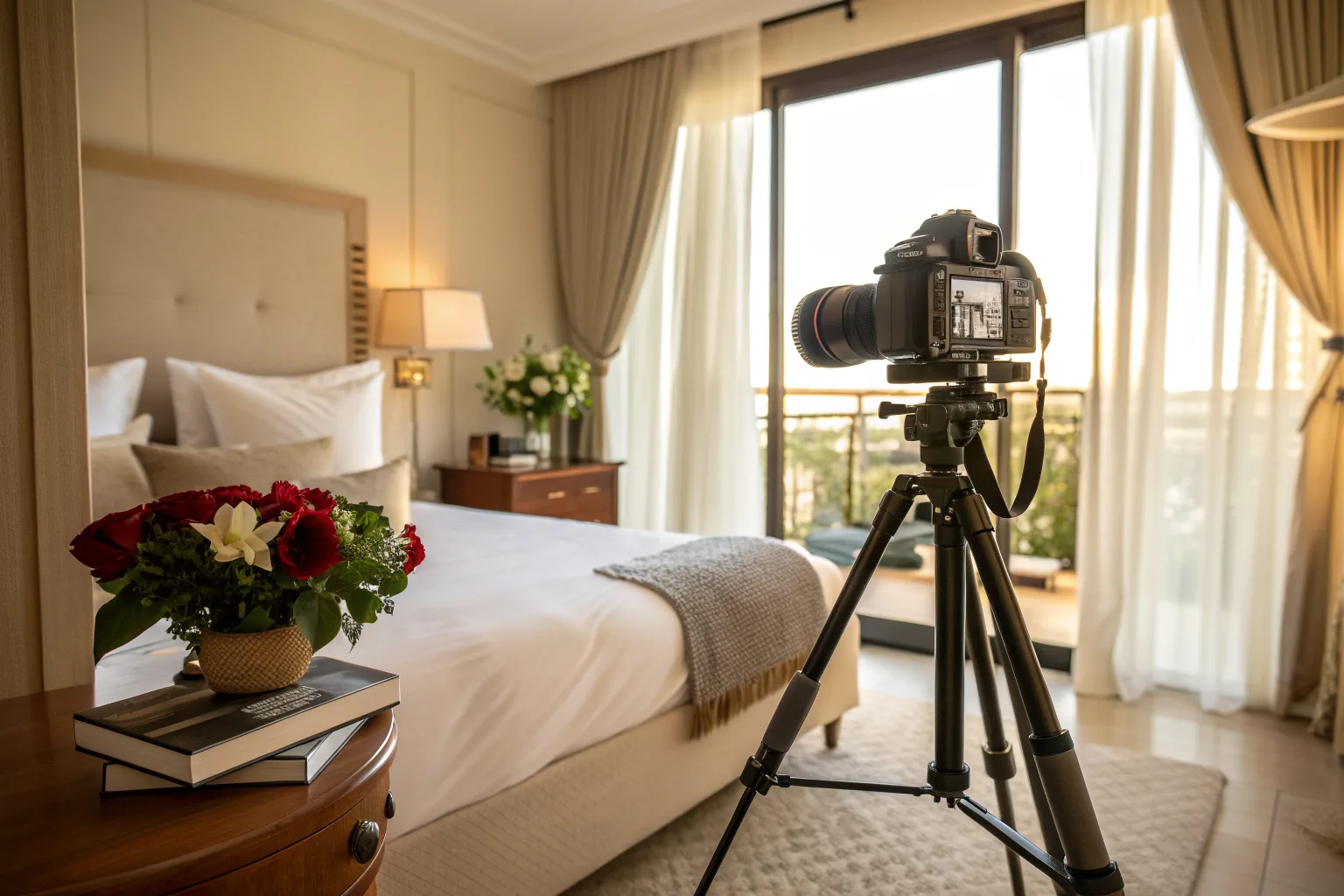
- Quality and natural light: sharp, horizontal photos shot in daylight with tidy rooms.
- Show experiences, not just walls: breakfast served, the views, the pool at sunset, the common area with life. The traveller buys an experience, not square metres.
- Order by relevance: the cover must be your best asset (the view, the iconic façade, the star room). Then a logical tour.
- Cover everything that matters: rooms, bathrooms, common areas, outdoor spaces and standout details.
- Video or virtual tour: add it if you can. It increases time on the page and trust.
- No tricks: photos true to reality. An exaggerated photo inflates the booking but sinks the review, and the review weighs more in the long run.
Title and description: sell benefits, not features
Copy converts when it answers the traveller’s question (“is this for me?”) in seconds.
The title should combine name and value proposition: what you are and why choose you. “Boutique hotel in the old town, 5 min from the beach” communicates more than “Hotel Las Palmeras ***”. Use the space for what sets you apart: location, views, style, ideal guest.
The description should be scannable and benefit-focused:
- Start with what the guest gains (rest, location, comfort), not a technical list.
- Short sentences, brief paragraphs and, where the channel allows, headings and lists.
- Speak to a specific profile (couples, families, business travel) instead of “everyone”.
- Include the practical details that reduce doubt: distances, transport, parking, flexible check-in.
- Mind the keywords travellers search for (area, “charming”, “pet friendly”), without forcing them.
Where to publish: choose your channels well
There’s no single channel. The smart strategy combines several and adapts the listing to each one:
| Channel | What it’s for | What to watch most |
|---|---|---|
| OTAs (Booking, Expedia) | Volume and instant visibility | Ranking, photos, reviews, a complete page |
| Metasearch (Google Hotel Ads, Trivago) | Reaching price comparers | Competitive price and direct-booking link |
| Social (Instagram, Facebook) | Inspiring and segmenting audiences | Creativity, video, interest-based audiences |
| Email to your list | Returning guests and offers | Personalisation and send timing |
| Your own website | Direct bookings, no commission | Speed, mobile and a clear booking engine |
The key is consistency: the listing’s creative (photo and message) must match the booking page it leads to. If the listing promises one thing and the landing page shows another, you lose the traveller at the final step.
Optimise your page on OTAs
If you work with Booking or other platforms, their internal search decides how much visibility you get. Factors that tend to help:
- A 100% complete page (all fields, amenities and photos).
- Recent reviews and a good score.
- Conversion rate and fast response to messages.
- Competitive availability and price.
To go deeper, see the dedicated guide on managing Booking for property owners and another on boosting occupancy with Booking reviews.
Mobile first and speed: the invisible things that also convert
Most bookings start (and many finish) on mobile. A listing that looks bad or a slow website scares the traveller off even if the hotel is perfect:
- Check that photos and text look right on a small screen, with no overflow.
- If you drive traffic to your site, make it load fast and let the booking engine work in two taps.
- Cut the steps to “Book”: every extra form costs bookings.
Personalisation and themed offers
The same hotel sells better when the message fits who sees it. With your guest data (always with consent) you can adapt language, dates or offers:
- Romantic getaway, family pack, wellness/spa, last minute.
- Local storytelling: sell the destination and the experience around the hotel too.
- Segment by language, trip purpose, or whether it’s a new or returning guest.
A specific offer for a specific profile converts far better than a generic promotion for everyone.
The factor almost no one looks after: the experience becomes reviews
Here’s the lever that separates a listing that performs from one that stalls. Reviews and rating aren’t just “social proof”: they feed the ranking on OTAs and metasearch and increase the page’s conversion. And reviews don’t come from the listing, they come from the stay.
The first physical contact (arrival and check-in) sets the first impression. An arrival with queues, paperwork and photocopied IDs starts the stay with friction; a smooth arrival, by contrast, primes the high rating. That’s why it pays to look after the pre-arrival communication with a good booking confirmation email and to kick off online check-in so the guest walks in without waiting.
In Spain, moreover, registering travellers and reporting their data to the authorities is mandatory (Royal Decree 933/2021, via SES.Hospedajes). Solving that formality online, before arrival, saves work at the front desk and improves the guest experience from minute zero. You’ll find the detail in the traveller registration guide.
Measure, test and adjust
A listing isn’t published and forgotten: it improves with data. Metrics worth watching:
- CTR (clicks / impressions): measures whether the photo and title attract. If it’s low, try a different cover.
- Conversion rate (bookings / page visits): measures whether the content convinces. If it’s low, review price, description and reviews.
- Traffic source and ROI per channel: where it’s worth investing.
- Rating and review volume: the long-term health of the listing.
Lean on Google Analytics, the OTA dashboards or the social pixel, and run A/B tests of cover and title: small changes move conversion a lot.
Common mistakes that sink a hotel listing
Frequently asked questions
What’s the most important thing in a hotel listing? The photos and the first visual impression. They’re the first filter and what weighs most in the click. Then a clear title with your value proposition, visible reviews and a transparent price.
How many photos should a hotel listing have? Enough to cover rooms, bathrooms, common areas, outdoor spaces and standout details, ordered by relevance and starting with your best image. The quantity matters less than quality and order.
Is it better to advertise on OTAs or on my own website? They’re not mutually exclusive. OTAs bring volume and visibility; your website brings direct, commission-free bookings. The ideal is to combine channels and keep message and price consistent across them.
How do reviews affect my listing’s visibility? A lot. Score and recent reviews improve your position in OTA and metasearch results and increase the page’s conversion. A good arrival experience is the best way to generate them.
Does traveller registration have anything to do with the listing? Indirectly, yes: solving check-in and registration online before arrival makes the stay smoother, and a smooth stay generates better reviews, which in turn improve your listing. Always verify current requirements through official channels.