


On 9 September 2026 the European Commission presented a proposal for a housing law. The headlines said Brussels wants to limit holiday lets. The truth is simpler than that, and more useful to understand.
What is on the table is a text that sets conditions for town halls and regional governments when they want to limit short-term rentals to protect housing. It limits nothing by itself. It is not a law yet: it is a proposal that the European Parliament and the Council still have to negotiate and approve.
Nothing changes for your property today
Your tourist licence is worth exactly what it was worth yesterday. Your booking calendar is untouched. So are your contracts.
The Commission has done what it does in Europe: propose. The text is proposal COM(2026) 599, dated 9 September 2026. The European Parliament and the Council are studying it now. They can change it, delay it, or let it die.
It would only become binding once three steps are complete: agreement between Parliament and Council, publication in the Official Journal of the European Union, and entry into force. Nobody knows today when that will happen, and we are not going to invent a date.
What Brussels is actually proposing
The proposal does not hand out licences or set quotas. It does something different. It says how an authority has to justify itself when it wants to limit short-term rentals to protect housing.
Today a town hall that restricts holiday lets works inside a general framework. It has the Treaty, it has the Services Directive, and it has the case law of the Court of Justice. All of that is broad, and it gets argued case by case in court.
The proposal replaces that with something more concrete. It asks for data, a defined perimeter, a duration, and publication before the measure applies. It is a rule about how a decision is made, not about what is decided.
Who the text reaches
It reaches two kinds of measures, and only when they are taken to protect access to housing:
- Measures limiting short-term rentals in residential property.
- Measures limiting the purchase or use of land and homes that are not a main residence, including empty homes.
There is one exclusion that matters a lot for the sector. The proposal borrows the definition from Regulation (EU) 2024/1028, the European rule on short-term rental registration. That definition leaves out hotels and similar accommodation, apartment hotels, motels, hostels, camping grounds and caravan parks. If you run a hotel, this framework is not about you.
It also does not reach measures an authority takes on other grounds. That part matters, and it gets its own section below.
The three tests a restriction would have to pass
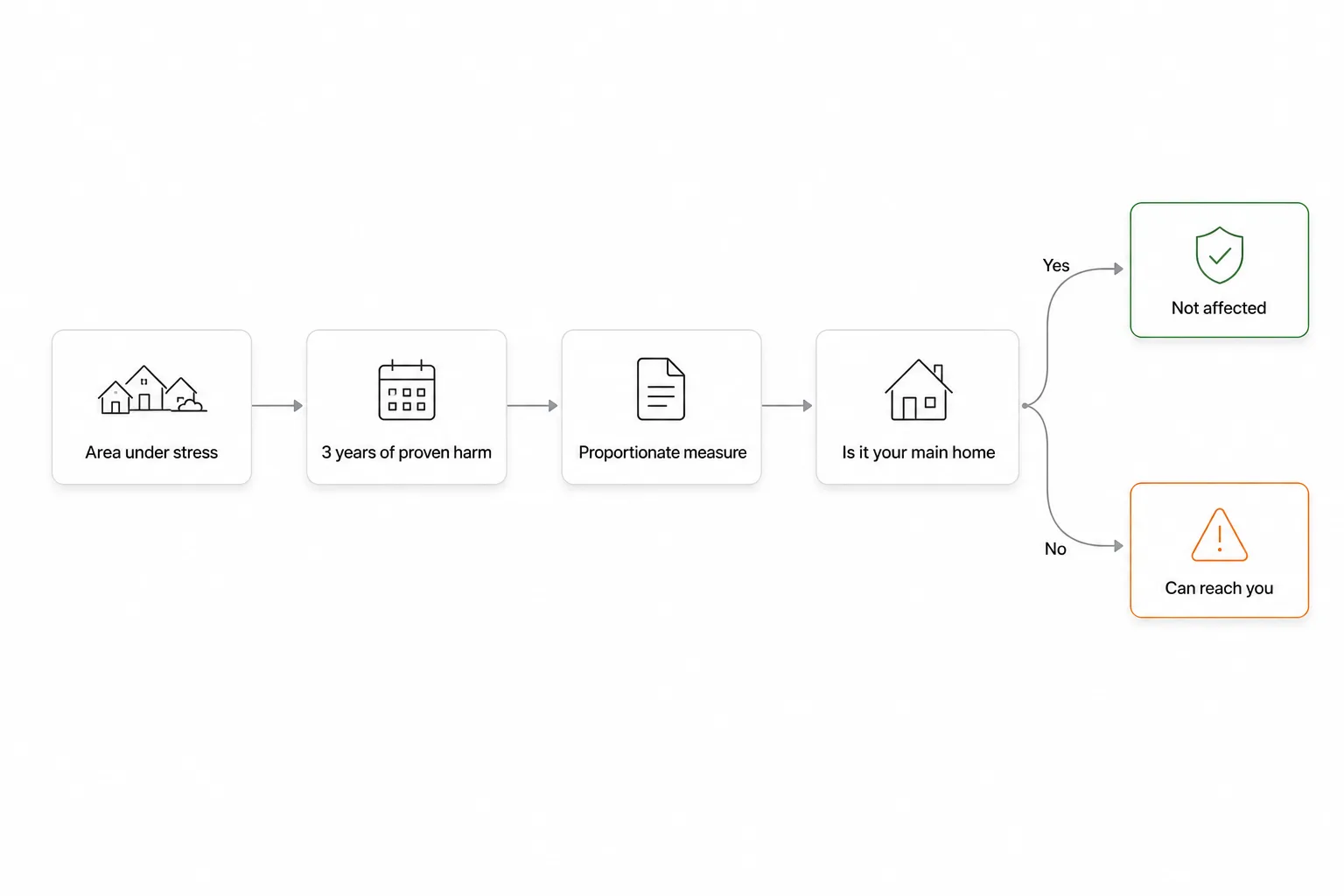
Here is the heart of it. Under the proposal, an authority could not limit your rental just because it wants to. It would have to pass three tests in a row.
First: prove the area is under stress. The text uses a simple sum, the ratio between the price of an average home in the area and disposable income per person. If that ratio reaches eight, it means eight years of income to buy that home. Eight is the threshold. The ratio also has to have risen over the most recent ten years of available data, and the pressure must not look likely to ease over the next three years. If the ratio reaches ten, the authority no longer has to show the earlier rise.
Eight and ten are years of income, not percentages. And there is no European list of areas. Each authority has to run its own analysis with objective, verifiable data.
Second: prove that short-term rentals are part of the problem. An expensive area is not enough. The authority would have to show that short-term rentals significantly harmed housing in that area over at least the three years before the measure. Where it has them, it has to use the registration data from Regulation 2024/1028.
Third: make the measure proportionate. It has to stick to the affected area, go no further than necessary, and respect existing lawful situations with a transition period. It has to aim at commercial-scale activity, looking at things like how many homes a single host offers. And the authority has to already be enforcing the European registration rules, including taking down listings with no valid number.
Your main home is outside, but not outside everything
If you rent out the house you live in, these restrictions would not reach you. The proposal says so plainly: limits on housing affordability grounds apply only to accommodation that is not the host’s main residence.
The reasoning is sound. Renting your own home for a few weeks does not take that home out of the residential market.
Now the small print, which almost nobody is reporting. That protection covers one ground only: housing affordability. An authority can still limit short-term rentals for other reasons, and those stay under the usual Services Directive. Public policy, public security, public health, consumer protection, the environment, the urban environment and cultural heritage are separate grounds. Through those routes, a local rule can reach your main home too.
Two more warnings. First, what counts as a main residence is still defined by each country’s own law. Second, the exclusion is a floor, not a ceiling. An authority can protect more categories of housing if it wants to, but not fewer.
What is already approved stays as it is
This is the question I have seen most this week. The text answers it clearly: the regulation would not apply to measures adopted before it enters into force.
The restrictions in force in Barcelona, the Canary Islands, the Balearics, Madrid or Málaga keep their own regime and their own court cases. The European proposal does not cancel them, does not validate them, and does not reopen them. The only thing it adds is that an authority may review them under this framework if it chooses to.
So do not use the news from Brussels to declare any local battle won or lost. If you have an open file, stay with your lawyer and your own calendar, not with Europe’s.
It creates no new register and no new number
Good news for anyone tired of paperwork. The proposal invents no new register, no new number and no extra periodic filing.
What it does is lean on the register that already exists. Regulation (EU) 2024/1028 has applied since 20 May 2026 and organises listing registration and data sharing between platforms and authorities. The 2026 proposal would use that data as evidence, and it actually requires an authority to enforce those rules first before restricting anything.
In Spain the map of numbers has moved a lot this year. If you are lost, two guides sort it out: how to add your registration number on Airbnb and Booking and how to check your tourist registration code. And if you were left wondering about the Spanish national register, the ruling that struck it down is explained in the Supreme Court annuls the NRUA.
The safeguards you would get as an operator
The proposal is not only a list of conditions for restricting. It also gives the affected operator three supports.
| Safeguard | What it means for you |
|---|---|
| Publication in advance | The authority publishes the analysis, the exact perimeter and the duration before the measure applies |
| Limited duration | Each measure lasts five years at most, and is only extended after a review |
| Judicial review | You can challenge the measure and argue the authority’s own analysis in court |
The third one carries the most weight. Being able to argue the analysis, not just the decision, changes the odds on an appeal.
What to do over the next few weeks
Nothing urgent. Do not cancel bookings or rewrite contracts over a European proposal. But there is calm work worth having done.
- Get your numbers in order. A valid regional licence and the right registration number on every listing. It is required today, and it is the first door any inspection looks at.
- Write down which properties are a main residence. If any of them is, keep whatever proves it. That line separates two very different treatments.
- Separate occasional from professional. Note how many homes you offer under the same owner and how many nights a year. The text looks at scale.
- Work out your exposure by town. If 70 % of your income comes from one city, you know which official gazette to read.
- Give the follow-up to one person. One person, half an hour a month, watching Parliament, the Council, and your regional and local gazette.
To keep it tidy, note these details for each property. If the days, the units or the licences change one day, you will know in a minute what it touches.
| Detail to note per property | Why it matters |
|---|---|
| Is it a main residence? | Splits the two treatments: inside or outside these limits |
| Owner and number of units | The text looks at a single host’s scale |
| Frequency and nights per year | Separates the occasional from the commercial |
| Valid licence and registration number | It is the first thing an inspection checks today |
| Your regional and local rules | This is where the real limits live, not the EU proposal |
| Weight of each channel (Airbnb, Booking, direct) | Your exposure if a channel or a rule changes |
| Licence renewal date | So you are not late for a filing |
| Committed income | What is at stake at that property |
| Residential or mid-stay fallback | Your plan B if a future rule cuts days or units |
What will really decide your year is still local rules, not the European proposal. If your regional framework is not clear to you yet, start with the guide to tourist licences in Spain.
Timeline, with what is known
- 9 September 2026: the Commission presents proposal COM(2026) 599 and sends it to the Council.
- 10 September 2026: the Council circulates it to delegations as document 12967/26.
- Now: negotiation in the European Parliament and the Council. Thresholds, scope and transition can all change.
- Later: final text, publication in the Official Journal, and entry into force twenty days after that.
- Only then: new local measures would have to follow this framework. Earlier ones would not.
Frequently asked questions
Does this ban Airbnb or holiday lets? No. It bans no platform and no activity. It regulates how an authority has to justify limiting them.
Does it affect hotels? No. The definition the text uses leaves out hotels, apartment hotels, motels, hostels and camping grounds.
Does it protect me if I rent out the home I live in? Against limits on housing affordability grounds, yes. Against limits on other grounds, such as planning or heritage, no. And what counts as a main residence is defined by Spanish law.
Do the restrictions already in place in my city fall away? No. The text would not apply to measures adopted before it enters into force. Each one follows its own path.
Do I have to apply for a new permit or file anything? No. The proposal creates no new register, number or filing for hosts.
Details and sources
The text is proposal for a Regulation COM(2026) 599 final, dated 9 September 2026, interinstitutional file 2026/0268 (COD), with its legal basis in Article 114 of the Treaty on the Functioning of the European Union. It follows the ordinary legislative procedure.
The articles cited above, in case you want to go to the original:
- Article 2: scope. Measures restricting short-term rentals in residential property, and measures on the acquisition or use of property that is not a main residence, when justified by housing affordability and availability.
- Article 3: relationship with other acts. Measures under Article 2(1)(a) would fall outside Directive 2006/123/EC, including the notification duty in its Article 15(7). The regulation would not apply to measures whose only purpose is applying the registration rules in Chapter II of Regulation (EU) 2024/1028.
- Article 5: restrictions on housing grounds can only affect accommodation that is not the host’s main residence.
- Article 6: area under housing stress. A price-to-income ratio of eight or more, a rise over the most recent ten years of available data, and stress that is not expected to ease within three years. At a ratio of ten or more, the requirement to show the earlier rise falls away. The Commission could amend those thresholds by delegated act.
- Article 7: the perimeter can be a district, a municipality, a metropolitan area, a functional urban area, an agglomeration, a rural area, or any part of them, without exceeding what is necessary.
- Article 9: necessity. A significant adverse effect demonstrated over at least the three years before the measure.
- Article 10: proportionality, less restrictive alternative, legal certainty, calibration by scale, frequency or commercial character, effective enforcement of Regulation (EU) 2024/1028, and transitional arrangements where existing lawful situations are affected.
- Article 11: procedural safeguards and judicial review, including the possibility of challenging the authority’s assessments.
- Article 12: a maximum duration of five years, regular review, and withdrawal without undue delay if the measure stops meeting the requirements.
- Article 13: publication of the assessment, the perimeter and the duration before entry into force.
- Article 14: it would not apply to measures adopted before its entry into force, although an authority could review them under this framework.
- Article 17: entry into force twenty days after publication in the Official Journal.
The hotel exclusion comes from Article 3, point 1, of Regulation (EU) 2024/1028, which leaves NACE Rev. 2 groups 55.1, 55.2 and 55.3 outside the definition of a unit. That regulation has applied since 20 May 2026.
Sources: